
 E-Paper



Mayawati shares stage with Mulayam after decades
The last time Mayawati, 63, and Mulayam, 79, were on the dais together was in 1995, when their partnership was on its last legs and about to disintegrate into political distrust bordering on personal enmity.

 Prefer HTon Google


Bahujan Samaj Party (BSP) chief Mayawati and Samajwadi Party (SP) patriarch Mulayam Singh Yadav — bitter political rivals for over two decades — sat together on stage in Mainpuri on Friday and asked workers of both parties to ensure their once-inconceivable alliance defeats the Bharatiya Janata Party (BJP) in Uttar Pradesh and topples Prime Minister Narendra Modi at the Centre.
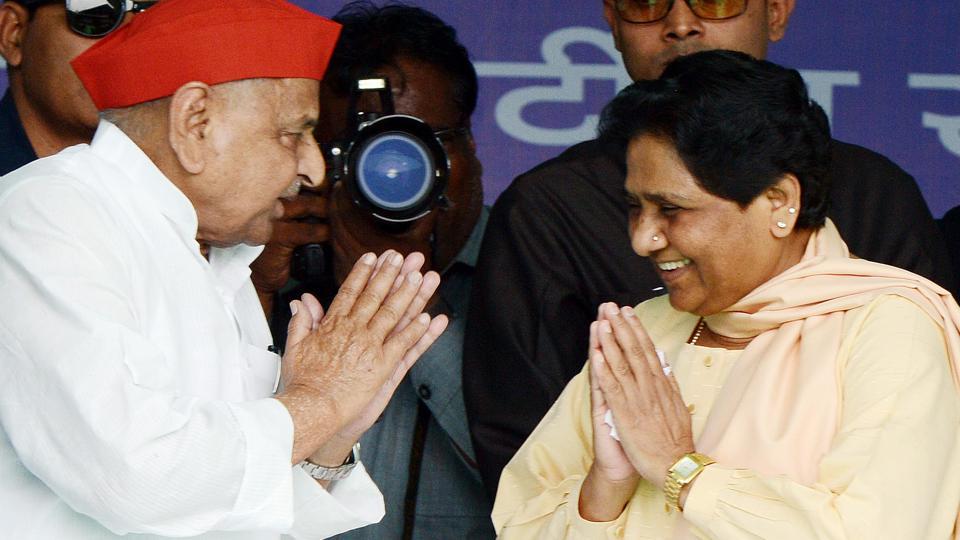
The last time Mayawati, 63, and Mulayam, 79, were on the dais together was in 1995, when their partnership was on its last legs and about to disintegrate into political distrust bordering on personal enmity.
Sitting next to them on the stage on Friday was Mulayam’s son, former chief minister Akhilesh Yadav, who is seen as the architect of this coming back together of two powerful heartland parties that between them hold sway over large sections of the Dalit, Muslim and other backward class (OBC) communities in the region.
“I am thankful to Mayawati and will remain obliged to her for coming here to seek votes for me,” said three-time UP chief minister Mulayam, who is contesting the Lok Sabha elections from Mainpuri, a seat that has been a Yadav family bastion.
“I always extend respect to Mayawatiji because she has always stood by us in the times of need. I am happy she has come here to campaign,” Mulayam told a crowd comprising mainly of SP supporters at the Christian College ground.
Mayawati responded in words of similar warmth and bonhomie.
“He [Mulayam Singh] has given representation to every section of society in the Samajwadi Party. He is not a fake backward community member. Mulayam ji ...has always been from the backward community unlike PM [Narendra] Modi,” she said in what experts are calling a significant public event of the 2019 campaign.
The four-time CM added that the BSP joined hands with the SP to defeat the BJP in the Lok Sabha elections, and asked her party workers to set their past differences with the SP aside and work for the victory of the alliance.
Mayawati summed up her appeal with the slogan of “Jai Bhim, Jai Lohia” – the former a reference to India’s tallest Dalit icon BR Ambedkar, and the latter an allusion to activist Ram Manohar Lohia, who was considered the founder of the socialist Samajwadi movement.
She also referred to an infamous incident from June 1995 — when several SP leaders laid siege to the state guest house in Lucknow where Mayawati was staying, and threatened to physically assault her while the police allegedly watched — and said she had put it behind her in the “larger interest” of the people.
The SP and BSP had together formed the government in UP with Mulayam as the chief minister, and with support from the Congress, in 1993. The coalition collapsed in June 1995 following the guest house incident where BJP leaders came to Mayawati’s rescue. She was administered the oath of CM’s office three days later.
At the Mainpuri rally, a Samajwadi Party legislator, Raju Yadav from Mainpuri Sadar, bowed to Mayawati to welcome her and touched her feet to complete the symbolism that the division between the two sides had finally ended.
The “grand alliance” of BSP, the SP and the Rashtriya Lok Dal (RLD) is contesting 78 of the 80 parliamentary seats in the state, leaving Amethi and Rae Bareli for Congress president Rahul Gandhi and United Progressive Alliance (UPA) chairperson Sonia Gandhi.
Akhilesh, who spoke after Mayawati described him as the true heir to Mulayam’s legacy, said it was time to come together to defeat the politics of division propagated by the BJP.
“It was the Samajwadi Party which brought Delhi nearer to Uttar Pradesh. It was us who brought Delhi closer to you by constructing proper roads and highways. Don’t you think, now it is your duty to bring Delhi closer to the BSP-SP alliance?” Akhilesh said, referring to the Yamuna and Taj expressways that connect Lucknow and Delhi.
Uttar Pradesh deputy chief minister and BJP leader Keshav Prasad Maurya said the SP and BSP chiefs were afraid of Modi’s re-election. “Both Akhilesh and Mayawati are afraid of the unity of backwards to make Modi PM again. The backward PM made a world record of ‘Sabka Saath Sabka Vikas’. The alliance of fake-Bhatija (nephew) and fake-Bua (aunt) will fail. Due to Modi equation all caste equations have failed this time,” he said.
The BJP won 71 seats in UP – more than one-fourth of its national tally of 282 – in the 2014 general elections. The SP was reduced to just five seats, while the BSP won none. The BJP followed it up by sweeping the 2017 assembly elections – with its allies it won 325 of the 403 seats, reducing the SP and the BSP to 47 and 19 respectively. But even in the 2014 parliamentary and the 2017 assembly polls, the combined vote share of the SP and the BSP was higher than the BJP’s, prompting the two parties to think of coming together for their survival.
“It is extraordinary that Mayawati has chosen to campaign for such a bitter rival. While we cannot infer much about the relationship between them from this, it speaks of the commitment of the SP and BSP to work as a coalition,” said Neelanjan Sircar, assistant professor, Ashoka University, and visiting senior fellow, Centre for Policy Research.


