Fewer flamingos visited wetlands in the Mumbai Metropolitan Region (MMR) in the last migratory season, a study by wildlife conservation group Bombay Natural History Society (BNHS) has revealed.
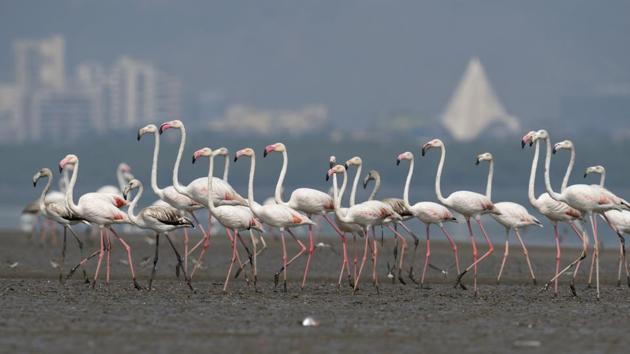
Researchers arrived at this conclusion after studying seven wetland sites — TS Chanakya, behind Seawoods Estate along Palm Beach Road in Navi Mumbai; Funde-Panje mudflats and wetlands in Uran taluka; Thane creek flamingo sanctuary; Sewri mudflats; and Mahul creek.
Flamingos visit Mumbai wetlands between October and May every year. BNHS officials said the study suggests that 30,000 to 35,000 birds wintered in Mumbai the past winter, compared to an average of 40,000 to 45,000 in the earlier seasons. The Uran wetlands saw the biggest decline, owing to construction activity in the vicinity, the report said.
BNHS attributes the decline to the fact that the migratory birds found better nesting grounds in Gujarat. “This year, there were 5,000 to 6,000 fewer flamingos. The birds came to the city quite late, arriving between the last week of February and the first week of March. The reason is better nesting areas, good rainfall last monsoon, and abundant food along the Gujarat coast,” said Deepak Apte, director, BNHS. “If they had come slightly early, the numbers would have been similar to the previous years.”
This is the first attempt made to document flamingo population in MMR, BNHS officials said, adding that more studies will need to be done to establish whether the population is stable or on the decline.
Apte said construction activities and wetland reclamation along Mumbai’s eastern waterfront has restricted the birds to fewer locations. “Locations such as Uran have seen very few birds as the habitat is not suitable anymore. Any development around the eastern seafront, including the Navi Mumbai International Airport, needs to be carried out carefully, keeping in mind that these birds are annual visitors,” he said.
{{/usCountry}}Apte said construction activities and wetland reclamation along Mumbai’s eastern waterfront has restricted the birds to fewer locations. “Locations such as Uran have seen very few birds as the habitat is not suitable anymore. Any development around the eastern seafront, including the Navi Mumbai International Airport, needs to be carried out carefully, keeping in mind that these birds are annual visitors,” he said.
{{/usCountry}}Environmentalists believe the BNHS report is most likely accurate. “Despite being a signatory to the Ramsar convention [an international body formed to identify and protect such wetlands], Maharashtra has failed to live up to its commitment to protect wetland habitats. Less than five years ago, we had over one lakh birds visiting MMR wetlands, but the numbers have declined significantly,” said Stalin D, director of environment group Vanashakti.
Other birders said the drop in flamingo numbers is marginal and not alarming. “These birds are extremely sensitive to habitat and food-specific variations. Every year, there can be a fluctuation in their numbers, not only in Mumbai but in Gujarat, too. The figures ranging up to 45,000 annually could be over-estimation. The flamingo population in Mumbai has not exceeded 25,000, and this time, there may have been a 10% to 15% decline,” said Sunjoy Monga, ornithologist and writer.
Stay updated with all the Breaking News and Latest News from Mumbai. Click here for comprehensive coverage of top Cities including Bengaluru, Delhi, Hyderabad, and more across India along with Stay informed on the latest happenings in World News.
Stay updated with all the Breaking News and Latest News from Mumbai. Click here for comprehensive coverage of top Cities including Bengaluru, Delhi, Hyderabad, and more across India along with Stay informed on the latest happenings in World News.