
 E-Paper



Green Diwali: Women from Maharashtra’s border village make seed crackers, sweets
This Diwali, light up your house in a different way. Instead of fireworks, bring home a seed cracker that would burst into a plant.


This Diwali, light up your house in a different way. Instead of fireworks, bring home a seed cracker that would burst into a plant.
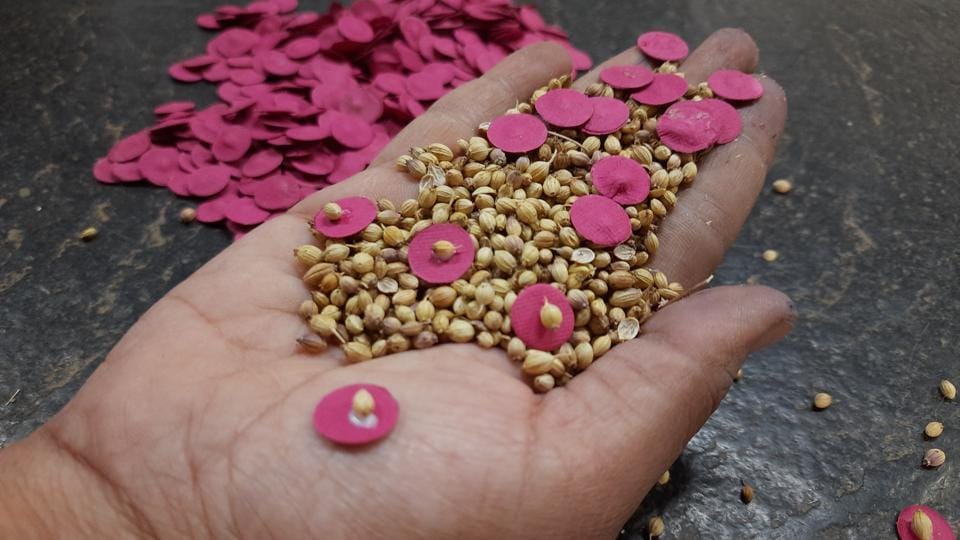
Concerned about noise, air and light pollution from firecrackers affecting birds and animals, a group has developed a unique concept – BeejParva or seed crackers - to celebrate an eco-friendly festival this year.
Women from 40 families, part of the Gram Art Project (GAP), a collective of farmers, painters, social workers, and writers from Paradsinga village in Chhindwara district, on the border of Madhya Pradesh and Maharashtra, have made exact replicas of firecrackers (available in markets – see image) using recyclable material embedded with seed balls.
Rather than bursting them, these uniquely designed crackers, which have seven different variations can be sowed in a pot, watered, and nourished into an edible plant.
“There is an urgent need to address the impacts of our actions on voiceless species like birds and animals that suffer miserably due to the use of firecrackers during festivals like Diwali every year. Thus, we came up with this idea that not only benefits them but the overall environment while ensuring the concept also upholds the symbol of this festival,” said Shweta Bhattad, visual artist and member, GAP.
The variations of plant species and types of crackers include the micro-green ladi (series of crackers that have seven types of seeds in them - red amaranthus, amaranth, fenugreek, common purslane, mustard, green amaranthus, and spinach). “This cracker has seven pairs of micro-green seeds for each day of the week. One simply needs to separate each pair, sow them in different pots and water regularly, and can be consumed within a month,” said Nutan Dwivedi, another member.
Other seed crackers include the phoenix chakkar (using onion seeds), hemp bomb (roselle seeds), golden shower (amaranthus seeds), laxmi bomb (bauhinia racemosa seeds), coriander tikli (coriander seeds), and cucumber rocket (cucumber and green sorrel seeds).
The growth of the plant has been designed similar to the emitting trajectory of a cracker. For example, the anar firecracker (flower pot) forms a shower of colours when lit. Similarly, the golden shower (amaranthus) forms the same pattern when nourished into a plant.
“A normal series of crackers (ladi) lasts hardly seven seconds even after having more than a dozen crackers in it creating both noise and air pollution. On the contrary, if you nurture the hatcher ladi, the plant will last for more than seven generations. Instead of creating pollution and disrupting the ecosystem, it will rejuvenate it,” said Roshni Narnawre, member of the group.
The group has been working with environmentalist and IT professional Arundhati Mhatre in Mumbai to share the concept among nature lovers in the city. “The concept took me by surprise when I learnt that all the crackers were handmade, and so much thought had gone behind this. Such projects need to be replicated in different regions while also nurturing the livelihood of communities working on them. In this case, the use of art to create something so meaningful in an attempt to conserve nature is the need of the hour,” said Mhatre adding that apart from the ladi, which is priced at ₹50 apiece, all other seed crackers are priced at ₹40.
Bhattad added that GAP generally has 100 families from across 10 villages involved in seed band projects. “However, due to the Covid-19 pandemic, we had to restrict our work to the closest villages. For BeejParva, we had ladies from 40 families from two villages,” she said.
Seed-sweets an alternative to expensive sweets this Diwali
Not just crackers but the group of women from GAP have also made seed-sweets are an alternative to expensive sweets available in the market during Diwali. These seed-sweets are seed balls made from waste paper and are biodegradable. “They can be consumed once nurtured after sowing and watering. They are alternatives to sweets during festivals with main ingredients as sugar and palm oil. We intended to highlight the burden of overworked sugarcane farmers across the country while habitat degradation to recover palm oil from monoculture plantations,” said Dwivedi. The four variations of the seed-sweets include palm-oil free laddu with tomato and radish seeds, what-less cookies with brinjal and common purslane seeds, sugar-free barfi with okra and amaranthus seeds, and sovereign cham-cham with chilli and carrot seeds.
Stay updated with all the Breaking News and Latest News from Mumbai. Click here for comprehensive coverage of top Cities including Bengaluru, Delhi, Hyderabad, and more across India along with Stay informed on the latest happenings in World News.


