Amid global turbulence, the year 2026 may go down as a banner year for India-EU relations. Decades of frustration and finger-pointing have suddenly given way to unprecedented opportunity between the world’s two largest democratic political entities. The conclusion in January of an India-EU free trade agreement (FTA), expected to be signed later this year, is an important milestone, one that might have taken a decade longer under different structural or political conditions.
But also important is the Security and Defence Partnership (SDP), coming just as Europe has begun to remilitarise and develop significant autonomous defence industrial capabilities. The latest development announced during the third EU- India Trade and Technology Council (TTC) meeting is formal negotiations towards India’s association with the 93.5-billion- euros Horizons Europe research and innovation programme.
ALSO READ | India, US working to conclude trade agreement early: Govt
These three agreements, once concluded, will create the enabling conditions for India to truly leverage a comprehensive partnership with Europe for the first time since Independence. But the real task of leveraging these conditions for benefits in terms of trade, supply chains, technological cooperation, scientific research, education, energy cooperation, and defence industrial collaboration begins now.
India-Europe relations in the post-Cold War period were long defined more by misalignment than strategic convergence. In the 1990s and even after the Lisbon Treaty, India approached the EU mostly as a trade bloc, notwithstanding important bilateral relations with the UK, France, and Germany. New Delhi was often frustrated by a lack of coordination among European capitals and limited security and people-to-people cooperation.
{{/usCountry}}India-Europe relations in the post-Cold War period were long defined more by misalignment than strategic convergence. In the 1990s and even after the Lisbon Treaty, India approached the EU mostly as a trade bloc, notwithstanding important bilateral relations with the UK, France, and Germany. New Delhi was often frustrated by a lack of coordination among European capitals and limited security and people-to-people cooperation.
{{/usCountry}}For its part, Europe’s singular focus on the transatlantic alliance with the US, its concerns about Russia and its partnerships, and the seduction of China’s large market contributed to India’s relative marginalisation. For European businesses, legislators, and academics, India remained a low priority.
ALSO READ | US lawmakers meet Pak Army chief Munir amid warming ties under Trump
Three main factors have altered these perceptions significantly.
One, the Covid-19 pandemic, Beijing’s wolf warriorism, and China’s economic overcapacity have motivated both India and Europe to de-risk from China’s over-concentration of supply chains.
Two, Russia’s war in Ukraine has not just heightened threat perceptions in Europe but has disrupted potential defence and strategic supplies to India, requiring new defence industrial partnerships.
Three, both Europe and India have been the object of US tariffs and sharp political disagreements during Donald Trump’s second presidency. Taken together, the consolidation of a wide-ranging India-Europe partnership is a natural outgrowth.
Other factors have helped. Europe and India align more on issues such as Artificial Intelligence (AI) and technology regulation or on clean energy investments than either currently does with the US or China. The promise of building resilience and connectivity via West Asia — in the form of the India-Middle East-Europe Corridor (IMEC) — is today a more appealing prospect for India and Europe than a Belt and Road Initiative across Eurasia, even taking into account continuing conflicts in Gaza and Iran.
ALSO READ | PM Modi says ties will deepen as India-UK free trade pact comes into force
A series of bilateral mobility agreements between India and individual European countries have significantly increased the number of Indian students and temporary workers in continental Europe, contributing to stronger people-to-people ties. And India has acknowledged these developments by widening its diplomatic footprint in Europe, opening up new consulates and embassies in places such as Belfast and Barcelona, Latvia and Ljubljana.
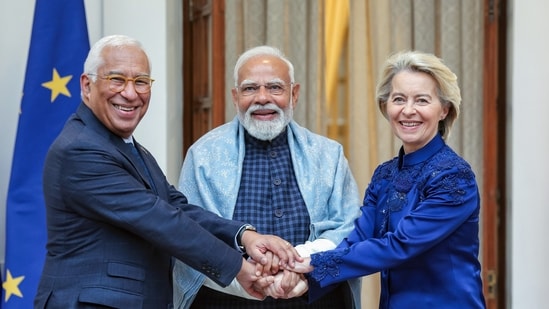
The renewed push for cooperation between India and the EU can, in large part, be credited to top-down directives from Prime Minister (PM) Narendra Modi and European Commission President Ursula von der Leyen. The EU-India Summit hosted by then Portuguese PM (and current European Council President) Antonio Costa during the Covid-19 pandemic in 2021 helped put India on the map of Europe’s national leaders.
But India’s hosting the entire European College of Commissioners in February 2025 deeply impressed the leadership and senior bureaucracy in Brussels and indicated New Delhi’s seriousness in taking the partnership forward. In the run-up to this year’s Republic Day — at which the FTA and SDP were finalised — complications arose, but were surmounted with both flexibility and top-down intent. A compromise was reached on Europe’s carbon border adjustment mechanism (CBAM), some European conditionalities were also made non-binding on India, and certain concerns about quality control orders (QCOs) were also addressed. By the end of 2026, should the three major enabling agreements be fully concluded, the TTC will remain a centralised decision- forcing mechanism to deliver on joint outcomes and projects.
While these formal structures take shape over the next year, other institutions will need to catch up. At present, the study of contemporary India in Europe and that of contemporary Europe in India are both to be found wanting. There are few well-informed interpreters of policy at think tanks and non-governmental institutions. Indian business groups and trade bodies are insufficiently represented in Brussels, where regulations with significant implications for India are often decided. European corporate entities often lack a basic understanding of India’s economic and trade policies and business environment. As official EU-India relations have surged ahead over the past year, the non-governmental sector will quickly need to catch up.
(Dhruva Jaishankar is executive director of ORF America in Washington DC. The views expressed are personal)