Earlier this month, one of the pantheons of the Ambedkarite Buddhist movement in India and among the last surviving associates of Dr BR Ambedkar, Lahori Ram Balley, died in Jalandhar. His death marks the passing of an era. The younger generation picks up the baton and marches on. For our ancestor’s work remains to be completed, and our struggle is multigenerational, inviting joy, sacrifice, and gaining merits.
Born in a Dalit family on July 20, 1930, Balley was educated in
Earlier this month, one of the pantheons of the Ambedkarite Buddhist movement in India and among the last surviving associates of Dr BR Ambedkar, Lahori Ram Balley, died in Jalandhar. His death marks the passing of an era. The younger generation picks up the baton and marches on. For our ancestor’s work remains to be completed, and our struggle is multigenerational, inviting joy, sacrifice, and gaining merits.
Born in a Dalit family on July 20, 1930, Balley was educated in Arya mission schools. A polyglot with a command over Urdu, English, Punjabi, Farsi and Hindi, he got a job as a copyholder who accompanied pre-Independence government servants. Barely in his early 20s then, Balley was introduced to Dr Ambedkar at the latter’s residence in Delhi, keenly observing and following the man who was to become his messiah. In his late years, Dr Ambedkar would often oblige people visiting his Delhi house, and many scheduled caste employees would frequent his residence. That is how Balley found himself surrounded by senior leaders of the All India Scheduled Caste Federation (SCF), learning the nuances of the politics of newly independent India.
During one such meeting on September 30, 1956, while Balley was taking notes on one of Dr Ambedkar’s final political decisions, the founding of the Republican Party of India (RPI), he saw the great constitutionalist suffer a sharp bout of chest pain. He was immediately rushed for medical treatment. Seeing the empty chair, Balley embraced it and pondered over it, vowing to dedicate his life to Dr Ambedkar’s mission.
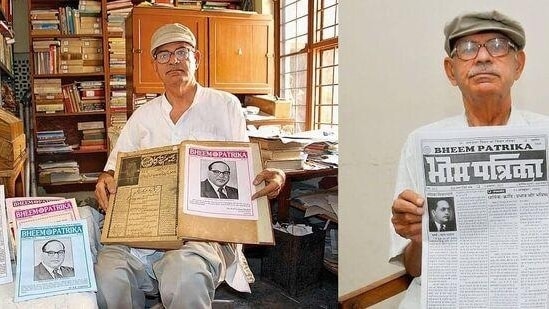
In three months, Dr Ambedkar was dead. Balley immediately resigned from his government job and chose to focus on steadying the still-nascent RPI, where he was general secretary. In 1958, on Dr Ambedkar’s birthday on April 14, he started a magazine, Bheem Patrika, among the oldest anti-caste publications in the country, thus cementing his position in the Ambedkarite community for the last six decades. Thus, began the caravan of Ambedkar Mission— two pivotal words in the life of Dalits.
Balley was a true Ambedkarite to the core—a morally upright and honest missionary. He never flinched nor questioned the prowess of the ideology of his liberator, Dr Ambedkar.
He hailed from a region that holds the largest proportion of Dalit people in the country and also birthed several anti-caste icons. Yet, this is also the land where a third of the population could never realise their potential for political power, and were kept subjugated by a mix of subterfuge, land-ownership laws, and caste assertion by dominant communities. Against this backdrop, the words of Balley often spoke about equity, Ambedkarism and the need for Punjab to rediscover its legacy of anti-caste activism propounded by Buddha and Guru Nanak. He also went to jail on a number of occasions during protests for land rights, and faced a string of police complaints often filed by aggrieved dominant caste groups.
His magazine – which was published in Punjabi, Urdu and Hindi and funded by the community – found a permanent place in the households of many Dalit families and gave space to anti-caste thinkers who found their work squeezed out of the so-called mainstream. A sharp critic of MK Gandhi, Balley’s Rangeela Gandhi was one of the earliest statements exposing the bareness of the Mahatma and his sexuality. For this work, he was slapped with 295 cases.
He was devoted to the Ambedkarite cause but not a blind follower. He ably comprehended the nuances needed for the community’s uplift. From December 6, 1956, the date of Dr Ambedkar’s death, till July 6, 2023, Balley was a household name for the Ambedkarite community worldwide, for 67 years. He remained a lifelong learner who was ever keen on learning new things irrespective of age and give his experiences, knowledge, and wisdom in return.
Like many people who grew up in Ambedkarite households, I heard the name of Balley growing up. Because he was Punjabi, it carried a certain fascination — a Punjabi man speaking fondly of Dr Ambedkar, calling him his own and giving advice on the merits of Buddha’s dhamma (path). This was revolutionary.
His impassioned biography of Dr Ambedkar was a warm text that introduced India’s first law minister to the people. Balley wrote in Hindi, which gave him access to a wider audience. Many generations were educated about Dalit history and Ambedkarite ideology through the pages of Bheem Patrika.
I sought an audience with Balley in 2018. His enthusiasm was charming, his energy infectious. He gave time without knowing much about me, sharing anecdotes and memories. I was one of thousands, scholars and ordinary people alike, who would make their way to his house in Jalandhar. This style of being available and welcoming was a trademark of Balley. His house was sought by everyone, from Yashwant Ambedkar and Mark Jurgensmeyer to Anand Teltumbde, among a host of noted writers and activists. His magnetic force made a lasting impression.
In May this year, I again spent some time with him. He remained to many a babbar sher — powerful and commanding. Governments overlooked the work of this great man, but this year, we started an LR Bally National Award to be given on his birthday in Nanded. Work is also ongoing to revive the Samata Sainik Dal, a social organisation that Dr Ambedkar founded and Balley motivated and led for decades. He has left the world, but his work remains with us.
Suraj Yengde, the author of Caste Matters, is a Du Bois Fellow at Harvard University. The views expressed are personal
One Subscription.
Get 360° coverage—from daily headlines
to 100 year archives.
Archives
HT App & Website