We are months away from Delhi becoming unliveable again. Every breath then will cut years off the lives of its residents. Progress in technology, infrastructure, and economic growth is meaningless if the air we breathe is toxic.
In 2021, the annual average level of particulate matter of a diameter less than 2.5 micron (PM2.5) peaked at 126.5 µg/m3 — more than 25 times the safe limit set by the World Health Organization (WHO). During winter, these levels soar, flooding hospitals with respiratory patients. According to the 2023 Air Quality Life Index, pollution claims up to 25,000 lives annually in Delhi alone, shortening life expectancy by about 6.3 years.
The economic toll is also staggering. Estimates peg GDP loss at 3%, roughly $100 billion annually, due to disrupted work, soaring health care costs, and decreased productivity. Low-income families often left unprotected against toxic fumes are the most vulnerable. To breathe safely has become a privilege.
Despite this, policymakers have offered only temporary band-aids. Bureaucracy, overlapping authorities, and political apathy have failed the people. It is a failure of governance and of moral responsibility. The time for excuses has run out. The only option left is radical, decisive action.
What must be done?
{{/usCountry}}What must be done?
{{/usCountry}}Burning of biomass is the single-largest contributor to Delhi’s air pollution, responsible for nearly 60% of PM2.5 emissions annually. Burning dung, firewood, and agricultural waste releases vast amounts of particulate matter, especially in winter. Policies promoting clean cooking fuels like LPG — with subsidies of 75% — starting in NCR+ areas need to be enforced and community biomass plants with subsidies for transition provided, even as traditional cooking methods and agricultural waste burning are phased out.
Contributing approximately 31% of PM2.5, industrial processes and thermal power plants are the second-largest source of Delhi’s pollution. Delhi-NCR hosts 12 thermal power plants with a total capacity of 13.2 GW, but only seven comply with the 2015 emissions standards. The outdated and poorly regulated plants emit pollutants that jeopardise both health and the environment.
Accounting for 8% of total emissions, brick kilns are another large factor of Delhi-NCR’s air pollution. Currently, around 4,608 kilns are operating primarily in areas such as Baghpat and Bulandshahr, making India’s brick production industry the second-largest globally, trailing only China. Present methods employed by these kilns release harmful pollutants into the atmosphere, and also expedite soil degradation and groundwater depletion.
Mandatory flue gas desulphurisation in thermal plants must be enforced in accordance with the applicable emission standards, outdated plants older than 35 years must be shut with cleaner technologies replacing these. At the brick kilns, adoption of zigzag technology — arranging bricks in a zigzag pattern to enhance heat transfer and combustion efficiency, leading to reduced fuel consumption and lower emissions — must be accelerated. SMEs must be shifted to electric boilers, supported by rooftop solar. Industrial zones must have efficient waste management, with quarterly emission reporting and public disclosures. Establish efficient waste management in industrial zones.
Responsible for roughly 8% of PM2.5 emissions, Delhi’s vehicles are a significant but addressable pollution source. The dominance of older, polluting vehicles and slow adoption of electric mobility hinder air quality improvement. India is witnessing rapid growth, where two-wheelers and three-wheelers account for about 95% of total EV sales. Delhi, however, contributes only 5% of this figure.
The need is to transition all delivery two-wheelers to electric within two to three years, retrofit or replace two-wheelers older than 10 years within 24 months. All new autorickshaws must be electric, and those older than eight years replaced within the next year (older than five years replaced in the next two years). All 30,000 taxis older than eight years must be replaced with EVs over the next two years. Procure and deploy 5,000 new electric public and school buses within three years.
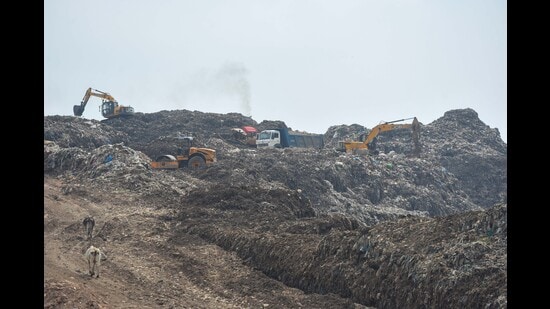
Delhi produces about 11,000 tonnes of municipal solid waste daily; yet, over half of it ends up in overloaded landfills, causing land and water pollution. Its sewage treatment capacity is far below the volume of wastewater generated; untreated sewage flows into the Yamuna, polluting its waters and endangering public health. Despite some efforts, ineffective waste segregation, inadequate treatment infrastructure, and neglect of urban sanitation have only compounded the crisis.
Waste segregation at source, modelled after Surat’s, must be enforced with digital monitoring and penalties. Modern, decentralised sewage treatment plants must be set up and old infrastructure repaired. Focus on formalising waste picking, expanding recycling, and supporting circular economy practices. The city must prioritise land reclamation and beautification, turning contaminated sites into green spaces. Municipal governance must be strengthened with data-driven management, akin to Bhubaneswar’s, and public participation promoted through community cleanup drives and awareness campaigns. There must also be regular public disclosure of pollution data, with community-led monitoring.
Regional cooperation is another focus area, with collaboration with neighbouring states key to reducing external pollution; the aim must be to bring PM2.5 levels by 40-50% from the 2023 standards by 2028.
By 2036, India’s population could reach 1.5 billion, and if growth remains unplanned, our cities will be swallowed by unsustainable expansion. In Delhi-NCR alone, real estate prices have skyrocketed by 57% since 2019, yet infrastructure remains woefully inadequate to support this surge. Residents are caught in a vicious cycle of mismanagement: government agencies, planners, and industries repeatedly neglect their responsibilities, turning urban growth into a ticking environmental time bomb.
To remedy this, implement comprehensive master planning — focused on walkability, green spaces, and sustainable growth. Enhance public transport and de-incentivise car dependence while promoting citizen involvement in urban development. Every delay exacerbates the health crisis — especially for Delhi’s most vulnerable demographics.
Delhi must realise that progress without clean air is hollow. The city’s survival hinges on an urgent pursuit of environmental justice, underlined by a policy overhaul, tech innovation, community push, and regional unity.
Amitabh Kant was India’s G20 Sherpa and is the former CEO of NITI Aayog. The views expressed are personal.