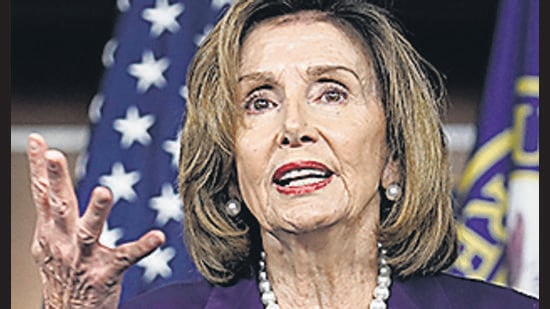
The United States (US) House of Representatives Speaker Nancy Pelosi’s Taiwan trip, and the controversy around it, have illustrated the multiple and, at times, contradictory, impulses dictating America’s China policy.
Here is what has happened.
Pelosi, a long-time China critic and a friend of Tibet, decided to go to Taiwan to express solidarity in what is widely assumed to be the final lap of her political career. Beijing was unhappy and sent a clear signal of displeasure. The administration, acutely
The United States (US) House of Representatives Speaker Nancy Pelosi’s Taiwan trip, and the controversy around it, have illustrated the multiple and, at times, contradictory, impulses dictating America’s China policy.
Here is what has happened.
Pelosi, a long-time China critic and a friend of Tibet, decided to go to Taiwan to express solidarity in what is widely assumed to be the final lap of her political career. Beijing was unhappy and sent a clear signal of displeasure. The administration, acutely aware of the political sensitivities in Beijing in the run-up to the party Congress later this year, thought it wasn’t wise to poke Xi Jinping. President Joe Biden then ended up publicly revealing that the military thought Pelosi’s visit was not a good idea.
As soon as the administration’s discomfort became clear, political dynamics kicked in. The Republicans smelled weakness and attacked the Democrats for being soft on China. With midterms approaching, even Democrat legislators jumped in to make it clear that the Chinese Communist Party couldn’t dictate the Speaker’s travel agenda. The American strategic community got divided. Some argued that Pelosi’s visit wasn’t worth the risk of escalation and instead quieter support to Taiwan, including through military aid, was more productive. Others argued that backing off would signal weakness and embolden Beijing to step up its aggression against Taiwan.
Meanwhile, in a mark of continued engagement between the two sides, Biden got on to a call with Xi. National security adviser Jake Sullivan had met his Chinese counterpart, Yang Jiechi, in Rome in March. The two top leaders spoke that month in the wake of Russia’s invasion of Ukraine. Sullivan then met Yang again in Luxembourg, where the US side sought a leader-level call. During their Bali meeting, Chinese foreign minister Wang Yi confirmed to secretary of state Antony J Blinken that Xi would be interested in a top-level conversation.
So, while last week’s call represented the logical next step in this process of intensified engagement, it came even as Pelosi’s visit had become a matter of discussion in the public domain. Xi reiterated China’s red lines on Taiwan. Biden (after having given contradictory signals in the past year) reiterated that there had been no deviation from the one China policy. Xi could not, and cannot, be seen as weak on Taiwan at home, but also possibly saw this as a moment to test the US’s mettle. Biden did not, and does not, want an escalation, but also warned that a unilateral change in status quo wasn’t acceptable.
It is in this backdrop that Pelosi decided to go ahead. Her strong ideological opposition to China’s political and strategic behaviour, coupled with domestic electoral imperatives where the Democrats cannot be seen as running scared of China, explains the visit. The visit’s cancellation would also have eroded US strategic messaging in the rest of the Indo-Pacific. No one in the region wants a confrontation, but if Beijing’s threats were enough to deter a high-level US visit, did America really have the appetite to defend the “rules-based order”?
Once it became a matter of public debate, the administration, or parts of it, may well have concluded that having played the good cop with China, it was fine to let Pelosi play the bad cop and point to the fact that the legislative branch is separate from the executive. Whether the Chinese buy the story, and how they respond, will be the next phase of this evolving geopolitical friction. Expect escalation in tensions, but perhaps not outright confrontation.
The entire episode reveals two powerful impulses in America’s China policy.
At the level of the establishment, the US’s China strategy is based on the principles of invest (in capabilities at home), align (with partners and allies), and compete (directly with China on a range of issues). The US has indeed stepped up its investment, most recently in the form of the Chips Act, which represents a significant State intervention to boost semiconductor manufacturing and reduce dependence on China. It has stepped up alignment, in the form of Quad, more aggressive diplomacy in all corners, from West Asia to Latin America, and a focus on emerging tech, the real frontier of the future.
But when it comes to immediate competition, the administration’s public stance on the Pelosi visit reveals that on the really tricky geopolitical fault lines — and Taiwan is clearly one of them — Washington wants to be careful. Couple this with intensified engagement with China, which is a part of the US’s stated policy of keeping channels of communication open to manage competition, efforts to work together on climate, or talk of reducing tariffs. All of this will be noted in Asian capitals as they make their calculations about the future security architecture, when to bandwagon and when to hedge.
At the level of public opinion, however, the Pelosi visit shows that no US politician can be seen as weak on China. Beijing has its lobbyists, business chambers and John Kerry-type single-issue advocates backing a reset in DC. But on the street, China is seen as having stolen jobs, exporting the virus, behaving badly and posing a real threat. Neither the Republicans nor the Democrats, neither governors nor Senators, neither Fox nor CNN can ignore it. And the White House can’t undermine a powerful Speaker in an election year. China’s ultra-nationalist belligerence will drive geopolitics, but so will the US political theatre and public opinion.
The views expressed are personal
One Subscription.
Get 360° coverage—from daily headlines
to 100 year archives.
Archives
HT App & Website