A civil rights lawyer by day, an author by night, Vaishnavi Patel constantly challenges the mainstream. Her first book gives us a contrarian version of the Ramayana—letting wicked stepmother Kaikeyi tell her side of the story.
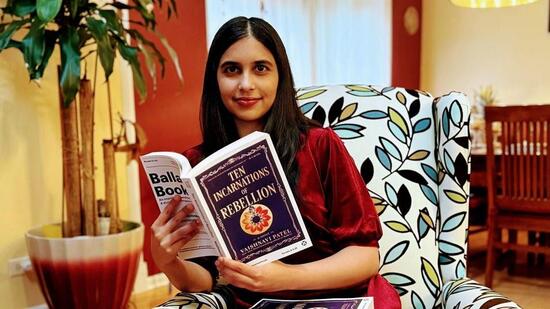
On a recent Friday evening, we gathered on Zoom—Vaishnavi logged in from New Orleans, Louisiana. The book club readers joined from three continents—Toronto, London, India, and Singapore. Here are edited excerpts from our conversation:
Vaishnavi, your upbringing seems like a fascinating mix of Indian tradition and Western influences. Tell us about your childhood reading and how it shaped your approach to mythology.
I was the first person in my family born outside of India, born here shortly after my parents immigrated. My parents tried really hard to give me as much of their culture as possible, especially my mom who is Marathi, and she wanted to make sure I spoke at least some Marathi, and my aji would come six months every year and stay with me, so we were as close as we could be with that distance as a family. As a child, I was always a big reader. I also would read a lot of books here from the library. And also I’d read a lot of Amar Chitra Katha and those sorts of books as well, or comics. So it was kind of a nice blend of everything.
{{/usCountry}}I was the first person in my family born outside of India, born here shortly after my parents immigrated. My parents tried really hard to give me as much of their culture as possible, especially my mom who is Marathi, and she wanted to make sure I spoke at least some Marathi, and my aji would come six months every year and stay with me, so we were as close as we could be with that distance as a family. As a child, I was always a big reader. I also would read a lot of books here from the library. And also I’d read a lot of Amar Chitra Katha and those sorts of books as well, or comics. So it was kind of a nice blend of everything.
{{/usCountry}}The Amar Chitra Katha comics were my first exposure to Indian epics, but even then, I remember questioning certain portrayals—why some characters were always “good” and others “evil.” That definitely influenced how I approached Kaikeyi’s voice.
What was the specific moment that sparked the idea for Kaikeyi?
The seeds of Kaikeyi were planted seventeen years ago in a discussion between my mother and my grandmother. One particular summer, my grandmother told us the story of how the noble prince Rama was exiled by his jealous stepmother Kaikeyi. At this, my mother stepped in to add that Kaikeyi had actually helped Rama. Without Kaikeyi, my mother pointed out, Rama would have never achieved his destiny by slaying the demon king Ravana, his main adversary in the Ramayana. My grandmother disagreed, arguing that it was cruel to exile your child, no matter the circumstance.
And then we moved on. But their minor dispute stuck with me for years, and I would periodically search for stories told from or studying Kaikeyi’s perspective to make sense of the contradiction. I never found them. Eventually, I decided to write my own.
You wrote Kaikeyi when you were 23, in your first semester of law school—a demanding program. How did you manage that balance?
I really don’t know how I did it, because I was living alone and presumably had law school work to do, but I’ve blocked out that time in my memory. Then as now, I write every night, from eight to ten—I just put aside all my other work and do my writing.
I feel that writing has actually been very helpful for me mentally because it’s a kind of release. The writing style is very different from the law. It’s very emotional—it’s almost therapeutic.
Nowadays, I’m also very fortunate that my husband does all of the cooking and the cleanup, so I can come home and write for two hours, and I will have a meal, and it will all be taken care of. And I mention that only to say that I think that male writers or workers throughout history have always been greatly aided by their wives supporting them and doing all of that work for them, and it’s kind of the invisible work that makes their work possible. And I don’t want his work to be invisible, so I have to give him that credit—that without him, I probably would not have been able to write more than one book.
Your civil rights background clearly influences your storytelling. Can you give us a specific example of how your legal work shaped how you approached characters like Kaikeyi and Ram?
Everybody has a story. And there is a side that ultimately is judged to be the correct—the side that the jury picks in a trial. But the other side has presented a very, very different story and characterization of events, and they probably have some evidence for their side of the story, and they probably have some very credible witnesses. And so though we still picked the other side, that doesn’t make their story completely false.
That’s kind of what happens in Kaikeyi—you probably shouldn’t believe 100% of everything Kaikeyi says, because she is a very self-justifying character. She always has a reason she’ll give you for everything that she did, and she believes that she’s right about everything, and she’s probably not. So also, you know, Ram’s side of the story—that is, Valmiki’s Ramayana—is also an equally plausible interpretation of the external events that happen.
Working on cases involving marginalized voices—where the system often dismisses their perspective—made me think about how history is written by those in power. Kaikeyi is condemned in the Ramayana, but what if she had a chance to defend herself? That’s the core of what I wanted to explore—not to say she’s innocent, but to ask, Why did she do what she did?
It’s the principle that everybody has their own side of the story—and in law, you see a full presentation of both sides, and then you have to choose one. This is very much the thought behind my story of Kaikeyi.
How did you get your first publishing break?
I just cold-emailed agents. Many agents have a process for contacting them—you just put yourself in there, in what they call the slush pile; if they like the first few chapters, they’ll ask for more. And that’s what I did, and I was very lucky that it worked out for me. I do think luck plays a big role, like it’s about getting the right person at the right time. Similarly for my editor—an Indian American woman who, at that time, was looking for myth retellings from Hindu mythology because she felt that myth retellings from Greek, Roman and Western European mythology were very represented, and there was nothing from Indian mythology.
The cover of Kaikeyi is so beautiful.
My editor sent me the cover, saying, “What do you think? If you don’t like it, we can make some changes.”
And I said, “Stop, I love it. Don’t change anything.” I think I benefited greatly from my editor being Indian American and having a vision for it and wanting to make sure that the cover looked Indian and had this sort of mythic quality to it.
You decided to write Kaikeyi as a first-person account?
When Kaikeyi’s voice came to me in first person, I felt if I’m going to tell her story, I have to tell it through her eyes directly. It was critical for me, to be in her head, to actually get her hopes and dreams, and most importantly, understand her fears. So you understand her motivations, what she’s trying to react to, and why she’s doing what she’s doing.
In your portrayal of Kaikeyi, she has a magic ability, one you call the “binding plane,” which helps her connect with people and even influence them.
I love fantasy and magic and wanted an element of this in the story. But I didn’t want it to be something that was completely just divorced from the story. I wanted it to be something based on maybe, you know, yoga practices or meditation, energy, etc. And then I had the idea for the binding plane, in part because Kaikeyi starts out her story wanting to not be like a woman. She sees so much value in hunting and fighting and riding and things that are more masculine practices in that time period.
But ultimately, her great power is her ability to see and use relationships and subtleties and influence—which, especially in that time period, was considered a means of women’s power.
You portrayed Ram with human frailties. Did you expect the intense backlash that followed?
I did get a significant amount of backlash when Kaikeyi came out. It was a pretty intense response—I got death and rape threats, but thankfully, it was all online. I tried to keep details about where I live off the internet, so I was fairly protected.
It was my mom who got very worried, and she was more right than me, which is always the case. I should always listen to her more than I do.
How did you cope mentally with that level of hostility toward your work?
Kaikeyi came out in April, and then in May, I graduated law school, and then in June, I got married, and then in July, I took the bar exam to become a lawyer. And I think that really helped—that I didn’t have too much time to think about it. My sister helped me manage my social media, so a lot of the stuff that came through was filtered, and I didn’t really have time to get upset about it. It can be really hard if you’re just fully invested—it can hurt your ability to write again. I’ve seen this happen to friends of mine, where they get afraid to write anything potentially controversial again. I feel lucky that that didn’t happen to me.
Tell us about the situation with publishing Kaikeyi in India. What exactly happened there?
I’m so glad that so many of you are based in India and were able to get the book, because there’s no official version in India. It was actually meant to be published—it was set to release the week before Diwali 2022. I asked, Are you sure about this timing? And the publishers were like, Yes, people will buy it as a gift for Diwali.
So they had printed the copies, and the copies were in India. And then ten days before publication, I was told, an Independent Review Board has said that this book is religiously offensive, and we’re going to pulp all the copies. So they gave a cancel order, and the books were—I was told that they were pulped, which means that they were literally, physically destroyed.
But thankfully, we live in a very interconnected world, so it’s no longer the case that if a book isn’t being published by an Indian publisher, it’s inaccessible. You can get it imported through a lot of other places. So it’s not a full ban, but it has made it harder because the book is much more expensive.
In your story, the character of Ravana is different—he is Sita’s father and is protective of her. How much of this draws from existing versions of the Ramayana versus your own invention?
This is not the Ravana in the original Valmiki Ramayana. But there are Ramayanas spread across South India, Sri Lanka, and Southeast Asia. Each of these different areas put different spins on the story according to their own principles, traditions, and how they viewed the world. And so in some versions of the story that are told in Southeast Asia, such as, for example, the Thai Ramayan, they have Ravana as Sita’s father. And in that version of the story, Ravana is told that your daughter is going to be your doom. And so he basically puts her into the earth, and the earth brings her north. And then later, in some versions, he recognizes it’s his daughter, and he’s trying to be like, If my daughter is going to kill me, then I’m going to imprison her. And in some versions, he doesn’t recognize that it’s his daughter. But either way, it’s the classic idea that in trying to protect yourself or in trying to avoid your destiny, you, in fact, bring your destiny upon you.
However, I did a lot of research on these other versions of the Ramayana and drew on portraying some elements from those into Kaikeyi. I wanted to weave in these nuances rather than sticking to a single “authorised” version.
Tell us about your new book.
I studied colonial history a lot in school, and I like to tell women’s stories of rising up and fighting back. I do this in Ten Incarnations of Rebellion, a reimagining of a portion of India’s independence movement.
And you are working on a fourth book as well?
It’s called We Dance Upon Demons, and it is about a young woman who works at an abortion clinic that’s being threatened by demons. So it is very much diving into American politics, and specifically the abortion fight, on which we are an incredibly backward country. I used to volunteer at an abortion clinic, and one of my areas of civil rights law that I have worked on is abortion rights.
Given all the controversy and even threats you’ve faced, what gives you the courage to keep writing these challenging stories? What do you hope readers ultimately take away from your work?
You should tell my mom that, because she is very much like, Please stop writing, stop writing these dangerous books. She is very supportive, but she’s just worried about me.
I’m interested in women’s rights, gender justice, voting rights, how democracy works and the interest in those topics transcend law, so they go into my writing quite a bit. I’m interested in women’s stories, in their side of the story, in hearing their voices. I’d love for readers to think about motivation behind actions, and to think about different perspectives and for readers to have conversations across generations on these issues. That’s exactly what you dream of as an author.
(Sonya Dutta Choudhury is a Mumbai-based journalist and the founder of Sonya’s Book Box, a bespoke book service. Each week, she brings you specially curated books to give you an immersive understanding of people and places. If you have any reading recommendations or reading dilemmas, write to her at sonyasbookbox@gmail.com. The views expressed are personal.)