The two biggest debates in India and the United States (US) over the past week have striking parallels.
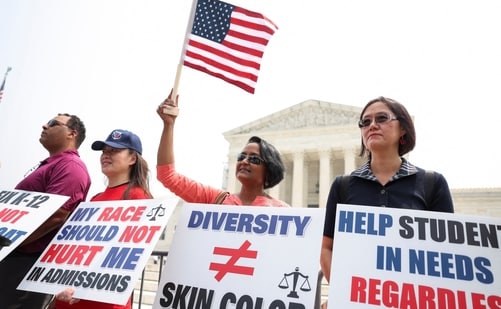
In Washington DC, the Supreme Court delivered a verdict that prohibited universities from using race as a category in determining admissions. The case involved a group called Students for Fair Admission challenging the admission programmes of Harvard and the University of North Carolina. The underlying argument of the petitioners was that the affirmative action policies in these institutions, with an eye to
The two biggest debates in India and the United States (US) over the past week have striking parallels.
In Washington DC, the Supreme Court delivered a verdict that prohibited universities from using race as a category in determining admissions. The case involved a group called Students for Fair Admission challenging the admission programmes of Harvard and the University of North Carolina. The underlying argument of the petitioners was that the affirmative action policies in these institutions, with an eye to include more Black students, were at the expense of White and Asian-American students. It, thus, violated the constitutional provision of equality and equal protection under law. Six judges, all nominated by Republican presidents, agreed.
In Bhopal, Prime Minister Narendra Modi reintroduced the idea of the Uniform Civil Code (UCC) into political discourse in the run-up to the 2024 polls. He argued that just like a household couldn’t have different rules for different family members, the country could not be run with a system which was based on separate laws for separate communities. He referred to the judiciary’s reminders about the need for a UCC, alleged that Muslims were being instigated by political interests that had kept the community backwards, and spoke of the need for a common law for all citizens to advance universal public goods such as education and health.
Despite the radical difference in context and subjects, mark the commonalities in the argument, who is making the argument, who is opposing it, and the grounds for the opposition. In both the US and India, it is the conservative political flank that has adopted the language of constitutional equality and non-discrimination to push forward a political agenda that, broadly speaking, liberals and the Left believe represent an attack on minority rights and representation.
In the US, the majority bench outlined America’s history of slavery and racism, including the court’s shameful complicity with the structures of racism even after the abolition of slavery. It hailed the 14th Amendment which barred race-based discrimination and promised equality. It celebrated the Brown v Board of Education judgment that was a blow against segregated schooling system.
And it used precisely this history to suggest that using race as a factor in admissions entrenched racial identities; it reinforced stereotypes; it was discriminatory against students from other social groups, including Asian-Americans, who had their own history of discrimination; and it went against the fundamental constitutional tenet of treating citizens as individuals, “not as simply components of a racial, religious, sexual or national class”. Chief Justice John Roberts, writing for the majority, claimed that the endpoint of such affirmative action policies was not racial harmony and integration, but a world where everyone was defined by their skin colour.
In India, the core of the argument in favour of UCC, too goes back to using Constitution and the directive principles of state policy which states, “The State shall endeavour to secure for the citizens a uniform civil code throughout the territory of India.” Bharatiya Janata Party (BJP) leaders, who don’t otherwise exhibit much affection for Muslims, have spoken of the gender-based discrimination embedded in the personal codes of other religions as an affront to constitutional principle of equality. And just as in the American case, advocates of UCC point to the need for treating all citizens as individuals, rather than prioritising their group identities.
Now examine the opposition in both cases. In the US, the three dissenting judges, all nominated by Democratic Presidents, argued that with identity having been a primary basis of discrimination in American society, the project of equality can never succeed without taking into account this facet of inequality. The main dissent pointed to the same history of racism that the majority bench articulated, but drew a starkly different conclusion. Using race as one among the many factors in determining admissions contributed to racial diversity, ensured representation of underrepresented groups including Asian-Americans, and was essential for institutions such as Harvard and UNC that had been reserved only for Whites for much of their history.
Justice Ketanji Brown Jackson, who wrote a separate dissenting judgment, pointed to the various indices on which Blacks continued to lag behind White-Americans. She argued that if the majority bench was proceeding with the assumption that not considering race will end racism, it was in vain, for ignoring race will make it matter more and it will take longer to end racism. The political context of the dissent is hard to miss where liberals fear that the judgment, at a time of rising White Supremacist politics, will give a further fillip to racism and interrupt efforts to create more inclusive classrooms and workforce.
If the affirmative action debate in the US is about diversity and minority representation, in India, the fundamental argument against UCC comes from a concern about preserving diversity and minority rights. India is home to various identities, and therefore, critics of Modi’s appeal argue, these different identities must be allowed to retain their distinct cultural and religious moorings. Ignoring the heterogeneity of Indian society to impose a uniform law will not lead to uniformity, but further alienation, not just among religious minorities but also the country’s various tribes.
And even those who are sympathetic, in principle, to the idea of UCC worry that the attempt to impose a uniform code in a political context where Hindu majoritarian politics is dominant may be a backdoor route to impose the ethos and customs of one religion over others and trample on diversity.
This writer is sympathetic to the dissenting judgment in the US, and skeptical of the effort to impose UCC at this particular juncture in India. But any analysis has to acknowledge that while deriving their support from the dominant race or religion in their respective countries, Indian and American political conservatives, by speaking the language of constitutional equality, individual rights, and universal public good, have gained an edge in the debate. Liberals and minorities are confronting a much bigger challenge in making a case for identity- and race-based differential treatment despite the dangers of majoritarianism. Defending the idea of diversity will require a different vocabulary.
The views expressed are personal
One Subscription.
Get 360° coverage—from daily headlines
to 100 year archives.
Archives
HT App & Website