I have never heard any Pakistani say anything offensive — critical, maybe, but never disparaging — about two Indians: Lata Mangeshkar and Mahatma Gandhi. And this is regardless of whether the two countries are at war or at peace. Gandhi — India’s revered Father of the Nation, still fondly called Bapu in parts of South Asia — occupies a complex place in Pakistan’s historical, political, and literary memory.
Gandhi’s name is part of Pakistan’s landscape, especially in the Sind province, as it is — expectedly — in India. For instance, Karachi’s zoo was famously known as “Gandhi Garden” before Partition, and continues to be called so despite an official change of name. The plaque may now say National Zoological and Botanical Garden, but the old name is imprinted on the cultural being of the majority of people in the city. Yes, attitudes towards seeing animals caged have undergone a change as the younger generation wants to see animals roaming free. The name, therefore, sticks rather ironically in popular recall, says my friend Aijaz Mangi, a Karachi-based poet.
Also Read | Gandhiji was a man of God, hence Mahatma
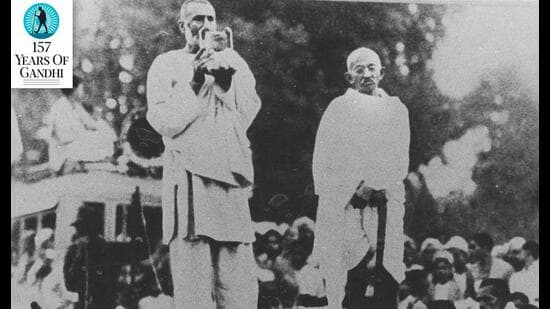
That we have borrowed Gandhi’s name for our own heroes should underline his impact in the subcontinent, perhaps even beyond. Noted freedom fighter Khan Abdul Ghaffar Khan, who led the non-violent movement against British colonialism in the North West Frontier Province (NWFP), became Frontier Gandhi or Sarhadi Gandhi. The stature of this Pashtoon leader, also known as Bacha Khan, in Pakistani socio-political movements was elevated by the halo of Gandhi’s name. Miskeen Jahan Khan Khoso became, through his work, the Gandhi of the Thar, the desert that’s not very far fromGandhi’s native village in Gujarat, India. Carrying piles of papers in his chador, an ink pot and pen in his hand, Khoso continued to be followed by crowds of poor litigants until his death in 1980. A tireless social worker, Khoso helped the poor, sick, unemployed, and hungry, traversing the length and the breadth of the Thar (on foot, mostly). He was forever knocking on the doors of bureaucrats, judges, doctors — anyone who could help the downtrodden natives of a difficult land. Once jailed under Pakistan’s Goonda Act for siding with the oppressed against local influentials, he fought the fabricated case and was acquitted within six months. A hero to the Thar’s marginalised communities, including Kolhis, Meghwars, and Bheels, he often remained hungry while feeding those who had nothing. One of his biggest contributions was the successful campaign to make antivenin available in Thar hospitals. This portrait is only to illustrate that we, in Pakistan, have not handed out the title “Gandhi” for ceremony or flattery, but for genuine selfless service. Neel Kanth, a fellow Thari and a family friend of Khoso, invokes this example to show how Pakistan has found ways to claim Gandhi.
{{/usCountry}}That we have borrowed Gandhi’s name for our own heroes should underline his impact in the subcontinent, perhaps even beyond. Noted freedom fighter Khan Abdul Ghaffar Khan, who led the non-violent movement against British colonialism in the North West Frontier Province (NWFP), became Frontier Gandhi or Sarhadi Gandhi. The stature of this Pashtoon leader, also known as Bacha Khan, in Pakistani socio-political movements was elevated by the halo of Gandhi’s name. Miskeen Jahan Khan Khoso became, through his work, the Gandhi of the Thar, the desert that’s not very far fromGandhi’s native village in Gujarat, India. Carrying piles of papers in his chador, an ink pot and pen in his hand, Khoso continued to be followed by crowds of poor litigants until his death in 1980. A tireless social worker, Khoso helped the poor, sick, unemployed, and hungry, traversing the length and the breadth of the Thar (on foot, mostly). He was forever knocking on the doors of bureaucrats, judges, doctors — anyone who could help the downtrodden natives of a difficult land. Once jailed under Pakistan’s Goonda Act for siding with the oppressed against local influentials, he fought the fabricated case and was acquitted within six months. A hero to the Thar’s marginalised communities, including Kolhis, Meghwars, and Bheels, he often remained hungry while feeding those who had nothing. One of his biggest contributions was the successful campaign to make antivenin available in Thar hospitals. This portrait is only to illustrate that we, in Pakistan, have not handed out the title “Gandhi” for ceremony or flattery, but for genuine selfless service. Neel Kanth, a fellow Thari and a family friend of Khoso, invokes this example to show how Pakistan has found ways to claim Gandhi.
{{/usCountry}}Of course, our relationship with Gandhi has never been simple, and we should not pretend it is. After all, the man opposed the very creation of Pakistan. Because successive Pakistani governments have struggled with establishing a national identity in opposition to India, Gandhi is rarely emphasised in mainstream Pakistani school textbooks. His overt Hindu religiosity was also something that our founding father, Muhammad Ali Jinnah, was openly dismissive of. On the contrary, the Deobandi Jamiat Ulema-e-Hind, which opposed Jinnah and Pakistan, held Gandhi in high esteem. Many Deobandis of Pakistan, despite their ossified religious beliefs, continue to revere the man. But, there is also one Rasool Bakhsh Palijo. This celebrated human rights lawyer, leftist scholar and Marxist leader of Pakistan, famously blamed Gandhi for “provoking” Jinnah with Hindu religiosity and the slogan of Ram Rajya. Ali Ahmad Rind, the editor of Affairs, a fortnightly Sindhi news magazine in Karachi, notes that Palijo perhaps held Gandhi responsible for Partition by pushing Jinnah against the wall.
For thousands of followers of GM Syed of Sind and Bacha Khan of the NWFP, Gandhi holds a place beyond politics — as a mystic and a prophet of non-violence. He becomes someone akin to Gautama Buddha, whose influence is still alive in the ruins of Takshashila. Shaikh Ayaz, the doyen of Sindhi poetry, wrote a collection called Raaj Ghat Tay Chand (Moon over Raj Ghat) and reminded us that the world offers a cross for Jesus and a bullet for Gandhi, even today. Barely a month after Partition, Gandhi said in a prayer meeting, “What the Muslims have done is not good, but what harm has the Koran done?” In the same meeting he said, “I want to go to Lahore. I do not want to go with any police or military escort ... I want to go with faith and trust in the Muslims there. Let them kill me if they want ... Let the Government stop me if they will. But how can the Government stop me? They will have to kill me if they want to stop me. If they kill me, my death will leave a lesson for you.” Clearly, it was this worldview that earned him friends and foes on all sides. Even Shaikh Ayaz once wrote out of frustration, “You have to deal with Gandhi to even ride a donkey.”
For my generation, Gandhi arrived via VHS tape, alongside Osho’s cassettes and Ben Kingsley’s film. We argued whether an empire fell because a brown man was thrown off a train in South Africa by the white colonialists.
Also Read | Gandhi, the man and the idea, lives on in Hindustani
History is full of such ifs. What if a woman named Kariman had not eloped with a Hindu man in Sindh? Would the Larkana riots of 1927 not have happened? Would identity-based political stances not have hardened? Would a Sindh-born barrister, then, still have launched a movement for a new, Muslim-majority nation? All are in the realm of hypothesis. What is not hypothetical is what Gandhi did in his final days: He demanded that Pakistan receive its share of the assets, the 550 million rupees, and stood against the killing that soaked Partition. Many Hindus of India bristled at this: Why was our Gandhi being generous to them, they probably wondered.
Pakistan isn’t united on Gandhi, a living symbol of unity. In today’s Pakistan, there is a section in politics that still likes to lump Gandhi with the hardliner elements in India, as an existential denier of Pakistan. I muse, therefore, that Nehru’s line about him, “I love the old man but never understood him,” could very well be ours too. Being fully understood by everyone, after all, did not matter to the saint of Sabarmati.
Hasan Mujtaba is a Pakistan-born poet, journalist, and human rights activist. The views expressed are personal.
In 2019, Hindustan Times marked Mahatma Gandhi’s 150th birth anniversary with a series of articles published from September 16 to October 2. Explore the coverage.