The quad with a small q is about connectivity, technology and, for India, a new relevance in West Asia. On October 21, the foreign ministers of India, Israel, the United Arab Emirates (UAE) and the United States (US) announced their intention to join hands and form an “international economic forum”.
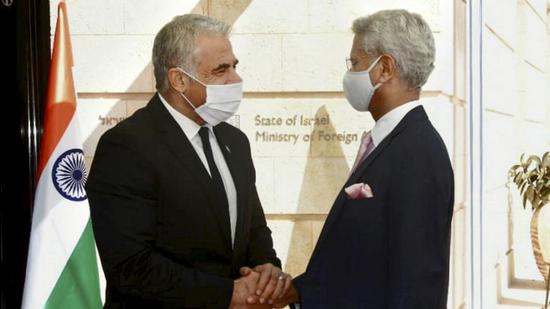
The forum arises from a cluster of existing and functioning bilateral initiatives. The question is whether it becomes larger than its parts. As the Israeli foreign minister, Yair Lapid, declared,
The quad with a small q is about connectivity, technology and, for India, a new relevance in West Asia. On October 21, the foreign ministers of India, Israel, the United Arab Emirates (UAE) and the United States (US) announced their intention to join hands and form an “international economic forum”.
The forum arises from a cluster of existing and functioning bilateral initiatives. The question is whether it becomes larger than its parts. As the Israeli foreign minister, Yair Lapid, declared, “Synergy is what will help us work together on infrastructure, digital infrastructure, transportation, ports, trains and maritime security.” As all the ministers agreed, this quad will succeed when it is able to get the corporate world to begin using the bridges that it strengthens.
The forum works on a number of different layers and its four members have different motives for being involved. The US’s role, for example, is largely to provide “geopolitical glue” to help three of its regional partners to work together. Washington was only brought into the picture after the three others had worked out the details.
Corridors: The UAE laid the foundation for the forum over the past few years. Abu Dhabi wants to be the economic gateway and logistics hub between the Mediterranean and Indian Ocean.
On its eastern side, the UAE has developed a “food corridor” with India, under which the latter promises to be a secure supplier to the Persian Gulf in return for the UAE developing the necessary infrastructure. The emirates are still rolling out $7 billion for the food corridor that they promised in 2017 with dozens of agro-processing centres and parks being set up across India, expanded port and container investments through joint ventures like Hindustan Infralog, and more. On the supply side are the Narendra Modi government’s farm reforms, designed to move Indian agriculture beyond the unsustainable farming methods of the Green Revolution. The corridor has already survived its first major test — during the chaos of its Covid waves, India maintained farm supplies to the UAE.
All this connectivity infrastructure across the Arabian Sea will also feed into the nearly complete Etihad Rail network. This will provide a rail link across Saudi Arabia all the way to Jordan and Israel. Dubai Ports is expanding the Israeli port of Haifa with an eye to ensuring container movement on to Europe. Studies indicate that when completed, this multimodal corridor will allow a container to move from Maharashtra to the Mediterranean 40% faster than if it went by the traditional Suez Canal shipping route. It would also provide a useful connectivity backup to Iran’s informal but unstable empire running from Iraq to Lebanon.
Tetra Tech: If container movement is the forum’s foundation, technology occupies its penthouse. As is evident from the agenda of the real Quad, there is a growing recognition technology will be at the core of 21st century relevance. The forum works on what is a set of bilateral technology relationships.
The UAE has been working overtime to prepare itself for a post-carbon future. Its two sovereign wealth funds have poured money into startups and venture capital funds across the world. Even before the Abraham Accords, it was investing millions in Israel’s famed technology ecosystem. On a smaller scale, these funds have been doing the same in India. India and Israel already have a nascent technology relationship that is slowly moving away from government-to-government cooperation to commercially-driven private deals. The US tech sector already works will all three of the others.
Dr Michael Tanchum, among the earliest analysts to recognise how all these parts could come together, has written, “Arab-Med Corridor presents New Delhi with unique opportunities highly conducive for value chain integration because of the existing synergies between India’s commercial ventures with its Arab Gulf partners and its commercial ventures with Israel.” He has called the corridor a “paradigm shift” in strategic connectivity.
Of special interest to all the members, though especially to India and the UAE, is the promotion of a green technology ecosystem along this geographical arc. All the members have joined or, in the case of Israel, are about to join the Modi government’s flagship International Solar Alliance (ISA) and can play a role in piecing together the ISA’s next step, the trans-regional One Sun-One World-One Grid project. More long-term is whether all of this can generate a green tech corridor that can become a source of research, finance, software and manufacturing for solar and wind energy components, electric vehicles and batteries. India’s desire would be for much of the physical elements of such a supply chain be in the east and the markets for such products in the west.
Geopolitics lite: The forum has a minimal geopolitical element. It is not designed to target China or Iran. Israel and the UAE work with Beijing; India and the UAE get along with Iran.
However, there are straws in the wind. One is that India and Israel, both of which handled West Asia through a cluster of bilaterals, are now venturing into the plurilateral space. For New Delhi, this represents a quiet revolution, changing how it may operate in a region that it tended to keep at arm’s length. As Israeli’s foreign secretary equivalent, Alon Ushpiz, said, his country would like to see “how can the new situation in the Middle East have an Indian angle to it.”
Two, the US’s symbolic role reflects Washington’s desire to fill in the spaces created by its slow regional withdrawal with like-minded countries. The maritime security reference is presumably about how the other three can share the US naval burden.
Three, having spent the past year or two reaching out to Iran, Qatar and Iraq, the UAE is openly incorporating countries on the edges of the Persian Gulf. But it is ignoring Pakistan — the Abu Dhabi royal family sees it as a cesspool of the most violent and regressive aspects of Islam and, tellingly, of negligible economic value.
Finally, the forum should include Saudi Arabia, which is crucial to the connectivity plans and a big investor, via Softbank and others, in the Indian tech space. Diplomatic sources say Riyadh was wooed extensively before the forum announcement. The Sauds felt this would imply Israeli recognition, a step too far for them, and preferred to be back bench supporters. The forum meets, physically, in the UAE in November and plans to detail its ambitions and come up with a more unique name for itself.
Pramit Pal Chaudhuri, one of India’s most perceptive foreign affairs commentators, writes an exclusive column on India and the world for HT Premium readers
The views expressed are personal
One Subscription.
Get 360° coverage—from daily headlines
to 100 year archives.
Archives
HT App & Website