This election, political parties are clear that they can win only with the support of Bahujan communities. The BJP has inducted several well-known Bahujan faces, who have helped expand the mass base of the party
Since Goa’s first election in 1963, the coastal state’s politics is seen as being centred on the binary narratives of secular and communal, placing the Congress and its allies under the former umbrella, and clubbing the Bharatiya Janata Party (BJP) and the Maharashtrawadi Gomantak Party (MGP) under the latter group.
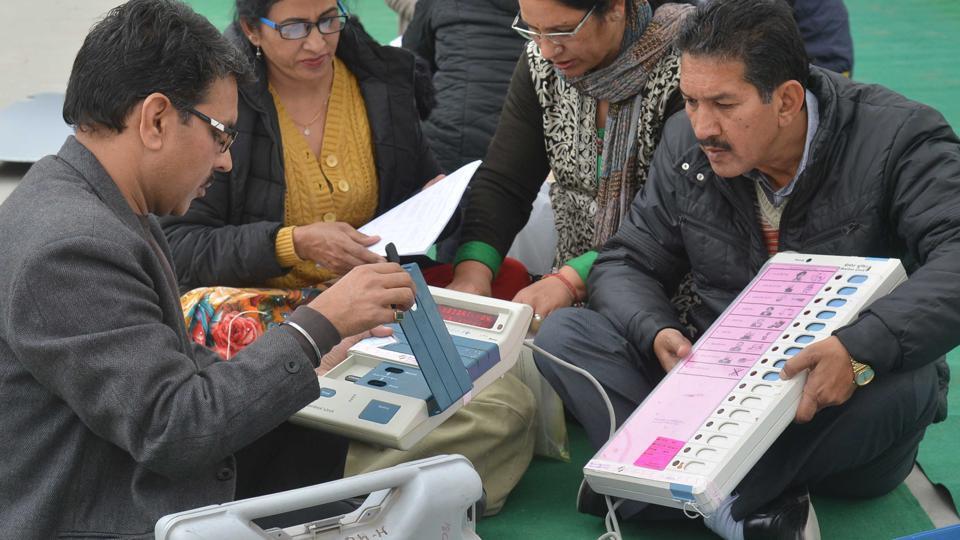
Election officials examine Electronic Voting Machines (EVM) from a distribution centre, 2017 (AFP)
But such an understanding obfuscates caste, which was the primary determinant of elections in the Portuguese times, when the Partido Indiana and Partido Ultramarino fought on caste lines. The impact of caste on the state’s politics can best be understood using the framework of Bahujan (an umbrella term for backward communities, scheduled castes, scheduled tribes and minorities) politics.
The MGP, led by social reformer Dayanand Bandodkar, managed to ally with the Bahujan communities, especially Bhandaris, Kharavis, Kunabis, Gomantak Maratha Samaj and Marathas. It ruled till 1980, but its grip on the Bahujan vote base loosened after Bandodkar’s death in 1973. Though the leader ignited the Bahujan consciousness, it failed to translate into social and political capital after his death.
The exit of Bandodkar loosened the hold of the Bahujan leadership on political parties. Pratapsingh Rane, an MGP leader whose family was known for its rebellion against the Portuguese rule, left the MGP to join the Devraj Urs-led Congress. Rane belonged to the Maratha caste and was a face of Bahujan leadership in the MGP. He became chief minister (CM) in the Congress government in 1980, but continued to face opposition from Catholic and Hindu upper-caste leaders.
His ouster in 1990 started the decline of Bahujan leadership in the state. The next 10 years increased instability, as leaders such as Churchill Alemao, Luis Proto Barbosa, Ravi Naik, Wilfred de Souza, Luizinho Faleiro, Francisco Sardinha could not form stable governments.
This changed with Manohar Parrikar, who popularised social schemes and attracted Bahujan communities, thereby consolidating the mass base of the BJP.
But as the BJP firmed its grip on power, the old secular vs. communal binary, which had almost disappeared in the politically unstable 90s, made a comeback. Moreover, the party’s increasingly strident Hindu politics made many lawmakers uncomfortable, who withdrew support to the Parrikar government in 2005. Further attrition of the BJP’s support base saw the Congress win in 2007.
Faced with a consolidation of the so-called secular parties, Parrikar changed his strategy and participated in anti-mining movements, anti-special economic zones and regional plan protests, and language agitations. He also refashioned the social schemes directed towards Bahujan communities by increasing the financial assistance under Dayanand Social Security Scheme and promising Griha Adhar Yojana and Ladali Laxmi Yojana to women. This resulted in a clear mandate to BJP in the 2012 assembly elections.
Parrikar joined Prime Minister Narendra Modi’s Cabinet in 2014, creating a vacancy that was filled by Laxmikant Parsekar. But Parsekar could not fulfil the BJP’s poll promises and faced protests against illegal mining and controversial grants for English medium schools. He also couldn’t tackle social dynamics and in 2017, lost from his home constituency of Mandrem.
After the BJP won only 13 seats to the Congress’s 17, Parrikar returned to the state and formed the government with the help of the Goa Forward Party, the MGP and independents. After the demise of Parrikar in 2019, Pramod Sawant was elevated to the position of CM. This created instability within the government but Sawant manufactured defections from the MGP and the Congress, and many of the turncoats were from the Bahujan communities.
This election, political parties are clear that they can win only with the support of Bahujan communities. The BJP has inducted several well-known Bahujan faces such as Ravi Naik, Chandrakant Kavalekar and Vishwajit Rane, who have helped expand the mass base of the party. The Aam Aadmi Party (AAP) has promised a CM from the Bhandari community, and the Trinamool Congress is focusing on social schemes. The Congress has yet not made many such moves, but has given tickets to many fresh faces, some of who are from the Bahujan communities. This time, the fight is for the support of the Bahujan communities.
Prachi Naik teaches Political Science at Goa University.

 E-Paper