
 E-Paper



Hijab row: Why empowerment through education is the only right approach
Hijab-abiding students should be allowed to exercise their right to education without any hindrance. Let the women be empowered first, so they can decide how much of themselves they wish to hide.

 Prefer HTon Google


Schools and colleges are limping back into normalcy, and yet, disruption appears to be the order of the day. Toxic communal conflagrations loom large with a worrying precedent being set by some colleges in Karnataka that enforced a ban on the hijab.
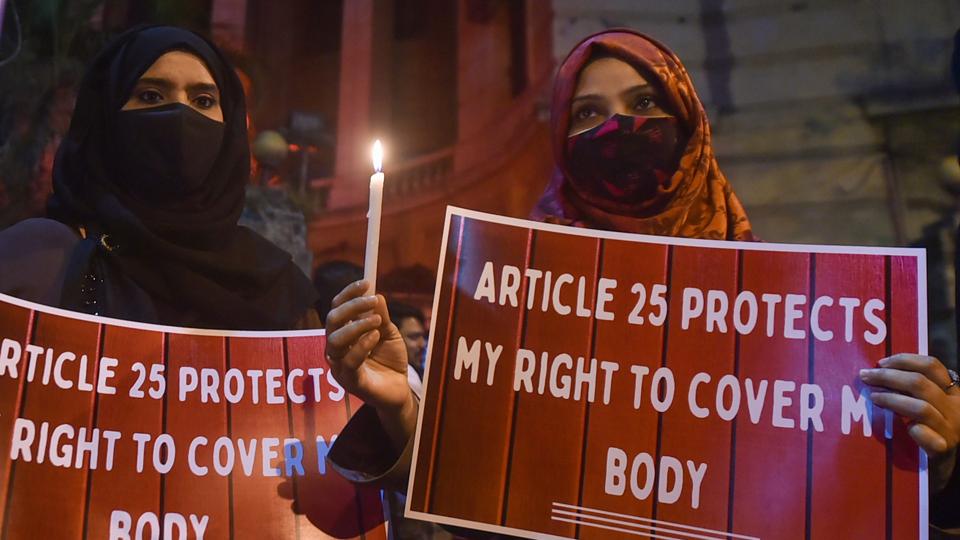
Overnight, young Muslim women students with hijabs have been debarred from colleges. They have been hounded and heckled by frenzied crowds within their college campuses. We have watched groups of students being instrumentally mobilised to create a divisive atmosphere.
Their assertion is plain and simple: "They should look like us if they wish to enter." This desire has metamorphosed into a rule of educational institutions to ban hijabs, and has also been bestowed a sanctity by the government. With parents not permitting the girls to go to college without the hijab and authorities denying them entry because of it, the girls' education has suffered.
A fierce debate rages in response to these troubling developments. However, an aspect that has won less attention and needs to be foregrounded is the necessity of the empowerment of women through unhindered access to education and dignified employment. The unfettered access to such resources by women of all communities is what empowers them to resist patriarchal impositions and diktats.
Evidently then, when women step out to study and work, they become part of the public sphere. With more women stepping out of the realms of family and community, conditions are bred for women to become active agents in the processes of change that can impact their own life and the world around them. It is by being an active part of the public sphere that women increasingly come to desire and hope to effect change within the dynamics of their family and community. Similarly, the separation from the surveillance of community and family that study and work facilitate, as well as the capacity to earn financial self-independence which is bred by unfettered access to the public sphere, is what makes reform a more feasible and realistic aspiration for women.
Unsustainable reforms are precisely those which come as impositions that breed exclusion from the public sphere, close avenues of material uplift, and push women into becoming bearers of inherited community identities and tradition.
Women’s bodies have historically constituted the site for community identity and communal politics — a process linked to religious, social or ethnic groups feeling threatened by and consequently opposed to external forces and dynamics of change. In particular, communal politics has tendentially evolved patriarchal norms for women to follow in the bid to construct and maintain the so-called distinctiveness, sanctity and purity of the community.
Given this longer historical tendency of women’s subsumption by tradition, the last thing we need is its reinforcement whereby women are neither constituted as the object or subject of reform but merely a site for contestation over tradition, religiosity, so on and so forth.
If Muslim women are excluded from education because they choose to wear a hijab, it would be counterproductive as it will further disempower their capacity to resist, contest and transform patriarchal customs, traditions and practices. It is then necessary to assert the fact that women’s right to education is paramount, and that what is at stake cannot be structured by or reduced to the support for or opposition to the hijab.
It is worth noting that as per recent data of the National Statistical Office, 21.9% of young Muslim women (ages 3-35) have never been enrolled in formal education. The Muslim community remains the most educationally backward among all other religious minorities. They recorded the lowest Gross Enrolment Ratio (16.6%) in higher education among all the communities in the country, whereas the national average was 26.3%. Further, Muslim students depend greatly on government institutions (54.1%) as compared to other communities (the national average is 45.2%).
Given such ground realities, it is criminal that instead of devising a robust education policy and enhanced infrastructure to accommodate the hitherto excluded masses into the formal mode of education, the Karnataka government has preoccupied itself with barring women students from their rightful access to educational institutions.
Consequently, the hollowness of impositions like the recent ban on hijabs rings loud and clear, given how quickly they translate into an intensified physical exclusion of Muslim women from education and employment; thereby triggering a downward spiral of disempowerment against patriarchal practices like the hijab.
At both levels then — exclusion from the public sphere and defensive identification with religious beliefs and customs — it is Muslim women who unfortunately stand to lose.
In given circumstances wherein community identity is politically used and existing Muslim identity has come to be significantly shaped by western imperialism, majoritarian politics and patriarchal family, it is ultimately bigotry that wins. Hence, we must recognise that more and more women will be forced to adhere to their community markers as community-based identity politics is let loose.
Let us remember that Muslim society, historically speaking, has never been monolithic. The process of religiosity informing their way of life has been contingent on many factors. Notably, Muslim women have been voicing criticism and dissent against the headscarf; seeing it as a recent encumbrance ushered in by the rise of the Wahabi version of Islam. Tendencies like these demand interventions that truly empower Muslim women instead of pushing them into defensive posturing about their religious identity.
Ultimately, the hijab is only as much a patriarchal imposition as is the ghunghat, sindoor, bindi, or other diktats being imposed on women across communities. Be it women from a majority or minority religious communities, the liberation from such diktats requires access to material resources, which can facilitate their active involvement and investment in transformative reforms. Thus, in no uncertain terms, hijab-abiding students should be allowed to exercise their right to education without any hindrance. Let the women be empowered first, so they can decide how much of themselves they wish to hide.
Maya John is assistant professor, University of Delhi, and a women’s rights activist
The views expressed are personal


