
 E-Paper



Hutong Cat | The relevance of the Brics summit
The Brics summit on June 23 will take place under pulls and pressures, with the Russian invasion of Ukraine, the India-China border standoff, and the economic downturn faced by two bloc members have taken a toll on the internal unity of the bloc.

 Prefer HTon Google


The upcoming Brazil, Russia, India, China, South Africa (Brics) summit on June 23 will take place under unprecedented pulls and pressures. So much so that not much is expected at the end of it. Except rhetoric and a lecture on what real multilateralism is.
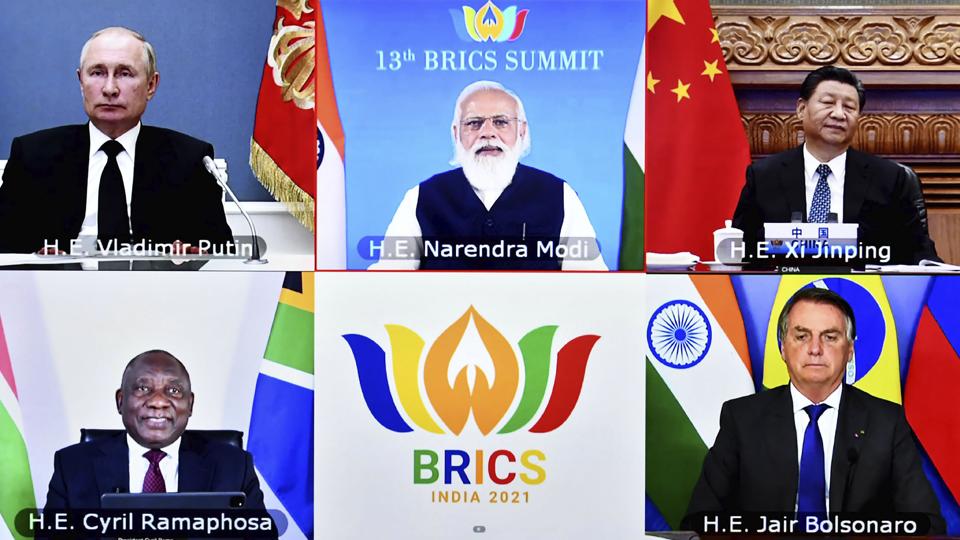
Not sure if it’s showing, but the Russian invasion of Ukraine, the India-China border standoff, and the economic downturn faced by two bloc members have taken a toll on the internal unity of the bloc.
That’s despite the fact that none of the countries condemned Russia’s war on Ukraine, in any manner perceived harsh.
Externally, China-United States (US) strategic confrontation and rivalry are pushing and pulling countries to take sides.
India’s membership of the Quadrilateral Security Dialogue or Quad, for example, hasn’t really pleased China, though Beijing has directed its stringent criticism of the group more towards the US and Australia.
China is especially wary of what it perceives as the military nature of Quad and India’s role in it.
“Of course, the United States, Japan, India and Australia have signed bilateral military logistics support agreements with each other and are stepping up military interoperability cooperation. They are doing it quickly, but they never publicise it publicly. The new marine domain awareness initiative is a dangerous signal,” Liu Zongyi, senior fellow at the South Asia and China Centre (SACC), Shanghai Institutes for International Studies (SIIS), said.
A leading Chinese expert on south Asia told HT about the West's influence on Brics.
“Especially the G7-led western community’s extreme sanctions against Russia… have more or less weakened BRICS to play the regional and global role or function. And, on the other hand, the deep involvement of India into American dominated-multilateral institutions, like QUAD has created more and more misgivings within BRICS,” said Hu Shisheng, director of the Institute for South Asian Studies at the China Institutes of Contemporary International Relation.
Then there is the case of the “accumulated dissatisfaction” with the actual results of the grouping’s decade of operation.
“The accumulated dissatisfaction with the actual results of the grouping’s ten years of operation has also contributed to these trends, since many initiatives remained mere slogans, including the goal to amplify the voice of developing countries and to seek reforms when it comes to institutions of global governance,” Dmitry Razumovsky of the Russian Council of International Affairs recently wrote for the Modern Diplomacy website.
Given this wary background, Chinese President Xi Jinping will chair the 14th Brics online summit on June 23 amid widening contradictions between member countries.
The summit is expected to bring forth Beijing’s calibrated push to expand the bloc to strengthen its own leadership position.
Brazil, Russia, India and China initially formed the bloc in 2009, with South Africa joining in 2010.
But Beijing wants to assume leadership.
It's clear from the words of President Xi Jinping when he said the world needs a new union of states capable of “introducing stability into international relations experiencing an era of radical changes.”
The summit’s theme to “Foster High-quality BRICS Partnership, Usher in a New Era for Global Development,” sounds like an idea straight out of the recent Chinese narrative comprising the twin propositions of the Global Development Initiative (GDI) and the Global Security Initiative (GSI).
There doesn’t seem to be much of a buzz in the diplomatic circles in Beijing about the summit given that it’s an online one where the leadership and diplomats sitting in the respective country’s capital are expected to decide the agenda and the conclusion.
The lack of diplomatic chatter could also be because member countries are aware of the differences within the bloc on global issues.
At the foreign ministers' meeting in May, the dissonance among the members on Ukraine, for example, subtly showed up in the joint declaration.
In the paragraph on the war, the countries limited themselves to “recalling their national positions on the situation” and advocating dialogue between Russia and Ukraine as well as expressing concern about the humanitarian situation in Ukraine.
Given the global situation, not many are expecting more than diplomatic rhetoric on “true multilateralism” and — the Chinese version of — how to work closely together to face a “turbulent” world.
China’s agenda for the summit has been made pretty much clear by its two top diplomats in the run up to the meet.
For one, China clearly wants to expand the group in its first shake up since 2010, and to cement its position by preaching to potential members that Beijing is at the heart of true, global multilateralism.
“China proposes to start the Brics expansion process, explore the criteria and procedures for the expansion, and gradually form a consensus,” Wang Yi, China's state councillor and foreign minister, told an online meeting of Brics foreign ministers in May.
Last month, Beijing invited nine non-Brics countries to attend the group's chancellors' meeting: Saudi Arabia, Argentina, Kazakhstan, Egypt, the United Arab Emirates (UAE), Indonesia, Nigeria, Senegal, and Thailand.
A week ahead of the meet, state-run Xinhua interviewed a Nigerian expert to make him share a view which is likely to be heard again.
“Brics is not an exclusive club for certain countries, but an international mechanism for engagement across the board,” the expert told Xinhua.
China might not get the support from the other members though.
For one, China is not expected to get the Brazilian government's approval for an enlargement at this time.
Brazil supports the dialogue with other countries and “is willing to consider criteria for this engagement to be done in a more institutional and permanent way,” Ana Maria Bierrenbach, general coordinator of Interregional Mechanisms and Brazil's chief sub-negotiator for the BRICS was quoted as saying by Brazilian media recently
It would be the beginning of a dialogue, she pointed out, not the conclusion, she said.
Ahead of the main summit, Yang Jiechi, director of the Office of the Foreign Affairs Commission of the Communist Party of China (CPC) Central Committee, chaired a meeting of the bloc’s security advisors on May 15.
At the meet, Yang talked about China’s new narrative of building the GSI, and how China is ripe to take over global leadership.
Yang said that facing various risks and challenges, the “…GSI put forward by China has contributed Chinese wisdom to solving the current dilemma of global security and provided an important guideline for building a world of lasting peace and universal security.”
Sutirtho Patranobis, HT’s experienced China hand, writes a weekly column from Beijing, exclusively for HT Premium readers. He was previously posted in Colombo, Sri Lanka, where he covered the final phase of the civil war and its aftermath, and was based in Delhi for several years before that
The views expressed are personal


