Before the Bharatiya Janata Party (BJP) captured the Samajwadi Party (SP) bastions Azamgarh and Rampur in the June 2022 by-polls, the party leadership was already working towards winning 70 of the 80 Lok Sabha seats in the 2024 parliamentary elections.
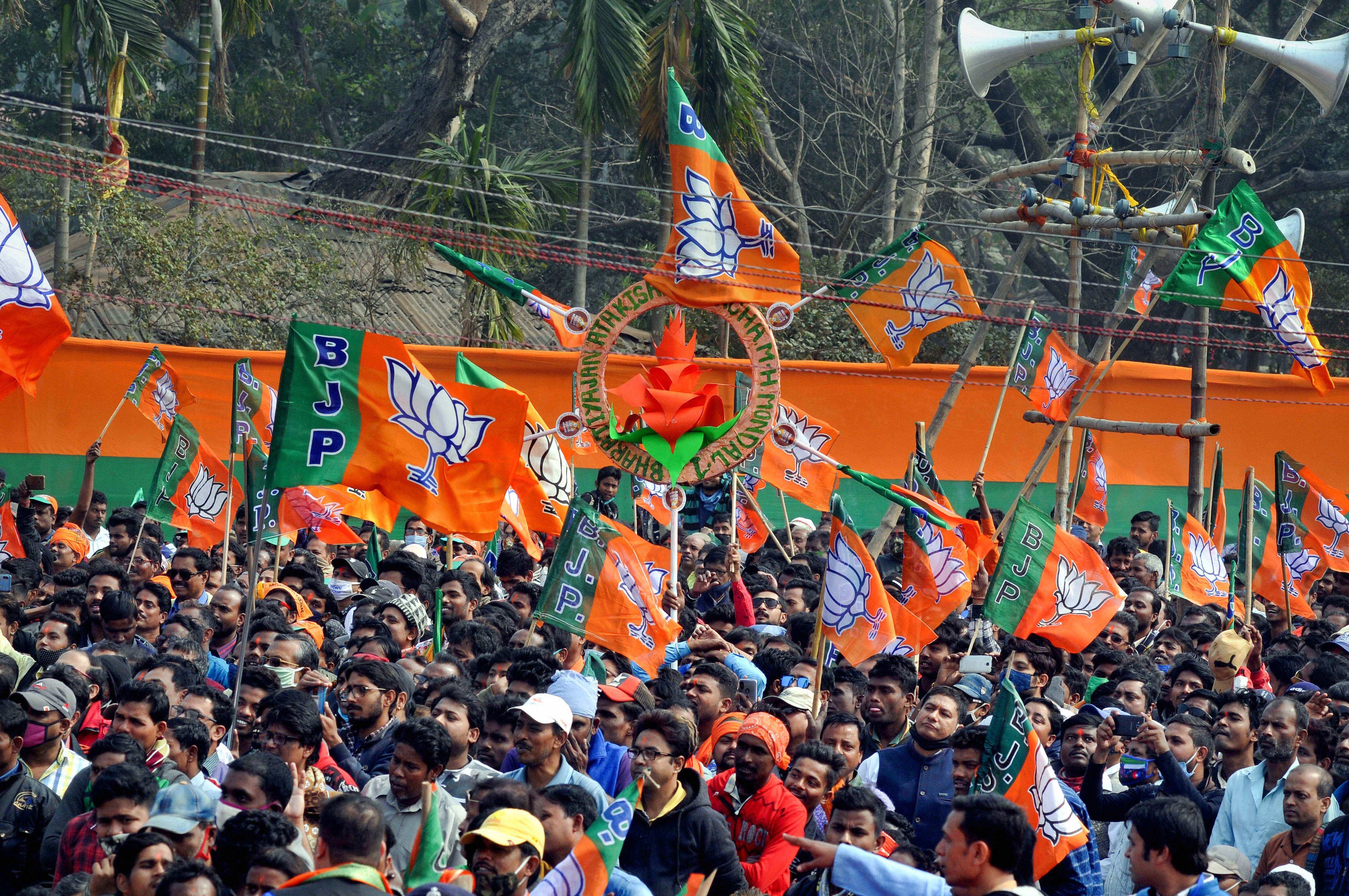
Now, the ambition is greater, to win all 80 seats. This will be Prime Minister Narendra Modi's fifth election in the state after steering the party to resounding victories since 2014, when he first moved from Gujarat to Uttar Pradesh
Before the Bharatiya Janata Party (BJP) captured the Samajwadi Party (SP) bastions Azamgarh and Rampur in the June 2022 by-polls, the party leadership was already working towards winning 70 of the 80 Lok Sabha seats in the 2024 parliamentary elections.
Now, the ambition is greater, to win all 80 seats. This will be Prime Minister Narendra Modi's fifth election in the state after steering the party to resounding victories since 2014, when he first moved from Gujarat to Uttar Pradesh (UP) and adopted Varanasi — the abode of Shiva — as his Lok Sabha constituency.
His magic has not waned since.
The BJP's winning streak
This confidence also stems from the BJP's penetration into once impregnable fortresses.
They first demolished the Gandhis' citadel of Amethi in 2019, and now, the party has hoisted its flag on several SP strongholds. Azamgarh — a Yadav-Muslim-dominated constituency — which was represented by both the founder-president Mulayam Singh Yadav as well as the SP national president Akhilesh Yadav, was also considered a challenging seat, which the BJP has taken from the SP.
To be sure, the BJP partially owed its win to the Bahujan Samaj Party (BSP), which fielded a local Muslim candidate Shah Alam aka Guddu Jamali to cut into the SP’s traditional votes. Supported by the Rashtriya Ulema Council and the All India Majlis-e-Ittehadul Muslimeen (AIMIM), Jamali polled 2.66 lakh votes, while SP nominee Dharmendra Yadav, who secured 3.04 lakh votes, lost to the BJP’s Dinesh Lal Yadav ‘Nirahua’ by a mere 8,679 votes.
Fingers were also pointed at SP president Akhilesh Yadav for not campaigning for his cousin in his own constituency (Akhilesh earlier vacated the seat causing the by-poll), while chief minister Yogi Adityanath and his team addressed a few rallies.
Rampur was the stronghold of SP veteran Azam Khan, who, no doubt, influences elections not only in his home district, but in the entire region. He won the seat in the 2019 Lok Sabha elections, polling over 52% of votes. However, this time, despite the sympathy factor working for him because he spent about two years in jail after the Yogi government slapped about 80 cases against him and his family, nothing worked. The SP lost Rampur as well.
Was it a testament to the government’s performance or a division of Opposition votes that helped the BJP “historic win”? SP spokesman Abdul Hafiz Gandhi had then credited the misuse of official machinery for the loss, especially in Rampur, while a sharp division of votes helped the BJP in Azamgarh.
What the data reveals
The BJP's formula of dividing the SP’s traditional vote bank of Yadav-Muslims may be used again in 2024. In Azamgarh, the BJP had fielded a Yadav and the BSP a Muslim.
Now, let's look at the data.
The BJP won 73 seats in 2014 and 64 in the 2019 Lok Sabha elections in UP. It won 312 assembly seats in 2017 and 255 in 2022 in the assembly elections to the 403-member Vidhan Sabha. Yogi also set a record by winning a second consecutive term, the last won by CM Sampurnanand in 1957.
The seats declined, but the voting percentage rose with the BJP polling 42.30% votes in 2014, 39.67% in 2017, 49.98% in 2019 and 41.29% in 2022. What worries them is not the decline in seats between 2019 and 2022, but the rise of SP votes from 21.28% to 32.06% in the same period.
Opposition in total disarray
The BJP leadership is also not satisfied with simply retaining its 2019 tally. It wants an “Opposition-mukt UP” and has thus galvanised the party functionaries, including former ministers and office bearers into action. The ministers are out on the field for the second review of government schemes with the CM and the deputy CMs covering 25 districts each, over and above the review by the group of ministers in their allocated divisions.
As of now, the Opposition is in complete disarray. The Congress is facing the worst-ever existential crisis in UP — the party had won two assembly seats, which does not account for one half of a Lok Sabha seat (each Parliament seat has five assembly segments). Bahujan Samaj Party chief Mayawati has been inactive and her campaigns have lost the fizz. Political experts believe she is more affable to the BJP than the SP.
The SP has not as yet recovered from the BJP’s onslaught in 2022, dashing their dream of returning to power. The main challenge for Akhilesh is to allay the cadre’s apprehension of vindictive action to keep their morale high. Muslims demand succour, but Yogi may not oblige. While many who are pinning their hopes on Akhilesh in an ideological battle want him to take to the streets, he has launched a membership drive and is hopping to places to visit party leaders and workers.
Moreover, the social coalition that he had built ahead of the 2022 assembly polls has weakened, with Om Prakash Rajbhar of the Suheldev Bharatiya Samaj Party ending the alliance, and estranged uncle Shivpal Singh Yadav's Pragatisheel Samajwadi Party (PSP) finally parting ways.
Om Prakash Rajbhar is hunting for an ally and many believe he, along with Shivpal, may form a front, which may eventually ally with the BSP.
What the BJP wants
The BJP would want the BSP to gain strength. Commenting on the 2022 assembly election results, a senior leader had said, “We thought the BSP would do better but it completely tanked. The bi-polar elections helped the SP as it independently gained 32%, the highest since its inception.”
The BJP is also not content with just a favourable political climate and the popularity of its double-engine government, as the leadership knows it won’t be enough to achieve the target of 80/80. The SP-RLD stands at 119 combined seats — roughly 24 Lok Sabha seats. Though elections are not pure arithmetic, the BJP high command does reckon with the SP’s strength in a bi-polar election.
An ambitious BJP plan
Thus, it has launched a multi-pronged strategy. First, isolate the SP, force a multi-cornered contest to divide the anti-BJP vote — a practice all ruling parties have deployed in the past to weaken their main opponent — and galvanise the BJP organisation at the booth level, reach out to the beneficiaries of government schemes and so on.
Ironically, the infighting within the Opposition camp is so intense that instead of coming together on one platform to take on the mighty BJP, they are harming each other.
Interestingly Mayawati, who has been focusing on the Brahmin-Dalit combination has now directed her attention to Muslim mobilisation. Shivpal, too, is talking about the Yadav-Muslim combination though confined to a few pockets. The BJP is trying to lure the Pasmanda Muslims, the backwards and poorest among the minorities, believing the government schemes will hold an allure more than ideology. They are also wooing the Yadavs. The PM himself attended the death anniversary of the community's tallest leader Harmohan Singh Yadav in Kannauj last month.
Any other political party, after winning the toughest state of UP for the second consecutive term and the CM retaining his seat, would have either remained in a mood of extended celebration or become complacent. But the BJP — in its endeavour to create yet another record — has now on overdrive. If one can read the BJP’s game plan correctly, it is out to contest elections on three issues — Modi’s magic, TINA (there is no alternative) factor, and a vote for nationalism in a multi-cornered contest.
Every seat and every candidate will be evaluated. It is no coincidence that the BSP often distributes tickets to undercut the SP under the formula “either win the seat or defeat the SP”. That’s the perception in the political quarters, though Mayawati insists she is guided by her own winning plans. The AIMIM is also out to damage the SP just as Chandrashekhar of the Bhim Army is cutting into the BSP’s votes.
With such a sharply divided Opposition, cramped with leaders locked in unresolved battles, the BJP doesn't have much to worry about, except meeting its ambitious target. No party has ever won 80/80 seats in UP.
From her perch in Lucknow, HT’s resident editor Sunita Aron highlights important issues related to the elections in Uttar Pradesh
The views expressed are personal
One Subscription.
Get 360° coverage—from daily headlines
to 100 year archives.
Archives
HT App & Website