I write today as a parent to two Generation Z (Gen Z) individuals, as a witness to the current protests, somewhat cognizant of the challenges facing this generation across the world. Never before in human civilisation have the young been so informed, so early, and in real time, of the events unfolding across the globe. This is the content waterfall generation, a generation that has social communication networks available beyond the traditional worlds of school, home and family. Gen Z is growing up in a world where information arrives continually, global events enter personal spaces instantly, and they are not so much observers of history, but rather participants in its unfolding. Ironically this unprecedented connectivity has also created a world where performance can easily masquerade as participation. The stage for this generation is thus global, their audience is permanent through players self-appointed. In this age, for my generation, within the echoes of the noise of constant visibility lies a far more serious responsibility: the business of parenting and raising the future citizens of India.
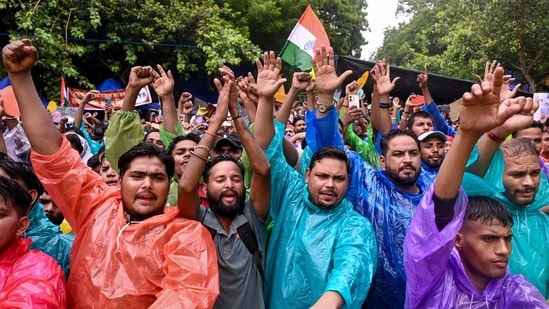
It is against this background that I view the student protests underway in the country today.
At their core is a generation asking for accountability. From us, their parents. From the stakeholders responsible for their education. From the testing agencies, the ministries that supervise them, and ultimately from India itself. There are many arguments in the public sphere, yet I find myself asking a simpler question: When did asking for accountability begin to be treated in our society as an attack on our values?
We are also a society where children are universally viewed as blessings. Yet, my mind struggles to reconcile these two truths with images of young people facing police action and institutional dismissal. Every minute, hundreds of young people are finding ways to disseminate their message in an increasingly fractured landscape. This generation of young Indians has found a way to remain Gandhian in a manner that makes the parent in me weep when I see images of young people standing before lathis, choosing to absorb violence while refusing to abandon their demands. And, in the very next moment, I find myself smiling at their ingenuity and their ability to find humour in adversity. Where else in the world have young protestors spontaneously broken into a national anthem to create a moment of pause, in the face of confrontation? That moment represents more than a tactic. It represents an instinctive understanding of protest, patriotism and non-violence. Gen Z demonstrates creativity in adversity, dignity under pressure and yet refuses hatred while challenging authority — a masterclass my generation would do well to consider.
{{/usCountry}}We are also a society where children are universally viewed as blessings. Yet, my mind struggles to reconcile these two truths with images of young people facing police action and institutional dismissal. Every minute, hundreds of young people are finding ways to disseminate their message in an increasingly fractured landscape. This generation of young Indians has found a way to remain Gandhian in a manner that makes the parent in me weep when I see images of young people standing before lathis, choosing to absorb violence while refusing to abandon their demands. And, in the very next moment, I find myself smiling at their ingenuity and their ability to find humour in adversity. Where else in the world have young protestors spontaneously broken into a national anthem to create a moment of pause, in the face of confrontation? That moment represents more than a tactic. It represents an instinctive understanding of protest, patriotism and non-violence. Gen Z demonstrates creativity in adversity, dignity under pressure and yet refuses hatred while challenging authority — a masterclass my generation would do well to consider.
{{/usCountry}}But perhaps what pains me most is my generation’s inability to accept the reflection that Gen Z has held up before us. My generation’s narrative is filled with armchair theorising. We question their choices, while rarely examining the circumstances that have shaped those choices. As if wanting to repair what is broken is unnatural. The arguments often center around culture, even though Indian culture itself has been shaped by those who questioned, challenged and reimagined society. From Adi Shankaracharya to Guru Nanak, our civilisation has been defined not by unquestioning acceptance, but evolved through dialogue. The arguments center around young people being misguided, as if every young person owes society the impossible responsibility of arriving at wisdom independently from childhood. The arguments center around unrest, even when the demand being articulated is not destruction but accountability. Perhaps the most revealing argument is the claim that toppers should not waste their time participating in protests. It suggests that a student's concern requires the legitimacy of a prestigious degree certificate or an impressive rank before it deserves to be heard. But citizenship is not a privilege reserved for the successful. A young person's right to question a system that affects their future does not depend upon marks, rankings or institutional recognition. Accountability is not something granted only to achievers.
Open any financial newspaper and one will repeatedly encounter the phrase that India’s greatest strength lies in its demographic dividend. Unlike ageing developed economies, India possesses the advantage of a young population that is expected to power the country’s economic and social future. However a demographic dividend is not merely a statistic. It is a responsibility. It is a promise that a nation makes to its young people: to educate them, to protect them, to listen to them and to create institutions worthy of their aspirations. How then do we justify turning against the very advantage that we so passionately celebrate? How do we imagine India will find its place in the global order, if we cannot engage in meaningful dialogue with the generation that is meant to carry that future forward? Why does my generation of parents feel so threatened by the possibility that the young may have something to teach us?
The young have always been the change makers. Every generation that has expanded freedom, challenged injustice or reimagined society has first been viewed with suspicion by those who came before it. The ideas that later become accepted wisdom often begin as uncomfortable questions. Why, then, have we decided that questioning itself is a problem?
Are we so consumed by the anxieties of our own time that we have lost the ability to listen? Are we so invested in preserving the systems that shaped us that we cannot recognise when those systems are failing those who come after us?
Also Read: Who is Rhiya Ahir? Woman who broke internet by blocking police van at Mumbai CJP protest
History teaches us that societies do not progress because they successfully prevent change. They progress because they learn how to respond to it with wisdom. The question before us is not whether Gen Z is demanding too much.
The question is whether we, the generations before them, are demanding too little of ourselves. A nation cannot celebrate its young people when they succeed and dismiss them when they question. It cannot speak endlessly of demographic advantage while treating young citizens as a problem when they ask institutions to do better. The least we owe our children is not agreement with every demand they make. The least we owe them is the humility to listen before we judge, to engage before we dismiss, and to understand that those who ask for change are not always challenging society.
Sometimes, they are the ones trying to save it.
(This is a Hindustan Times digital exclusive)
Talish Ray is an advocate and partner, TRS law offices, New Delhi. The views expressed are personal