Military aviation is at an inflexion point. Recent wars — Armenia-Azerbaijan, Russia-Ukraine — have revolutionised warfare through the extensive use of unmanned aerial vehicles (UAVs) and brought into question the relevance of the manned fighter. Elon Musk told a US Air Force Symposium in February 2020, “The fighter jet era has passed.” The statement created waves worldwide, but was premature then, and now.
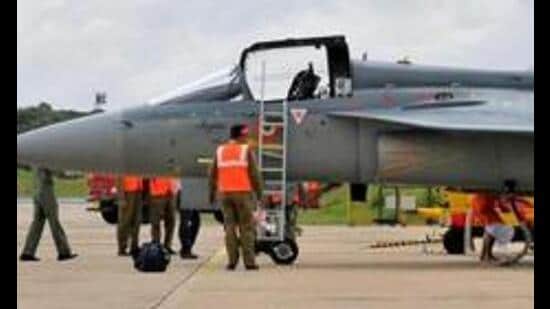
In India, the Indian Air Force’s offensive element will remain Delhi’s main deterrent weapon and, as a corollary, the Hindustan Aeronautics Ltd (HAL), being its main equipper, will remain vitally important. It is imperative that the government doubles down to make HAL deliver to prevent India’s air power from losing its operational bite. A few suggestions are offered here.
“IAF needs fighter aircraft urgently” now draws yawns. The revelation of J-36 by China and Pentagon’s sanction for F-47, both sixth generation fighters, is further proof that manned aviation is here to stay. So, with the IAF placing all its trust in HAL’s Tejas Mk1A, Mk2 and the Advanced Medium Combat Aircraft for the next four decades, its efficiency is critical. HAL needs to become a real maharatna — and not remain bureaucratically decorated as such. It needs to be made a more focussed company, by a structural reorganisation so that it becomes an efficient integrator, which all major aircraft manufacturers in the world actually are.
Organisationally, HAL has four ‘Complexes’: the Bengaluru complex, the MiG complex, the Accessories complex and the Helicopter Complex. These are further divided into 20 divisions and comprise production, overhaul and service sub-divisions.
{{/usCountry}}Organisationally, HAL has four ‘Complexes’: the Bengaluru complex, the MiG complex, the Accessories complex and the Helicopter Complex. These are further divided into 20 divisions and comprise production, overhaul and service sub-divisions.
{{/usCountry}}Within the complexes are 10 R&D centres catering to various specialties.
HAL is also a partner in 19 Joint Venture Companies with Indian and foreign vendors (UK, France, Russia, Israel, Canada) for items ranging from manufacturing aero engines and their overhaul to running a helicopter simulator, developing software, etc.
Then, there are the subsidiaries such as a helicopter training academy and a management academy offering PG diplomas in aviation management and production management.
HAL’s activities are veritable maze vis-à-vis the one-line task it should be performing: “Timely production of aviation assets for India’s armed forces”. Just as the inefficient Ordnance Factory Board was divided into seven corporate entities, can some major divisions of HAL be excised, corporatised and/or privatised to augment efficiency? For example, no aircraft manufacturer in the world makes its own engines; however, HAL not only has separate engine divisions for aircraft and helicopters but also has independent R&D centres for them. Can engine divisions be made separate corporate/private entities? Can money and intellectual capital be optimally utilised by merging HAL’s engine R&D centres and DRDO’s Gas Turbine and Research Establishment (struggling to make a fighter engine for decades) to form one entity with a focussed outlook? Similarly, HAL has an Aircraft Research and Design Centre in Bengaluru while, DRDO’s Aeronautical Development Agency (ADA), which is designing the Tejas and AMCA, is literally next door. Shouldn’t the two be merged to streamline R&D activity?
The above examples are but a snapshot of the need for a holistic review of the replication of tasks being done by a multitude of aeronautical bodies of different government departments that have spawned over time – HAL (DPSU), DRDO’s labs ADA, ADE, CABS, DEBEL et al, CSIR’s National Aeronautics Laboratory (NAL). The list is endless. Throw a stone near the old airfield in Bengaluru, and nine times out of ten, it will hit an aviation entity. And there are countless others in Hyderabad, Lucknow, Nashik, and Koraput among other cities and towns. HAL makes transport aircraft while NAL (under the department of science & technology) is also developing a light transport aircraft, implying that it also has a full-fledged aircraft design and flight test centre. Again, this is next door to HAL and ADA. Meanwhile, everyone (both public and private sector) seems to be having a go at making UAVs, without an overarching national vision of how this potent weapon system needs to be developed for the armed forces.
The aeronautical sector needs reorganisation. The government must institute a time-bound review by a high-powered body to channelise public expenditure and effort by examining the extraneous activities of HAL and rationalising independent, but similar, projects of multiple government agencies engaged in aeronautical programmes. This will ensure a cogent and focussed path to self-reliance in military aviation.
Post script: The IAF, which is the raison d’etre for HAL, is not represented on its Board of Directors — a serious anomaly that needs immediate correction.
Manmohan Bahadur is a retired Air Vice Marshal of the Indian Air Force. The views expressed are personal