The last Engender column looked at how community radio proved transformative for women’s lives in Jhabua, Madhya Pradesh. Community radio has been no less transformative in Haryana’s Birsika village. The village’s anganwadi was run by a woman from another village who routinely diverted rations meant for pregnant women and children to her own private school. But, backed by Radio Mewat, six women from the Hinsa Ko No group summoned the police and put paid to this pilfering. This ensured that the anganwadi started working again.
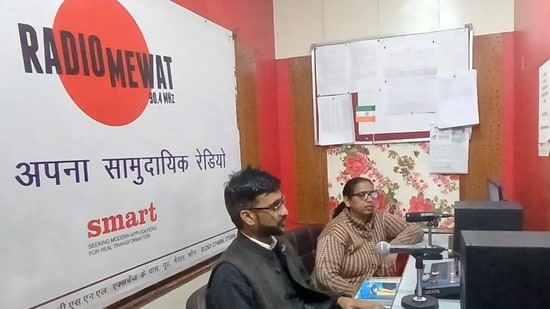
Radio Mewat was piloted in 2018 to familiarise women with the Domestic Violence Act (DVA) 2005. A survey across 10 villages revealed that nearly every household had a case to report, but women remained silent due to shame, fear, and the risk of social ostracism. In Nuh, most girls are married within the region, often to near or distant relatives. In such contexts, reporting violence jeopardises relationships across households, forcing silence.
Despite the DVA being in force since 2005, awareness of rights among women in Nuh district remained extremely low. Many women did not even recognise everyday abuse as violence. Access to formal support systems was limited, and trust in institutions was weak.
In 2019, with support from the Azim Premji Foundation, Seeking Modern Applications for Real Transformation (SMART), the NGO that runs Radio Mewat, mounted an on-ground intervention in 25 villages in Nuh. Groups of women aged 18-40 were formed. These groups became safe spaces for discussing rights, sharing experiences, and building collective confidence. Radio programmes were heard during narrow casts and discussions facilitated by the Radio Mewat team.
The intervention included training local media, police, ASHA workers and other stakeholders -- facilitating turning awareness into action. Najma from Nangli village says, “My husband used to torture me, and I endured it for my daughter. One day, he brought another woman home. I came to my parents’ home, lost and directionless. Then I heard the Hinsa Ko No programme on the radio and approached Radio Mewat. They helped me register my case and supported me throughout the process. Today, I run a small cosmetics shop to support myself and my child.”
{{/usCountry}}The intervention included training local media, police, ASHA workers and other stakeholders -- facilitating turning awareness into action. Najma from Nangli village says, “My husband used to torture me, and I endured it for my daughter. One day, he brought another woman home. I came to my parents’ home, lost and directionless. Then I heard the Hinsa Ko No programme on the radio and approached Radio Mewat. They helped me register my case and supported me throughout the process. Today, I run a small cosmetics shop to support myself and my child.”
{{/usCountry}}A community radio is run by the locals, speaks to the community in its language, and allows women to share, even anonymously if needed. Neeru from Kurthala village says, “Through Radio Mewat’s women’s group, I found my voice, my confidence, and my courage. Today, I can boldly say no to violence, not just for myself, but for other women in my community.”
Hinsa ko No, which received 590 cases at the station itself, has been an extraordinary intervention. Information on domestic violence, rights and DVA provisions have reached more than 6,000 households in the villages where Radio Mewat has formed groups.
Through 22 community radio stations in Odisha, Chhattisgarh, Madhya Pradesh, Bihar, Rajasthan, Uttar Pradesh, Uttarakhand, Himachal Pradesh, and Haryana, the initiative has supported more than 2,000 domestic violence survivors. Archana Kapoor, who heads SMART, says, “I think the time has come to look at community radio as civic infrastructure rather than an information dissemination. If we are serious about improving our social indicators, then community radio can play a pivotal role.”
Community radio’s impact is visible in health, education, nutrition, WASH, climate action and agriculture. What community radios lack is funding. It is high time that state governments explore its potential.
The views expressed are personal