While hosting Indonesia’s President Prabowo Subianto at this year’s Republic Day, Prime Minister Modi announced that India will help conserve yet unrestored parts of the Prambanan temple complex in Java. This is an example of India’s heritage diplomacy, a soft power tool centred around archaeology and conservation initiatives abroad. In the last decade alone, the Ministry of External Affairs (MEA) has invested in at least 20 heritage projects across eleven countries, including 14 managed by the Archaeological Survey of India (ASI).
There are several reasons why India invests in such heritage projects abroad. As part of bilateral cultural, scientific and development partnerships, they promote a country’s international image and help catalyse tourism and economic ties. Yet the most important driver for conservation or restoration initiatives abroad is often found domestically, as people seek validation for narratives that revive their States’ past grandeur and civilisational identity.
MEA and ASI have started catering to a growing domestic demand for evidence of India’s past glory and regional influence. When ASI excavates to search for Bharat abroad, it helps restore a sense of self at home. For example, in 2020, when a 1,100-year-old Shiva lingam was found in Vietnam, external affairs minister S Jaishankar cast the discovery as “reaffirming a civilisational connect”.
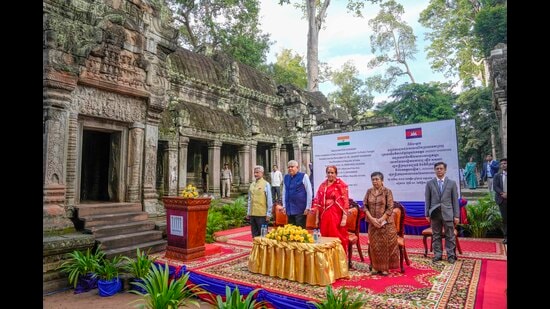
Our recent study of India’s heritage diplomacy projects since 2014 indicates that they typically follow one of two models after receiving MEA funding. In the first model, ASI leads implementation, often alongside local government organisations. Especially across South and Southeast Asia, ASI has been conserving Ta Prohm temple complex, Asram Maha Rosei temple, Preah Vihear temple complex, and Wat Raja Bo pagoda in Cambodia, Vat Phou temple complex in Lao PDR, and My Son sanctuary in Vietnam. Indian conservation has also been at work at the Hukuru Miskiy (Friday Mosque) in Maldives, the Ananda temple and Bagan pagodas in Myanmar, and the Thiruketeeswaram temple in Sri Lanka. In the last decade, the ASI also surveyed at Pashupatinath temple in Nepal, Ancient Termiz in Uzbekistan, and Dong Duong monastery and Nhan tower in Vietnam.
{{/usCountry}}Our recent study of India’s heritage diplomacy projects since 2014 indicates that they typically follow one of two models after receiving MEA funding. In the first model, ASI leads implementation, often alongside local government organisations. Especially across South and Southeast Asia, ASI has been conserving Ta Prohm temple complex, Asram Maha Rosei temple, Preah Vihear temple complex, and Wat Raja Bo pagoda in Cambodia, Vat Phou temple complex in Lao PDR, and My Son sanctuary in Vietnam. Indian conservation has also been at work at the Hukuru Miskiy (Friday Mosque) in Maldives, the Ananda temple and Bagan pagodas in Myanmar, and the Thiruketeeswaram temple in Sri Lanka. In the last decade, the ASI also surveyed at Pashupatinath temple in Nepal, Ancient Termiz in Uzbekistan, and Dong Duong monastery and Nhan tower in Vietnam.
{{/usCountry}}In the second model, implementation occurs through MEA grant assistance and is managed by host governments, sometimes with Indian or international NGO partners. Since 2014, MEA has funded initiatives in five countries. In Afghanistan, it funded the restoration of Stor palace by the Aga Khan Trust for Culture (AKTC). In Bolivia, it funded the illumination of the Tiwanaku archaeological site. In Maldives, MEA funded the renovation of a pre-Islamic heritage museum at the Maabadhige archaeological site and the conservation of Dhiyamigili Ganduvaru palace by the government and private contractors. And in Mali, it contributed cash for the revival of the World Heritage Site at Timbuktu. Finally, in Nepal, it funded the construction of a dharmashala and sanitation facilities at Pashupatinath temple by the Pashupati Area Development Trust (PADT). After the 2015 earthquake, MEA also funded the conservation and renovation of 28 cultural heritage sites in Nepal by the government, of which 12 were overseen by a partner NGO, the Indian National Trust for Arts and Cultural Heritage (Intach).
With more interest at home in such investments abroad, three challenges stand out. First, both the MEA and the ASI will require more capacity to plan, implement, and sustain these projects. One positive step was the creation, in 2020, of an MEA division within the Development Partnership Administration (DPA) exclusively tasked with heritage, conservation, and restoration projects abroad.
Another significant challenge will be allocating sufficient funds under the meagre MEA budget to ensure appropriate technical expertise and resources to start new projects that benefit local communities. Here, ASI could deepen engagement with Indian NGOs that have an excellent track record in heritage conservation and international research collaborations.
Finally, the private sector plays a vital yet underrated role to ensure that India’s excavations abroad are valued through a creative economy. There is a large market waiting to be explored by India’s cultural entrepreneurs, whether by enabling new tourism circuits or by skilling and reviving local arts and crafts connected to India.
India has the potential to play a role in global heritage diplomacy. This is not just about excavating abroad to cater to popular ideas and ambitions at home. China’s Global Civilization Initiative shows how history and archaeology are being leveraged for international influence, including at multilateral bodies such as Unesco. New Delhi will have to invest more resources to play this game better.
Constantino Xavier is a New Delhi-based foreign policy researcher and Aleksandr Kuzmenchuk a former Fulbright-Nehru scholar at Ashoka University. The views expressed are personal.