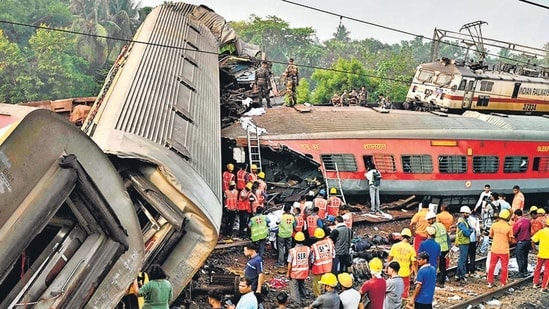
The railway tragedy in Odisha sparked much commentary about the state of safety in the Indian Railways (IR). A historical perspective might help place the accident in context.
Given the importance of the IR in India’s national life, its functioning has always been a major concern. And since accidents have not been infrequent, the issue has received much attention over the years. For instance, an average of 150 questions related to railway accidents were raised in the Rajya Sabha annually
The railway tragedy in Odisha sparked much commentary about the state of safety in the Indian Railways (IR). A historical perspective might help place the accident in context.
Given the importance of the IR in India’s national life, its functioning has always been a major concern. And since accidents have not been infrequent, the issue has received much attention over the years. For instance, an average of 150 questions related to railway accidents were raised in the Rajya Sabha annually each year over seven decades. Virtually every decade, a new committee was appointed to examine the issue and recommend changes, often in the aftermath of major disasters. Examples include the Railway Accidents Inquiry committee (1954); the Railway Accidents Committee (Kunzru Committee, 1962); the Railway Accidents Inquiry Committee (Wanchoo Committee, 1968); the Railway Accidents Enquiry Committee (Sikri Committee, 1978); the Railway Safety Review Committee (Khanna Committee, 1999, 2001); High Level Safety Review Committee (Kakodkar Committee, 2012). In addition, the standing committee on Railways in the Lok Sabha looked into this matter frequently.
After independence, the IR was in poor shape, partly because of underinvestment due to World War II and disruptions caused by Partition. A series of accidents in 1953-54 led to the formation of the Railway Accidents Inquiry committee of 1954. Besides human casualties, the damage to the IR property and equipment was also a matter of serious concern. The committee concluded that train accidents were due “mainly by the failure of station and train staff to follow the prescribed rules and by flaw in metal design of rolling stock.”
But there was another reality. National investment priorities on public enterprises starved the IR of much-needed funds for track renewal, replacing and augmenting ageing rolling stock and modernising signalling. As a parliamentary committee was informed in 1956, “In this country, the employment situation and the need for conserving foreign exchange (as all the track relaying and handling equipment is manufactured abroad) does not permit a change over from manual to mechanical methods.”
Between 1957-58 and 1962-63, there were more than five accidents a day: Nearly four derailments a day; a train collision roughly every three days; roughly three accidents a week at level crossings, and almost one fire daily in trains. Following three serious accidents in 1961, another committee submitted a report in 1963, making 377 recommendations. It, too, came to the conclusion that the majority of the accidents were due to human failure of some kind or other, and emphasised the need for better recruitment training and continuous safety drive and refresher courses.
Matters improved in the 1960s with accidents dropping by about a third. But even then, there was an average of a collision every five days and nearly three derailments a day. With growing traffic, accidents per million train kilometres declined by half. But a further spate of accidents in 1968 led to two new reports. While there were gradual improvements in safety, the early 1980s again saw a spate of accidents. A major new report in 1982 concluded by emphasising “the seriousness of the situation in relation to the arrear of renewal and replacement that has been building up.” The populism of introducing new passenger trains every budget, keeping passenger fares artificially low, all within constrained budgets, led to the inevitable neglect of essential capital expenditure.
The late 1990s saw a spurt of accidents, leading to the Khanna Committee, which made 278 recommendations in reports submitted in 1999 and 2001. After another series of train disasters in 2010-11, the Kakodkar Committee Report of 2012 bluntly stated that the “[p]resent environment on Indian Railways reveals a grim picture of inadequate performance largely due to poor infrastructure and resources and lack of empowerment at the functional level…The financial state of Indian Railways is at the brink of collapse unless some concrete measures are taken.”
When examining railways accidents, the sheer size and complexity of the system—rolling stock exceeding 400,000, more than 13,000 engines and 1.2 million personnel — and massive growth over the past seven decades (nine-fold in passenger traffic, 14 fold in freight traffic, but a system where track length has expanded by just three-fourths), needs to be kept in mind. While in this heated moment, it may not be apparent, over the last seven decades, there has been a steady decline in railway accidents across all four categories of accidents – collisions, derailments, accidents at level crossings and fires in trains. Collisions and serious fires have become a rarity and derailments have decreased. The number of accidents has plunged 100 fold, from 5.5 per million train km in 1960-61 to 0.05 in 2018-19. It should, therefore, not be surprising that the number of casualties in train accidents has also declined by almost an order of magnitude per million passengers carried.
Human nature is such that catastrophes such as plane crashes or train collisions generate powerful emotions that stay with us. We tend to overestimate the odds of dreadful but infrequent events and underestimate the risks of quotidian events such as road accidents. In 2010-2019, more than 1.4 million people died in road accidents, leaving India with the dubious distinction of having the highest number of road accident fatalities. According to the National Crime Records Bureau, in 2021, there were 15,866 deaths in railway accidents and 153,972 in road accidents. Importantly, the vast majority of deaths in railway accidents were people crossing railway tracks, falling from overcrowded trains, as is the case in Mumbai daily. Less than one percent of deaths were due to collisions or derailments.
Safety is the orphan child of public policy. Just as highways get so much more attention than rigorous training requirements for a driver’s licence, more trains, fancier coaches and stations, and low fares get much more attention than the hard grind of safety inspections, training, constantly upgrading equipment and so on. For instance, it has taken decades but the gradual elimination of all unmanned level crossings on the broad-gauge network has removed a major cause of accidents. Clearly, there has been learning in the system, including careful inquiries into all major accidents.
An important institutional innovation going back to 1940 was to place the body charged with holding inquiries into causes of railway accidents — the Commission of Railway Safety — independent of the railway board and put it under the administrative control of a different ministry (first in the department of posts and air, then under the ministry of transport and communications, and from 1967, under the ministry of civil aviation). Putting a politicised Central Bureau of Investigation to look into the Balasore accident, rather than the institution with the mandate and knowledge, is rubbing salt into a grievous wound. Those who do not want to learn from mistakes are bound to repeat them.
Devesh Kapur is Starr Foundation Professor of South Asian Studies at the School of Advanced International Studies at Johns Hopkins University. The views expressed are personal.
One Subscription.
Get 360° coverage—from daily headlines
to 100 year archives.
Archives
HT App & Website