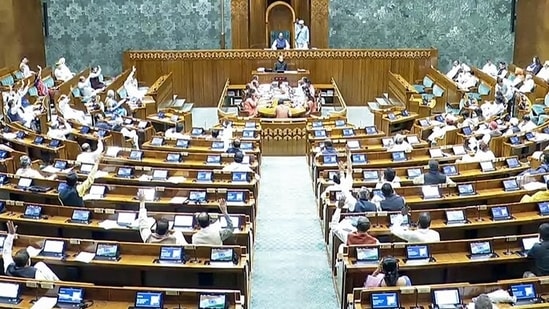
India is on the verge of its most significant electoral reform in five decades, and the politics have arrived well before the facts. The Modi government's April 2026 delimitation package proposes expanding the Lok Sabha from 543 to around 850 seats, protecting southern states' absolute seat count, operationalising 33 percent women's reservation by 2029, and establishing a new Delimitation Commission chaired by a Supreme Court judge.
The political response was swift. Tamil Nadu CM MK Stalin warned of protests. Telangana CM Revanth Reddy called it a death knell for federalism. The message across platforms has been uniform: South India governed responsibly, controlled its population, and is now being penalised for it. That narrative is powerful. It collapses the moment one examines the actual proposal.
The most damaging counter to the opposition's position comes from its own alternative. Congress has argued that delimitation must use current population data. Taken to its logical conclusion, that formula is catastrophic for the South. If Lok Sabha seats were redistributed proportionally on current population within the existing 543-seat House, Andhra Pradesh would fall from 25 to 21 seats.
Kerala from 20 to 14. Tamil Nadu from 39 to 30. Karnataka from 28 to 27. Telangana from 17 to 15. That is a combined loss of over 25 Lok Sabha seats for southern states. The BJP model, by contrast, uses 2011 Census data, expands the House to 850 seats, and explicitly guarantees no southern state loses seats in absolute terms. Applying the 50 percent expansion uniformly, the five southern states along with Puducherry, Andaman and Nicobar Islands, and Lakshadweep move from a combined 132 seats to approximately 198. The party accused of punishing the South has structurally protected and expanded its representation. The party claiming to defend southern interests is advancing a formula that would strip it of over a quarter of its parliamentary strength.
The constitutional basis for this reform is equally straightforward. Article 81 defines the Lok Sabha as the House of the People, with population-to-seat ratios kept as uniform as practicable. Article 80 creates the Rajya Sabha as the Council of States, designed to reflect the federal principle. The Constitution deliberately separated these functions: equal citizenship in the lower house, federal balance in the upper house. If the Lok Sabha is weighted to favour lower-population states, both chambers collapse into the same purpose, and the people's House stops representing people equally. This is not interpretation. It is what the text requires. Every serious federal democracy revisits this periodically. The United States reapportions its House of Representatives every ten years. Germany recalculates Bundestag seats after each federal census. Canada redistricts every decade through an independent commission, managing genuine federal tensions without freezing democratic arithmetic indefinitely. India has deferred this correction for 55 years.
{{/usCountry}}The constitutional basis for this reform is equally straightforward. Article 81 defines the Lok Sabha as the House of the People, with population-to-seat ratios kept as uniform as practicable. Article 80 creates the Rajya Sabha as the Council of States, designed to reflect the federal principle. The Constitution deliberately separated these functions: equal citizenship in the lower house, federal balance in the upper house. If the Lok Sabha is weighted to favour lower-population states, both chambers collapse into the same purpose, and the people's House stops representing people equally. This is not interpretation. It is what the text requires. Every serious federal democracy revisits this periodically. The United States reapportions its House of Representatives every ten years. Germany recalculates Bundestag seats after each federal census. Canada redistricts every decade through an independent commission, managing genuine federal tensions without freezing democratic arithmetic indefinitely. India has deferred this correction for 55 years.
{{/usCountry}}The delimitation exercise is, at its core, a meaningful correction of democratic proportionality, and the per-voter arithmetic illustrates precisely how. Uttar Pradesh currently holds 80 Lok Sabha seats for a 2011 population of approximately 19.98 crore, meaning one MP represents roughly 24.98 lakh citizens. Under the 50 percent expansion model, UP rises to approximately 120 seats, bringing that ratio down to 16.65 lakh citizens per MP. Kerala, moving from 20 to 30 seats, improves from 16.70 lakh to 11.14 lakh per MP. The democratic gap between a voter in Gorakhpur and a voter in Thiruvananthapuram, currently 8.27 lakh citizens per MP, narrows by a third. That is not full proportional equality. But after 55 years of a frozen system, it is a substantial and overdue correction that moves India closer to the constitutional ideal without penalising any single state.
The electoral fear that northern states will simply outvote the South deserves a direct answer, and the arithmetic dismantles it. A majority in an 850-seat Lok Sabha requires 426 seats. Southern states at approximately 198 seats represent a bloc no national formation can treat as dispensable. The 2024 general election demonstrated this precisely. The NDA's ability to form a stable government depended significantly on its alliance with the Telugu Desam Party, which delivered 16 seats from Andhra Pradesh alone. Without that southern anchor, the NDA majority would have been fragile. Any party that neglects 198 seats across India's most economically productive region does not build a majority. It signs its own electoral irrelevance.
The financial stakes for southern families are governed by the Finance Commission, a separate constitutional mechanism that delimitation does not touch. The 15th Finance Commission, covering 2021 to 2026, assigned 12.5 percent weight to demographic performance, directly rewarding states with lower fertility rates. Tamil Nadu received 4.079 percent of the divisible pool, Andhra Pradesh 4.047 percent, Karnataka 3.647 percent, Telangana 2.102 percent, and Kerala 1.925 percent, all substantially above their raw population share. Uttar Pradesh received 17.939 percent. The 16th Finance Commission, under Dr. Arvind Panagariya and governing transfers from 2026 to 2031, strengthens this further. It retains a 10 percent demographic performance weight and adds a new 10 percent contribution-to-GDP parameter. Devolution shares move further in the South's favour: Tamil Nadu to 4.10 percent, Karnataka to 4.13 percent, Kerala to 2.38 percent, Andhra Pradesh to 4.22 percent. Uttar Pradesh's share actually decreases from 17.939 to 17.62 percent. Decades of southern governance, education, and fiscal discipline are being rewarded in rupees, precisely as they should be. Parliamentary seat counts and Finance Commission transfers are entirely separate constitutional mechanisms. Conflating them is either a misreading of how the Indian Union functions, or a calculated attempt to manufacture a crisis the data does not support.