According to a recent World Bank report, the poverty rate in Pakistan is above 45%. Pakistan was saved from default by the 25th International Monetary Fund (IMF) bailout package last year. Amid recent hostilities with India, the IMF made a fresh commitment of $1.4 billion as part of its climate resilience funds. The Asian Development Bank (ADB) has also approved a $800 million loan. These funds are likely to be diverted to defence. It is against this backdrop that Pakistan’s budget for fiscal year (FY) 2025-26, presented on Tuesday, has slashed development outlay by 50%, while the defence budget has been increased by 20%.
The budget for FY2025-26 reflects the interests of the military and Pakistan’s elite. It has increased the defence outlay, while the overall budget has been reduced by 7%. The defence allocation is shown as 2.557 trillion Pakistani rupees ($9.05 billion). However, this figure does not include the military pension of $2.6 billion. Taking this into account, the actual outlay for the military is $11.65 billion. This represents an increase of 17% over the previous year. While the defence budget has been increased, the federal development budget has been slashed by half to $3.54 billion. This will affect the education and health sectors. Despite pressure from the International Monetary Fund (IMF), agriculture and retail remain outside the tax net, as they represent the interests of the powerful landed gentry and businessmen. Pakistan’s budget for the current year ending in June was predicated upon a GDP growth rate of 3.2%. The actual growth rate has been only 2.6%. Surprisingly, the budget for the new year projects a sharp increase in the growth rate to 4.2%. Higher projections help minimise the deficit.
Two major projects that have escaped cuts are the Diamer-Bhasha dam in Gilgit-Baltistan in Pakistan-occupied Kashmir and highway construction in Balochistan. The former is a China-assisted mega hydro power project. Both are driven by strategic considerations. The construction of the 4,500 MW Diamer-Bhasha dam will strengthen the Chinese presence in this strategic area. The highway project will consolidate the army’s hold over the province, where it is facing insurgency.
{{/usCountry}}Two major projects that have escaped cuts are the Diamer-Bhasha dam in Gilgit-Baltistan in Pakistan-occupied Kashmir and highway construction in Balochistan. The former is a China-assisted mega hydro power project. Both are driven by strategic considerations. The construction of the 4,500 MW Diamer-Bhasha dam will strengthen the Chinese presence in this strategic area. The highway project will consolidate the army’s hold over the province, where it is facing insurgency.
{{/usCountry}}Pakistan’s gross financing requirement for FY2025-26 is $19.316 billion, up from $18.813 billion last year. Its foreign exchange reserves of $11.5 billion are made possible by the rollover of debt service payments of $16 billion by friendly countries. If they called the debt, the country would go into default. The largest budget item is interest payment, for which a provision of $29.1 billion has been made. This, together with the defence outlay, exceeds the net revenue of the federal government of $39.23 billion by a margin of $1.52 billion. The rest of the government will have to be run on the basis of fresh borrowings.
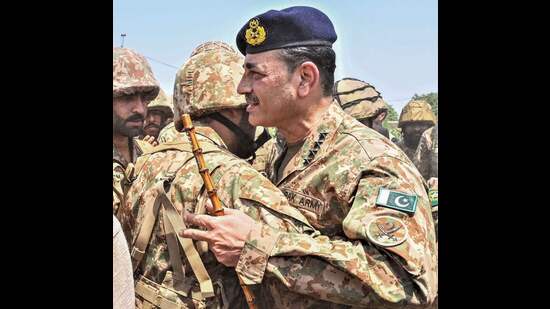
This disproportionate allocation to defence is in line with the recent chain of events in that country. It is rather unusual for a general to get a promotion after losing a war. Pakistan had sought the ceasefire on May 10, after Indian air strikes destroyed a large chunk of Pakistan’s air defence and severely damaged a critical facility near Nur Khan airbase in the country’s capital. But the general who led the forces got promoted. General Asim Munir’s elevation to Field Marshal was a calculated move to preserve the narrative that Pakistan had won the war.
Pakistan has in the past used the threat of nuclear escalation to deter India’s response to acts of terrorism. During the Kargil conflict, Pakistan’s foreign secretary issued a statement about the use of “any weapon in our arsenal”. No such statement was made during Operation Sindoor. The country's nuclear bluff has been thoroughly called.
The Pakistan armed forces’ legitimacy has been seriously challenged in the past two years. On May 9, 2023, supporters of Pakistan Tehreek-e-Insaaf ransacked Jinnah House, the Lahore Corps Commander’s residence, and attacked Army GHQ (General Headquarters) in Rawalpindi, following the arrest of their leader, Imran Khan. Senior generals were sacked after the riots. Most recently, former Inter-Services Intelligence chief lieutenant general Faiz Hameed was court-martialled.
All these have exposed the rift within the army. Add to this the raging violent insurgency in Balochistan, and Islamabad’s strained relations with Afghanistan and India. Clearly, Munir’s sagging authority needed shoring up. And, he chose to wave the flag of ideology.
In his April 16 speech, Munir reminded his audience of overseas Pakistanis that they belong to a superior ideology. He referred to Balochistan, the two-nation theory, and Kashmir, which he described as Pakistan’s jugular vein. The Pahalgam terror attack followed a week later. The slogan that Kashmir is the jugular vein of Pakistan reflects Pakistan’s interests, not Kashmiris’ aspirations.
The two-nation theory, based on faith, was never accepted by Balochistan. The Khan of Kalat had declared independence in 1947, which was supported by the tribal assembly (Loya Jirga). Pakistan initially recognised Baloch independence, but later dispatched the army to suppress the Balochs. Bizenjo, a member of the Loya Jirga, who later became chief minister of the province, said that if Baloch were to join Pakistan because they were Muslims, then Afghanistan and Iran should also be part of Pakistan.
The fact is Pakistan’s military strategies on both its eastern and western fronts lie in tatters. Not only is it at odds with what it claims as “Hindu India”, but there have been armed clashes with Sunni Afghanistan as well as Shia Iran. But that’s the last fact the likes of Munir would admit to. And, Islamabad will allow public funds, much of it borrowed, to be squandered by Rawalpindi in pursuit of flawed military strategies and ideologies.
DP Srivastava, a former ambassador, is the author of Pakistan: Ideologies, Strategies and Interests. The views expressed are personal.