With the appointment of General Asim Munir as the chief of army staff in Pakistan, one phase of the high-intensity drama that has played out for the past few months came to an end. Some last-minute turmoil came from feverish speculation over whether President Arif Alvi, an Imran Khan appointee and acolyte, would sign off on the recommendation he received from the government. Eventually, within a day, he did so, and this provided a veneer of order in what has
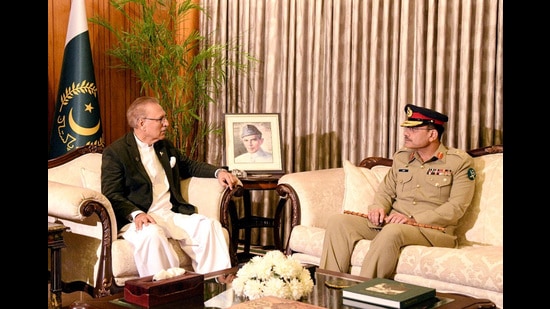
With the appointment of General Asim Munir as the chief of army staff in Pakistan, one phase of the high-intensity drama that has played out for the past few months came to an end. Some last-minute turmoil came from feverish speculation over whether President Arif Alvi, an Imran Khan appointee and acolyte, would sign off on the recommendation he received from the government. Eventually, within a day, he did so, and this provided a veneer of order in what has been among Pakistan’s most disorderly transitions in the army command. If he had not, Pakistan would have been plunged into a renewed constitutional crisis to compound the political and economic crisis that has already engulfed it.
Debate will continue on the role that the transition in the army has played in Pakistan’s political crisis. Was the high-decibel political drama that we saw — Imran Khan battling it out with virtually the entire political spectrum — only the ripple effect of the real issue: The battle within the army command for the top post? Or was it a real political dogfight into which all manner of issues got dragged in, including the transition in the army? Or is it a combination of the two? While politics and the military are inseparable in Pakistan, in reality, the former is a separate, if unequal, force — constantly jostling against the latter.
What is also considered significant is a speech made by the outgoing army chief, General Qamar Bajwa, in which he spoke of the army now being fully committed to staying out of politics. This appears as the continuation of the neutrality discourse, which resulted in Imran Khan losing the vote of confidence that ended his tenure as prime minister (PM). Most observers in Pakistan and outside, however, view the army’s future role as depending on the inclinations and attitudes of the new chief rather than on the commitments voiced by the outgoing one.
There is also a minority view which holds that lessons have been learnt by the army command from the searing experience of the past few months. They have not relished being made into a political football, and there is a widespread belief that apart from damaging individual reputations, the standing of the army itself may have been eroded. Many blame the outgoing chief for this. General Bajwa’s fault, they argue, is that he stopped acting like God and instead became a virtual player in the political scrum. The original sin was to act as he did against PM Nawaz Sharif by forcing him out. He then compounded this by seeking to rebalance this by according the same treatment to Imran Khan. In this view, a more “neutral” posture by the army is not a willingly exercised choice but a necessity now forced on it if it has to safeguard its reputation and avoid suffering further erosion.
Pakistan’s political spectrum today is made up almost entirely of those who have, at some point of time, been proteges of the army but then also been burnt by it. In brief, there is no one the army can bring itself to fully trust or see as a safe option. How the new chief will address this ecosystem and that of Pakistan’s complex geopolitics is much debated, but the truth will emerge only gradually.
Stepping back from these dual “game of thrones” — in the army and the polity — and the tactical melodrama that has played out for the past few months, can we read the tea leaves about the future? For the moment, a period of relative calm may set in as all sides regroup and evaluate next steps. Imran Khan has announced an end to street protests and marches without throwing down any fresh gauntlet or setting any deadline. He has, however, put out a teaser about the dissolution of the provincial assemblies in Punjab and Khyber Pakhtunkhwa where his party runs the government. How this will happen remains to be seen. For the government, a de facto truce could provide temporary respite to attend to urgent firefighting on the economic side. There is also the all-important question of Nawaz Sharif’s return from exile and his political future. Will the judiciary, much as the army has, also realise that it went too far in debarring him from politics and seek to somehow reverse that decision?
But what is clear is that whatever respite there is will be temporary. The current political conflict can perhaps only be settled by an election, if that. In the interim, all the political contestations will continue on a stage that will be even more sombre and perilous. The tanking economy, an uptick in domestic terrorism, frictions with Afghanistan, and relative calm with India but at a low and unstable plateau, are all pointers to this. This is not a new existential state for Pakistan, but it does mean that it will remain a neighbour on which attention must constantly rivet.
TCA Raghavan is a former high commissioner to PakistanThe views expressed are personal
One Subscription.
Get 360° coverage—from daily headlines
to 100 year archives.
Archives
HT App & Website