A few months ago, Vidhi Bubna, a 23-year-old scuba diver and founder, Coral Warriors, got in touch with me because of our mutual interest in the climate crisis, oceans, and biodiversity.
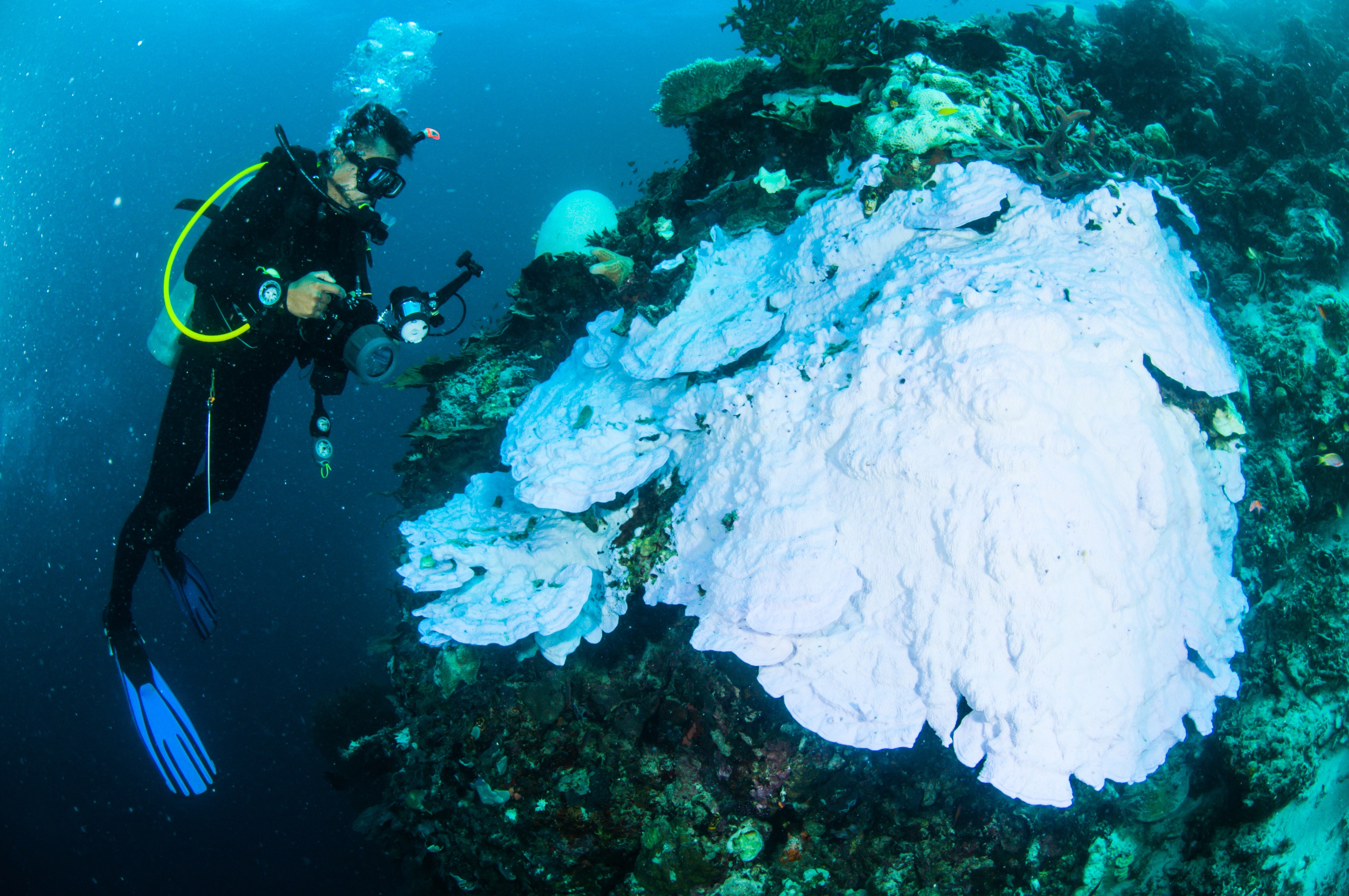
She had a distressing story to narrate.
“When I did my first dive in the Andamans Islands last year, I was shocked to find massive bleaching of corals,” said Bubna. “It was like a graveyard down there.”
This is alarming because corals are an important ecosystem for life underwater.
A few months ago, Vidhi Bubna, a 23-year-old scuba diver and founder, Coral Warriors, got in touch with me because of our mutual interest in the climate crisis, oceans, and biodiversity.
She had a distressing story to narrate.
“When I did my first dive in the Andamans Islands last year, I was shocked to find massive bleaching of corals,” said Bubna. “It was like a graveyard down there.”
This is alarming because corals are an important ecosystem for life underwater. They protect coastal areas by reducing the power of waves hitting the coast, and provide a crucial source of income for millions of people since corals teem with thousands of marine species.
What Bubna witnessed is well-documented in scientific studies: Coral reefs are among the most threatened ecosystems on earth, largely due to unprecedented global warming. According to UNESCO, coral reefs in all 29 reef-containing World Heritage sites would cease to exist by the end of this century if humans continue to emit greenhouse gases under a business-as-usual scenario.
Marine heatwaves and bleaching of corals
I recently remembered my conversation with Bubna during a presentation by Roxy Mathew Koll of the Indian Institute of Tropical Meteorology, Pune.
Speaking to 60-odd environment journalists at the Centre for Science and Environment’s Anil Agarwal Dialogue, Koll, who led the study, said that his team has seen a significant increase in marine heatwaves, aided by rapid warming in the Indian Ocean and strong El Niños.
Marine heatwaves are periods of extremely high temperatures in the ocean, which leads to coral bleaching, seagrass destruction, and loss of kelp forests, affecting the fisheries sector adversely.
An underwater survey showed that 85% of the corals in the Gulf of Mannar near the Tamil Nadu coast were bleached after the marine heatwave in May 2020.
These marine heatwaves, Koll explained, used to be rare in the tropical Indian Ocean, but now they have become an annual affair. The western Indian Ocean Region experienced the largest increase in marine heatwaves about 1.5 events per decade, followed by the north Bay of Bengal at a rate of 0.5 events per decade. During 1982–2018, the western Indian Ocean had 66 events, while the Bay of Bengal had 94 events.
First identified in 2013, marine heatwaves such as The Blob resulted in mass mortalities in marine mammals and birds, and the collapse of fisheries and aquaculture in the United States and Korea. However, Koll added, there is no research on how it has impacted India/South Asia.
His team’s research shows that between 1982 and 2018, the western Indian Ocean experienced a four-fold rise in marine heatwaves. The north Bay of Bengal saw a two-to-three-fold rise in the number of marine heatwaves.
Koll also warned that as oceans warm (93% of the heat from global warming goes into oceans), there would be an increasing number and intensity of cyclones and heavy rainfall.
On Thursday, the issue of marine heatwaves came up in Parliament. Member of Parliament Ripun Bora asked Jitendra Singh, minister of state, ministry of science and technology and earth sciences, whether it is a fact that marine heatwaves have increased temperatures over seas and oceans of the country and have increased significantly in the past few decades. Referring to the IITM study, Mr Singh confirmed that there has been a spike in marine heatwave events.
Impact on monsoons
For the first time, Koll’s team’s study has demonstrated a close link between marine heatwaves and atmospheric circulation and rainfall.
The marine heatwaves, it showed, in the western Indian Ocean and the Bay of Bengal are leading to drying conditions over the central Indian subcontinent. At the same time, Koll added, there is a significant increase in the rainfall over south peninsular India in response to the heatwaves in the north Bay of Bengal. These changes are in response to the modulation of the monsoon winds by the heatwaves.
All climate model projections suggest further warming of the Indian Ocean in the future. This, Koll warned, is likely to intensify the marine heatwaves and impact monsoon rainfall. This means a greater need to enhance India’s ocean observational arrays to monitor these events accurately, and update weather models to skillfully predict the challenges presented by a warming world.
If the marine heatwaves are indeed threatening to change India’s rainfall pattern and impact marine biodiversity, India must invest heavily into not just improving its observation capacity, but also its climate resilience and adaptation efforts.
kumkum.dasgupta@htlive.com
The views expressed are personal
One Subscription.
Get 360° coverage—from daily headlines
to 100 year archives.
Archives
HT App & Website