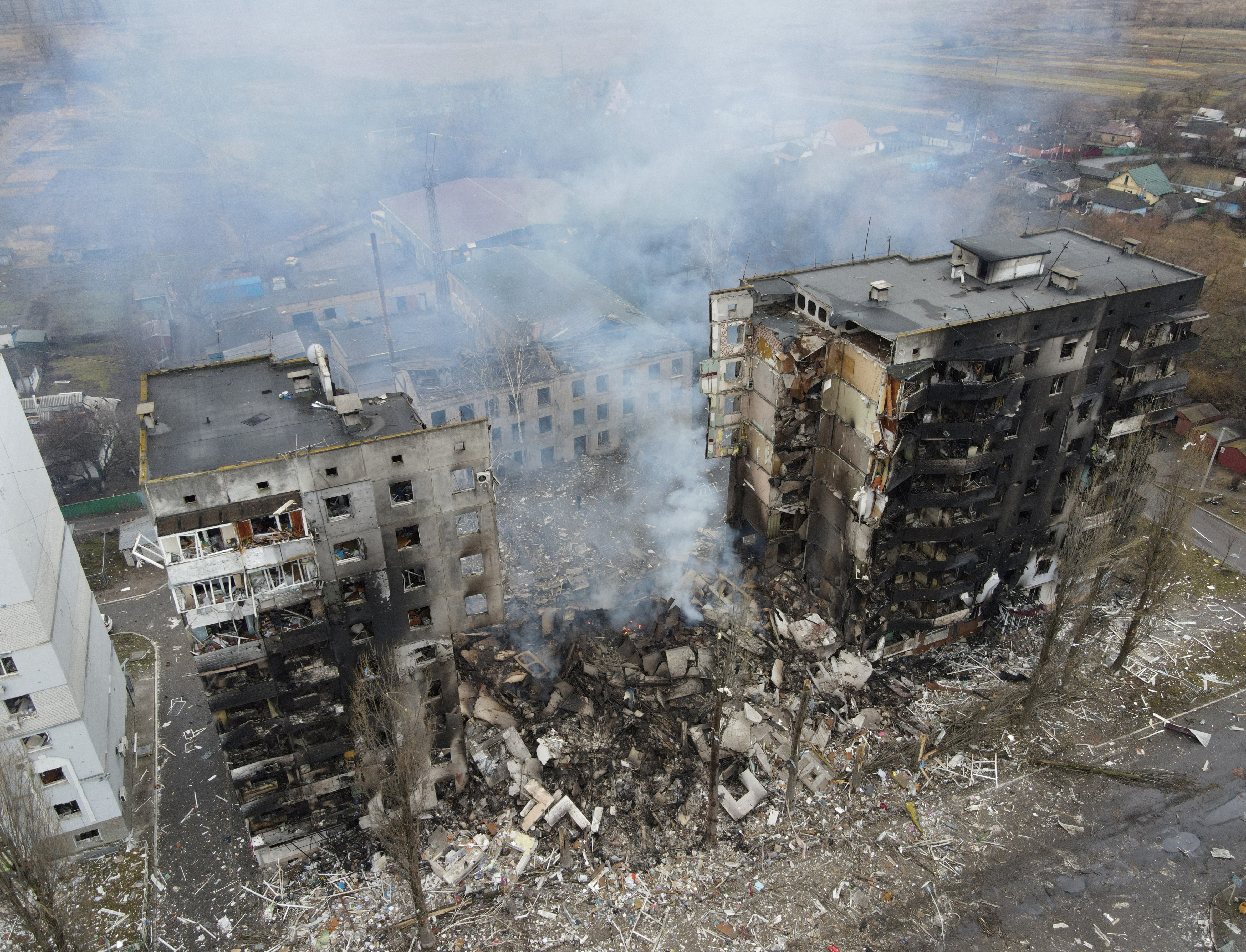
As the war in Ukraine enters the second week, reports of Russian advances and Ukrainian defence successes vary across media agencies and across countries. The United States (US) and its allies have imposed the harshest package of sanctions on Russia, unprecedented in scope, drawing in wide participation from other US partners.
India’s position on sanctions is that they contravene international law, unless they are approved by the United Nations (UN). This stand appears almost quaint today, when sanctions have become
As the war in Ukraine enters the second week, reports of Russian advances and Ukrainian defence successes vary across media agencies and across countries. The United States (US) and its allies have imposed the harshest package of sanctions on Russia, unprecedented in scope, drawing in wide participation from other US partners.
India’s position on sanctions is that they contravene international law, unless they are approved by the United Nations (UN). This stand appears almost quaint today, when sanctions have become commonplace weapons in the diplomatic armoury of countries, emphasising the economic leverage of the strong over the weak. Secondary sanctions, when even third countries can be punished for dealing with the sanctioned country, are the special privileges of the really strong.
Since the annexation of Crimea in 2014, the US and its allies have unleashed a series of sanctions against Russia for various transgressions of international law. Other than visa bans and asset freezes, they were sector-specific and technology-specific sanctions, with limits on trade financing in dollars and euros. Over the years, they have limited the growth of the Russian economy, but have not brought the country to its knees. The principal reason is the heavy global dependence on Russian hydrocarbons and other commodities. The sanctions regime was, therefore, leaky enough to permit a certain level of trade and investments, to avoid a major impact on western economies.
A military invasion in Europe, producing horrific images of civilians caught in the crossfire, fleeing war and cowering in bomb shelters, has mobilised a far more focused response. Measures to restrict the access of Russia’s Central Bank to its reserves and to exclude major banks from western financial markets and the SWIFT global banking system seek to throttle the Russian economy by cutting off its engagement with the world. Oil multinationals have announced withdrawals from their multibillion-dollar investments in Russia. Foreign shipping, logistics, technology and manufacturing companies have suspended business operations with Russia. The US and Europe will target the assets of Russian oligarchs in their jurisdictions. A stringent technology-denial regime is being constructed.
It is a historical truth that sanctions rarely deter a determined adversary. At best, they degrade its economic and military strength over time. They are also a double-edged sword: They inevitably inflict pain also on the sanctions-imposing countries. The present package of consolidated political pressure and economic measures goes well beyond usual sanctions: It is a deep surgical strike, intended to draw blood immediately. The question now is whether, and how soon, the objectives of the western sanctions can be reconciled with Russia’s goals and possibilities.
Vladimir Putin framed the objectives of the war as “demilitarisation” and “denazification” of Ukraine — which does not reveal much about his endgame. Broadly put, an acceptable outcome for Russia could be a settlement that guarantees, in some way, the neutrality of Ukraine and a mutual agreement on the forces and weapons deployments of the North Atlantic Treaty Organization (NATO) and Russia on their peripheries.
The US and its allies have not defined their sanctions endgame either. Their expectation is that the economic disruption and popular discontent created by the strong external pressure would force President Putin’s hand. Some may even hope that a wave of opposition might unseat him. For them, the withdrawal of troops from Ukraine is naturally a non-negotiable minimum. Added to this should be measures to adequately guarantee the security of countries on Russia’s periphery, including Ukraine. They will naturally want Russia to stand down as soon as possible to justify the rollback of sanctions. Meanwhile, their economies will increasingly feel the pain. The immediate spike in global commodity prices is only a preview. The extent of the hydrocarbons challenge is highlighted by US President Joe Biden’s recent announcement that the US and 30 other countries will release 60 million barrels of oil from strategic reserves around the world to cushion oil prices — this is just about 60% of global oil consumption in a day.
Gloomy as the situation looks, therefore, Russia’s action and the West’s strong reaction may have created a window of opportunity for some sort of a settlement. Russia’s negotiating strength will be determined by the military outcome and domestic resilience; that of the West will depend on how long it can sustain the pain from the sanctions. Whether the settlement that emerges is merely a band aid over the current wounds or addresses the underlying problem — a broken European security architecture — remains an open question.
India will naturally be impacted by the spike in commodity prices resulting from the war and the sanctions. Our bilateral economic engagement with Russia will be less impacted. After 2014, despite official declarations of India’s opposition to sanctions, our businesses had limited exposure to the Russian market, due to apprehensions about sanctions, unfamiliarity with the Russian business climate and uncompetitive freight costs. Defence cooperation has been sustained by bilateral currency arrangements, and India has withstood the threat of secondary sanctions from the US legislation, Countering America’s Adversaries Through Sanctions Act (CAATSA).
A prolonging of tensions will increase the pressure on India to take sides. It has not done so simply because its geopolitical situation ties it in different ways to all the protagonists of this drama. This will remain so even after the current ugly situation clears.
PS Raghavan is a former ambassador to Russia and is a distinguished fellow, Vivekananda International Foundation
The views expressed are personal
One Subscription.
Get 360° coverage—from daily headlines
to 100 year archives.
Archives
HT App & Website