Scientifically Speaking | Air pollution, failing eyesight and Claude Monet's art
A fascinating new study correlates real air pollution to the clarity and vibrancy filtered through the sight and imagination of Claude Monet. Later in life, his paintings changed again because he suffered from cataracts in both eyes
“Without fog, London would not be beautiful,” reflected Claude Monet, the brilliant French impressionist painter who revolutionised modern art through his paintings of gardens, flowers, and landscapes.
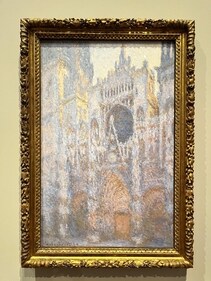
The genius of Monet is that his paintings look different depending on your perspective. (Photo courtesy: Anirban Mahapatra))
Monet is widely considered one of the greatest artists of the modern era and along with another genius, Vincent van Gogh, he’s the artist whose paintings I gawk at most.
I’ve had the great fortune of being able to see many of Monet’s paintings up close. And indeed, some of his most famous artworks hang in museums in Washington DC, New York, and Paris.
Perhaps the most impressive exhibit of Monet’s art can be found in the Musée de l'Orangerie in Paris which is designed in a way to highlight large imposing murals of water lilies. These water lilies were a favourite subject of Monet.
But even Monet’s smaller paintings are breathtaking. Monet was a prolific artist who created around 2,500 paintings. He was also a perfectionist who destroyed around 500 of his works because they did not meet his own standards.
The genius of Monet is that his paintings look different depending on your perspective. If you stand close to the frames, you will see only daubs of paint. But step back a few feet and vibrant patterns emerge that form exquisite and playful images accentuating both light and dark.
Monet was a prolific artist who created around 2,500 paintings. He was also a perfectionist who destroyed around 500 of his works because they did not meet his own standards. (Photo courtesy: Anirban Mahapatra)
We can all enjoy Monet’s paintings from an aesthetic perspective. But because he painted for many decades through many environmental and health conditions, and he often created different paintings of the same subject, his artistic development and output can be dissected by science as well.
For example, new research finds that the cause of the fog that captivated Monet while he was in London might have a nefarious source.
From 1899 to 1901, Monet created close to 100 different views of the Thames River while he was in London. These paintings, which hang in some of the leading art museums of the world, show a thick haze obscuring buildings such as the Houses of Parliament.
Writing in a research article published in the prestigious scientific journal Proceedings of the National Academy of Sciences, Anna Lea Albright of Sorbonne University in Paris and Peter Huybers from Harvard University link the lack of visibility and “whiter colour palette” in Monet’s paintings (and that of another contemporary painter JMW Turner) to air pollution. They conclude that Monet’s “paintings capture elements of the atmospheric environmental transformation during the Industrial Revolution”.
It is a fascinating new study that correlates real air pollution to the clarity and vibrancy filtered through the sight and imagination of an artistic genius. But it isn’t the first attempt of this kind.
Paintings can be correlated to environmental patterns. In 2017, three researchers argued that the red sky in Edvard Munch’s famous painting, The Scream, was prompted after he was “terrified after seeing a spectacular mother-of-pearl cloud event.”And based on lunar tables, text, and topographic data, the moment of creation of Vincent van Gogh’s Moonrise has been dated to 2108 hours, local time on 13 July 1889.
Coming back to Monet, we find that after he returned to France, his paintings bore the hallmarks of his earlier vibrant phase. But even this phase would come to an end. By 1912, when Monet was in his 60s, he started to suffer from cataracts in both eyes. Glasses and drops did not improve the situation and Monet’s paintings changed due to his failing eyesight.
Monet complained that “reds had begun to look more muddy.” His paintings from this phase have coarse brushstrokes and darker colours. He also labelled paint tubes to be able to ascertain their hues properly. Fortunately, the damage to his eyesight was not permanent.
There would be yet one more change to Monet’s vision — this time for the better. In 1923, after surgery to remove the lens of his right eye, his paintings showed the contrast and vibrancy of his earlier paintings again. And it is during this later phase of his life that he painted the murals that now adorn the Musée de l'Orangerie in Paris.
What should we make of these new studies that tie the environmental conditions in which an artist lived and their eye health with the characteristics of their artistic output? We have some evidence that there are factors that might have contributed to a widely known artist’s visual development. And to be clear, I think it is absolutely fascinating that we can correlate actual events and health conditions to the artistic style of a prolific genius like Monet.
But we must also accept the limitations of these studies in elucidating the process of actual creation. After all, a painting is not a faithful reproduction. Monet’s paintings are a result of his own experiences and unique artistic vision (in the broadest sense of the term) and not just what he saw with his eyes.
Anirban Mahapatra is a scientist by training and the author of a book on COVID-19

 E-Paper