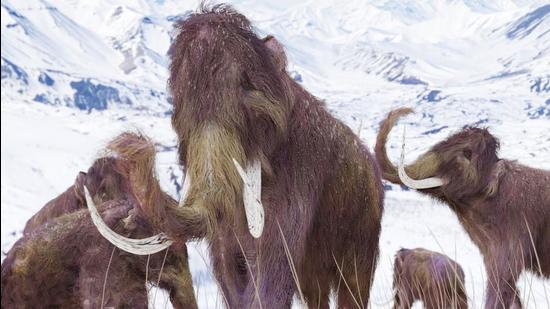
Recent, media attention has focused on “de-extinction” efforts to bringing back extinct woolly mammoths. Meanwhile, elephants, their closest living relatives, are threatened in their natural habitats.
Humans have influenced the evolution of plants and animals that we have come in contact with throughout our existence. The size of horns of bighorn sheep in Canada has dropped by 20% because of hunting. Many fish have also decreased in size due to overfishing.
In Mozambique, hunting of African elephants for ivory to
Recent, media attention has focused on “de-extinction” efforts to bringing back extinct woolly mammoths. Meanwhile, elephants, their closest living relatives, are threatened in their natural habitats.
Humans have influenced the evolution of plants and animals that we have come in contact with throughout our existence. The size of horns of bighorn sheep in Canada has dropped by 20% because of hunting. Many fish have also decreased in size due to overfishing.
In Mozambique, hunting of African elephants for ivory to finance a long civil war has resulted in their populations declining by over 90%. Research by biologist Shane Campbell-Staton and his colleagues at Princeton University published in Science on October 21 found that hunting elephants for their tusks has driven them towards tusklessness.
Most African elephants have tusks. Before the 15-year conflict, fewer than 20% of female elephants were tuskless. Now poaching for ivory has resulted in more than half of female elephants lacking tusks. And it’s not just that tusked elephants are being hunted to death and that there are fewer around. The tuskless trait is selected in surviving elephants and is passed on to offspring that are also tuskless.
Researchers found that the tuskless trait is caused by a mutation on the X chromosome. It is fatal in male elephants but gives rise to tuskless female elephants.
By comparing genomes of tusked and tuskless elephants, Campbell-Staton and his team were able to identify two candidate genes which are probably involved in the formation of tusks. Interestingly, these genes have equivalent versions in humans that are responsible for our incisor teeth.
What is also worrisome is that these changes in appearances due to poaching are not encoded genetically. In other words, even if conservation efforts are successful in increasing the numbers of African elephants, it will take time for the proportion of tusked elephants to increase.
Poaching is a serious threat to large animals such as elephants and tigers that are prized for their tusks and pelts. These animals are also threatened by shrinking habitats due to encroachment by humans and the climate crisis.
Elephants are a keystone species. Tuskless female elephants eat different plants from tusked elephants. So, the change in the populations of elephants will also have long-term consequences on the entire ecosystem.
I can’t help but think about the loss of elephants with tusks in the context of the fanfare last month on a start-up reported as attempting to bring back woolly mammoths.
With the thawing of the Arctic, many well-preserved mammoths are being unearthed from ice. But even with these samples, DNA which is fragile is degraded and can’t be extracted in intact form. Scientists used DNA fragments to piece together the genetic blueprint of extinct woolly mammoths.
But many of the reports of reviving woolly mammoths are incorrect. There is a massive chasm between determining the DNA sequence of an animal and recreating it. What this start-up envisions doing is using relatively new gene-editing tools to insert some woolly mammoth genes into its nearest living relative, the Asian elephant.
This genetically modified elephant-mammoth hybrid will be implanted into a female elephant surrogate, which will give birth to offspring with certain genes for cold adaptation from mammoths. But because there are around 1.4 million differences in the genomes of Asian elephants and mammoths, the engineered animals that will be created will not be mammoths. They will still be elephants.
The goal of the project is to “rewild” a modern ecosystem, the Siberian tundra, with these cold-adapted elephants. There’s some data that reintroduction of large herbivores such as mammoths or elephants to the tundra might be good for restoring the environment, but no one has attempted an experiment of this scale before. The last woolly mammoth died around 4,000 years ago.
How healthy the genetically engineered elephants with mammoth genes will be, how well they will be adapted to their new environments, and what the long-term outlook for the project might be are not very clear. How many cold-adapted elephants will need to be created to sustain a population and how large a habitat will be required are also open to debate.
The Earth has undergone five earlier mass extinction events. In the Anthropocene, we are currently in the midst of the sixth. A 2019 United Nations report estimated that humans are pushing one million species towards extinction. We cannot save all of them. Who decides which ones are candidates for de-extinction?
In a research article published in Nature on October 20, zoologist Yucheng Wang of the University of Cambridge and his colleagues found that the main culprit for the disappearance of the woolly mammoth was rapid climate crisis which had caused their food sources to dwindle. Can we ensure that any mammoth-like elephants that are introduced will not die out rapidly due to the current crisis?
To be clear, I’m not opposed to de-extinction, but there should be well-defined objectives. De-extinction should not create a moral hazard problem providing a consequence-free excuse to continue destroying habitats and warming the planet. The primary goal should be to save species that exist right now or have become extinct in the last few years. Such species should be introduced only after robust public discussion. Candidate species could include the Balinese tiger or the northern white rhinoceros.
The crux of the matter is this. For each species to exist on the planet, there needs to be a conducive environment. The goal of de-extinction should not be to create a Jurassic Park type zoo, but to reintroduce an organism that has a real shot at thriving in a sustainable habitat. If such a habitat does not exist, then we will only briefly introduce species that become extinct again.
Anirban Mahapatra, a microbiologist by training, is the author of COVID-19: Separating Fact From Fiction
The views expressed are personal
One Subscription.
Get 360° coverage—from daily headlines
to 100 year archives.
Archives
HT App & Website