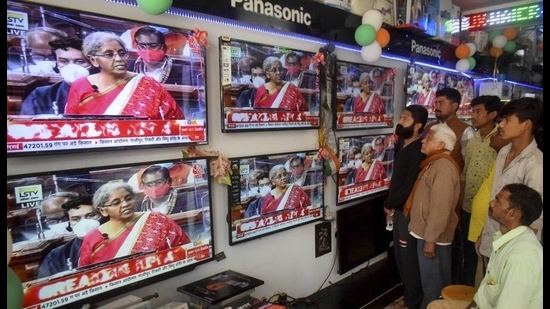
Finance minister (FM) Nirmala Sitharaman opened her budget speech with two overarching points. First, she asserted that unlike in the other two instances since 1947, the contraction of the economy in the current year is due to a global force, namely the pandemic. This presumably absolves her government of criticism of how the fallout could have been handled. Second, she claimed that the overall policy response to Covid-19 in 2020-21, by the central government and Reserve Bank of India (RBI) combined, amounted to 13% of the Gross Domestic Product (GDP).
Taking the second point first, it must be pointed out that the liquidity enhancement by the central bank does not count as a stimulus, for while it makes it easier for firms to borrow, it does not, by itself, increase demand. If the measures undertaken by RBI are excluded, the stimulating role of the government in 2020-21 would be far lower. The International Monetary Fund pegs it at less so that 2% of the GDP by October, among the lowest for emerging market economies. It implies that though the negative shock was global, the government of India did little by way of a stimulus to counter its economic impact. This reluctance to stimulate the economy has found its way even into this budget.
It is in the area of health that the budget is striking, with a 137% increase in spending compared to the previous year. This is impressive in itself, but so are the details of expenditure — to be spread over laboratories in every district, strengthening of the Jal Jeevan Mission, a national institute of virology and interventions to reduce air pollution. But the most significant part of the health budget is the provision of ₹35,000 crore for vaccination, with FM promising more funds if needed. It would have been interesting to know the details of the government’s plans for pricing and allocation of the vaccine, but the provision along with the promise of enhancement is sufficient to allow for free vaccination for a section of the population.
{{/usCountry}}It is in the area of health that the budget is striking, with a 137% increase in spending compared to the previous year. This is impressive in itself, but so are the details of expenditure — to be spread over laboratories in every district, strengthening of the Jal Jeevan Mission, a national institute of virology and interventions to reduce air pollution. But the most significant part of the health budget is the provision of ₹35,000 crore for vaccination, with FM promising more funds if needed. It would have been interesting to know the details of the government’s plans for pricing and allocation of the vaccine, but the provision along with the promise of enhancement is sufficient to allow for free vaccination for a section of the population.
{{/usCountry}}While increased health spending is the need of the hour, there was a case for transferring at least some part of it to states, which is where provisions mostly takes place, as health is a state subject. Nevertheless, a significant beginning has been made by flagging the importance of health for both the economy and our well-being, and it is hoped that the states will be moved to increase their health spending by re-orienting their budgets.
The second noteworthy element of the budget is the focus on infrastructure. It was correctly stated that for the government’s aim of a ₹5 trillion economy to succeed, more manufacturing is needed, and that manufacturing needs infrastructure. For privately financed infrastructure, a bill is to be moved within the year to establish a development finance institution. The aim is for this bank to grow a ₹5 lakh crore portfolio within three years. This is good news, as only long-term lending institutions can finance the building of infrastructure.
As far as public investment is concerned, the numbers are significant. At ₹5.54 lakh crore, the spending is more than 30% greater that the budget estimates of the previous year, though less in relation to the revised estimates for 2020-21. A significant part of this is to be financed by the monetisation of public assets. Given the acute shortage of public infrastructure, it makes sense to transfer funds from public sector production units to this segment through privatisation. At the same time, there is a case for earmarking public land exclusively for production avoiding other uses of it, such as for luxury housing, for land is scarce in India. Finally, the suggestion made that foreign investment be attracted to build domestic infrastructure seems to be a pipedream.
While the enhanced spending on health and capital goods is significant, it can be misleading to assume that this represents the budget’s overall expenditure thrust. In fact, there is no thrust at all. The expenditure budgeted for 2021-22 is less than 1% higher than the revised estimates for the current year. It is in this sense that there is no immediate stimulus in this budget despite the developments with respect to the health and infrastructure sectors.
With no increase in public expenditure in the budget, there is reason to doubt the government’s claims on the economic recovery that may be expected from it. It is difficult to find in it a coherent strategy for growth in a contracting economy. In the absence of policies that raise profit expectations, the private sector is likely to wait for an expansion of the economy before investing.
Without a sizeable increase in private investment or a major revival in exports, unlikely right now as the global economy is weak, the government alone can lift the economy. This it has refused to do, privileging fiscal consolidation over an economic recovery. Under the circumstances we face today, reducing the fiscal deficit is not prudence; it is a premature withdrawal of sustenance to a struggling economy.
Pulapre Balakrishnan is professor of economics at Ashoka University, Sonipat, Haryana
The views expressed are personal