Marital rape remains a vexatious issue for India as it is not recognised as a criminal offence under the law. Under the Bharatiya Nyaya Sanhita (BNS), a man cannot be prosecuted for rape when he has non-consensual sexual intercourse with his wife if she is 18 years of age or older. There are other legal protections for women for abuse in marriage but not specifically marital rape. There are many petitions before the courts on the right to bodily autonomy, and despite law commission reports, amendments to the law and new legislations, no clear legal provision exists and everything is left to the interpretation of the courts.
The Criminal Law Amendment Act, 2013, introduced a number of changes in the Indian Penal Code, 1860, Code of Criminal Procedure, 1973, and the Indian Evidence Act, 1872. These changes are based on the recommendations of the Justice Verma Committee Report of 2013. However, one of the committee’s key recommendations — that marital rape be criminalised — was not accepted by the Cabinet. The reasons given were that women will fabricate rape charges; a complaint of marital rape breaks the marital relationship; and the law provides other remedies that the wife can exercise. The exception made for marital rape is viewed by many legal experts as being based on the flawed presumption of irrevocable sexual consent within marriage.
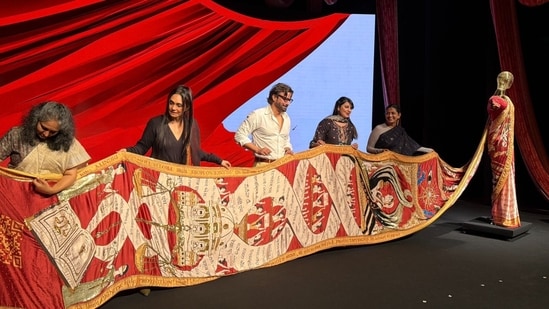
In this context, the Infinite Saree, a campaign advocating for the removal of the marital rape exception from the law, is worth mentioning. The campaign was developed for Red Dot Foundation by Klick Health in collaboration with MediaMedic Communications, INVNT, TA2, and LightFarm.
{{/usCountry}}In this context, the Infinite Saree, a campaign advocating for the removal of the marital rape exception from the law, is worth mentioning. The campaign was developed for Red Dot Foundation by Klick Health in collaboration with MediaMedic Communications, INVNT, TA2, and LightFarm.
{{/usCountry}}Also Read | Tech & worsening of sexual violence within marriage
A four-kilometre-long saree was embroidered with thousands of signatures supporting the removal of the marital rape exception and was displayed at Mumbai’s Royal Opera House. This is meant to begin public engagement and dialogue around legal protections for married women facing sexual violence. It highlights how creativity, culture and collective action can amplify conversations around gender justice. Imaginative campaigns like this draw attention to the issue. It is a largely unseen crime as most women are either unable or unwilling to come forward and make a case against their husbands. Family honour, patriarchy, and lack of any form of empowerment ensure silence.
The campaign highlights the lived reality of many married Indian women who experience sexual violence while often having limited legal protection. The legality of marital rape has been challenged by women’s rights advocates, legal experts, and civil society organisations who argue that marriage should not negate an individual’s right to consent.
Also Read | Marital rape can’t remain an exception to rape law
A survivor who did not wish to be named said, “For years, I believed what was happening to me was something I simply had to endure because I was married. The emotional and physical trauma was real, but the silence around it was even more painful. Knowing that so many people are standing up and demanding change gives survivors like me hope.” The courage of such survivors is at the centre of the movement and serves as a reminder that the conversation is ultimately about human dignity and fundamental rights.
Supreet K Singh, co-founder & CEO, Red Dot Foundation says, “Around the world, one of the greatest barriers to ending gender-based violence is the persistence of silence. The Infinite Saree is our response to that silence. Real change begins when society discards normalisation of violence as a social obligation and stops asking women to endure violence.”
The views expressed are personal.