“We particularly focus on employment, skilling, MSMEs”. Finance minister (FM) Nirmala Sitharaman’s opening statement, as she presented the first full budget of the newly elected government, clearly indicates that, Prime Minister (PM) Narendra Modi and his government have finally acknowledged that without quality jobs, the path to Viksit Bharat will remain elusive. But in its prescriptions, the budget lays bare the unresolved tensions in economic policy making that brought us to such a pass. These tensions may not be new, but they have sharpened in the last decade. And this budget offers little by way of solutions.
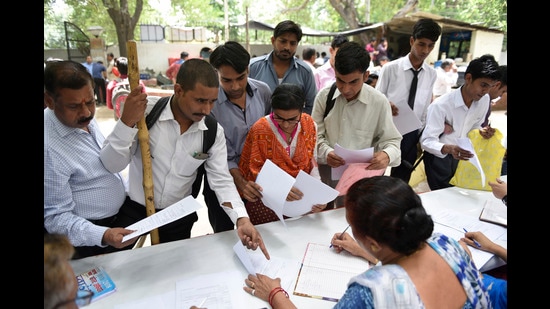
The first is the formal versus informal economy, and the role of government in enabling transition pathways for better quality jobs. The Economic Survey highlights that corporate profits have nearly quadrupled between FY20 and FY23. In sharp contrast, the recently released Annual Survey on Unincorporated Sector Enterprises for roughly the same period, shows a decline in the growth of enterprises in manufacturing, and with it, a decline in employment, from 2015-16. These two contrasting facts highlight the reality of India’s growth model — a model that favoured growth via the small formal, corporate sector, leaving unincorporated enterprises that make up the informal economy, where the bulk of India is employed, to bleed. This is India’s K-shaped economy — actively facilitated by policy missteps of the last decade from demonetisation to the Covid lockdowns, which exacerbated the jobs challenge.
The budget’s big ticket interventions — the Employment Linked Incentive (ELI) schemes, the internship programme and skilling — taken on their face value may well be reasonable interventions. But like previous budgets of the Modi government, they cater to the formal sector — the ELI incentives are linked to EPFO, the internships are in 500 top companies — leaving unaddressed the vast informal economy where the real distress is. Not only does the budget ignore distress in the informal sector, it also doesn’t recognise the need to devise transition pathways to formalisation in the long term. Nothing has been learnt from the havoc caused by forced formalisation of the last decade. Rather than a policy road map and transition pathways, we got new schemes and some political squabbling over who owns the idea, the Congress or the Bharatiya Janata Party!
{{/usCountry}}The budget’s big ticket interventions — the Employment Linked Incentive (ELI) schemes, the internship programme and skilling — taken on their face value may well be reasonable interventions. But like previous budgets of the Modi government, they cater to the formal sector — the ELI incentives are linked to EPFO, the internships are in 500 top companies — leaving unaddressed the vast informal economy where the real distress is. Not only does the budget ignore distress in the informal sector, it also doesn’t recognise the need to devise transition pathways to formalisation in the long term. Nothing has been learnt from the havoc caused by forced formalisation of the last decade. Rather than a policy road map and transition pathways, we got new schemes and some political squabbling over who owns the idea, the Congress or the Bharatiya Janata Party!
{{/usCountry}}Two important elements of such a road map did find mention in the budget: MSME’s and urbanisation. For MSMEs there is old wine in the form of credit guarantees and factor market reforms. And for the urban transition, housing (Pradhan Mantri Awas Yojana allocations increased by 18% over FY23 revised estimates) is prioritised along with a commitment to develop cities as growth hubs. But, as economist Amit Basole reminds us, the binding constraint for MSME growth is poor quality infrastructure, particularly in the small and census towns (local roads not highways, transport, power). This reality has been forgotten in the rush to formalise via blunt policy instruments, including those deployed in the proposed ELI. To get there, we needed a new policy imagination. One that, as Basole argues, prioritises capital expenditure for local roads and railways rather than highways and Vande Bharat. Moreover, we need to refocus social policy such that it addresses vulnerabilities of urban workers, including via an urban employment guarantee and enhanced portability of safety-nets like cash transfers. None of this is on the agenda.
The second tension relates to welfare policy. This budget offers no directional change. Allocations for key welfare schemes remain stagnant as they did in the interim budget. Its welfarist stance notwithstanding, the Modi government, in its successive avatars, has been a conservative welfare spender. Between 2015-16 and 2024-25, social sector spending as a proportion of total government expenditure fell from 23% to 19%. Fiscal space for Modi ki Guarantee was squeezed out of health, education, and nutrition.
Underprioritising critical investments in human capital is not unique to this last decade. However, technology created a new site of tension between human capital and cash transfer. DBT-based transfers sold as “guarantees” are far more visible and therefore electorally salient than investments in the public system needed for delivering health and education. Indeed, Samgra Shiksha, the flagship scheme for school education, saw a slight drop in allocations over the interim budget. The windfall from the Reserve Bank of India could have been used effectively, but that requires a policy imagination that goes beyond tinkering with deficit targets. We will continue on the path of skilling on the back of an education system where 50% children in standard 5 can barely read a standard 2 text!
The third is Centre-state tensions. In the Economic Survey and budget speech, the need to work in coordination with states to achieve the next generation of reforms found repeated mention. However, this requires a commitment to federalism, missing in this government’s DNA. The ruling parties in Bihar and Andhra Pradesh extracted their pounds of flesh, but that is the price of coalition politics. For the rest, devolution to states as a percentage of gross tax revenue is stuck at 33%, a far cry from the 15th Finance Commission recommendation of 41%. There remains no foundation for cooperative, competitive federalism, and the blame game will continue
In her speech, the FM promised to formulate an economic policy framework. But if this framework continues to paper over the challenges, and refuses to confront the role that policy missteps of the last decade played in exacerbating the jobs challenge, we will get an economy that will continue to hobble, stuck in a K-shaped Viksit Bharat.
Yamini Aiyar will be a visiting senior fellow at Brown University from 2024-25.The views expressed are personal