I never thought I’d be writing this to you. I didn’t think our friendship would get cut off so brutally and without any warning. From so far away all I can do is write this letter to you. When you came down to New York to meet me in 1975 from your time at the Islamic Institute at McGill University, Montréal, we instantly recognised that we were gay but of quite different flavours. You are very shy and reticent about joining the gay scene whereas I was already out and loud and proud. I was determined that you should join me in our liberating quest. It seemed at the time that we were the only two out gay men of Indian origin that we knew.
Also Read: Historian, queer rights activist Saleem Kidwai dies in Lucknow
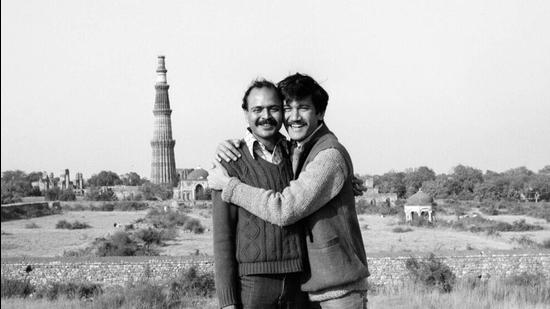
You went back to teach history at Delhi University, and I didn’t manage to visit you till 1980. We became very close as you helped me in my quest to visualise Indian gay men. After five years of British art schooling, I had not been able to find any mention of them and it had become my overarching goal to locate them in the canons of art history. You were my informant and also my muse and appeared in my earliest pictures at a time when nobody else would. Together we cruised the parks and parties of gay Delhi hoping to meet like-minded men in search of gay liberation. We talked a lot about where one could live as a gay man at that time, and you opted to live in India and make a difference while I found it impossible to go back and live in the closet. We exchanged letters and postcards and occasional phone calls and sometimes even managed to meet in person in London or in Delhi. Then in the 1990s you began to research the work of excavating the hidden history of same-sex love in India along with Ruth Vanita, a fellow scholar at Delhi University at the time. The resulting book, Same Sex Love in India: Readings from Literature and History, became a vanguard for South Asian queer studies in academia around the world.
In Photos: Artist Sunil Gupta remembers historian & activist Saleem Kidwai
{{/usCountry}}In Photos: Artist Sunil Gupta remembers historian & activist Saleem Kidwai
{{/usCountry}}It also became the historical backbone of the movement to overturn Section 377, the law that criminalized homosexuality in India. I returned to Delhi in the early 2000s when you helped me make a video on AIDS for the University of Southampton in the UK, about the local situation. You put me in touch with the Lawyers Collective, and the local queer community in Delhi, and helped make what eventually became “A World Without Pity”.
The scene was changing rapidly, and you encouraged me to return to live in Delhi and [you would stay with me when you visited the city where you taught for over 20 years]. By now, you had established yourself back in Lucknow, where you had gone to make a base for your academic research work away from the social hubbub of Delhi. There, you translated several books from Urdu to English. I made a book too, “Pictures. From Here” and we exchanged them. Making books became another thing that brought us together. In 2009 we were proved wrong that we would never see the anti-gay law changed in India in our lifetime. We celebrated and we partied, and we had a great flat to do that in. We were both single and you revelled in that: you were quite happy to be single and gay. I had a number of disastrous but entertaining internet dates that you were witness to. But then you were also witness to my meeting the man who would become my husband eventually. This led to more conversations about whether queer people should get married or not, whether I had sold out the old gay liberation politics. It became difficult to live as a married and gay man in Delhi, so I returned to London, and you returned to your books in Lucknow. You, of course, remained a champion of our original gay politics that critiqued the accumulation of capital and hetero-normative family life as the source of patriarchal oppression in India.
We had to make do with fleeting annual visits to see each other. I would keep turning up with the latest photo book I had made, and you had proudly given me a whole shelf to fill. Just the other day, we spoke about how I would soon be on my way to meet you clutching my latest book to add to your shelf. But now that will never be as I woke up this morning to the sound of my phone pinging endlessly to the messages from India announcing the news of your passing. You broke my heart my friend by leaving me so soon, but I will love you forever.
(Sunil Gupta is a photographer based in London. He is the author of ‘Pictures. From Here’ and ‘Queer’, among other photography books. He is also renowned as a documenter of queer lives in India. His photos have been exhibited in galleries globally, and in India.)