
 E-Paper



What happens when the act of reporting becomes an act of resistance?
Complaints of police harassment of women journalists expose the dangers of reporting from protest sites.

 Prefer HTon Google


She says the senior police officer molested her at Jantar Mantar on October 3. The officer, assistant commissioner of police Vivek Bhagat counters that she used a casteist slur against him, an offence under the SC/ST act, and has filed a First Information Report.

Two days later, came the announcement: Bhagat had been promoted to additional deputy commissioner. The police clarified the promotion had been proposed before the allegations surfaced. Nevertheless, in the outrage that followed, it was put on hold.
On Thursday, the Supreme Court issued directions: No coercive action could be taken against the journalist.
The two-judge bench of Chief Justice Surya Kant and Justice Joymalya Bagchi was hearing a petition filed by the Network of Women in Media in India (NWMI), a national collective of 950 women journalists and media professionals. The petition flagged allegations of violence and sexual harassment faced by women journalists covering the SIR protests in Delhi.
Appearing for NWMI, senior advocate Indira Jaising submitted to the court, in a sealed cover, the identities of women journalists who had been harassed and were willing to submit written complaints. She suggested that the court set up an independent committee, premised on the Vishakha guidelines and, so, distinct from any other committee set up in connection with the protests. It will be headed by a retired woman judge, to look into specific complaints about police’s treatment of women journalists.
“They go to protest sites to work. They are particularly vulnerable to abuse,” Jaising told the court. The court agreed to set up a committee.
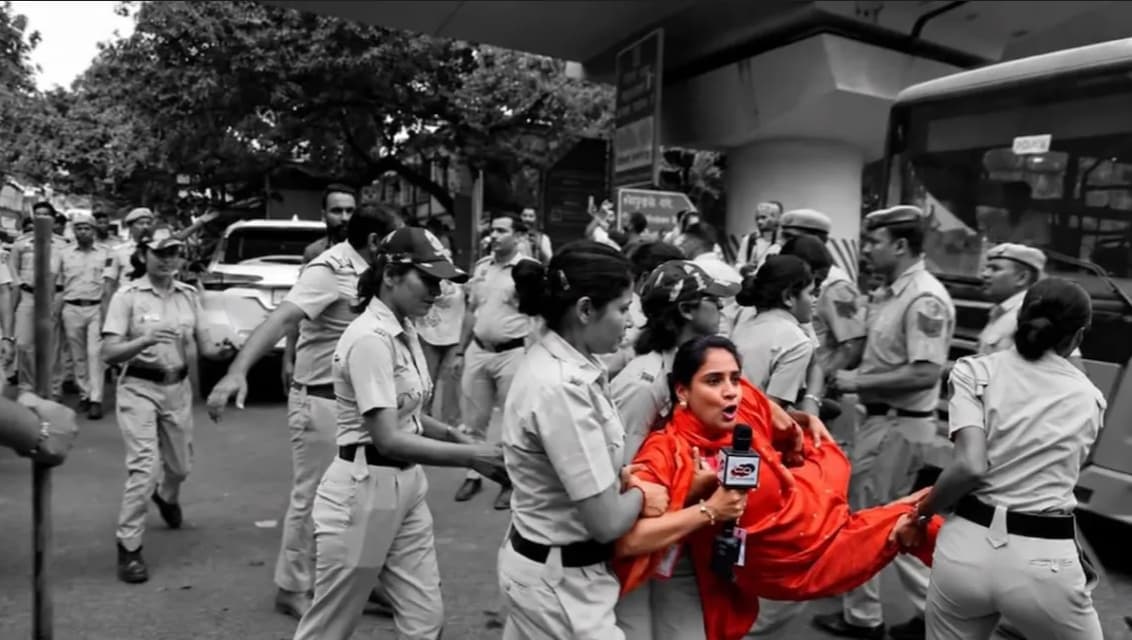
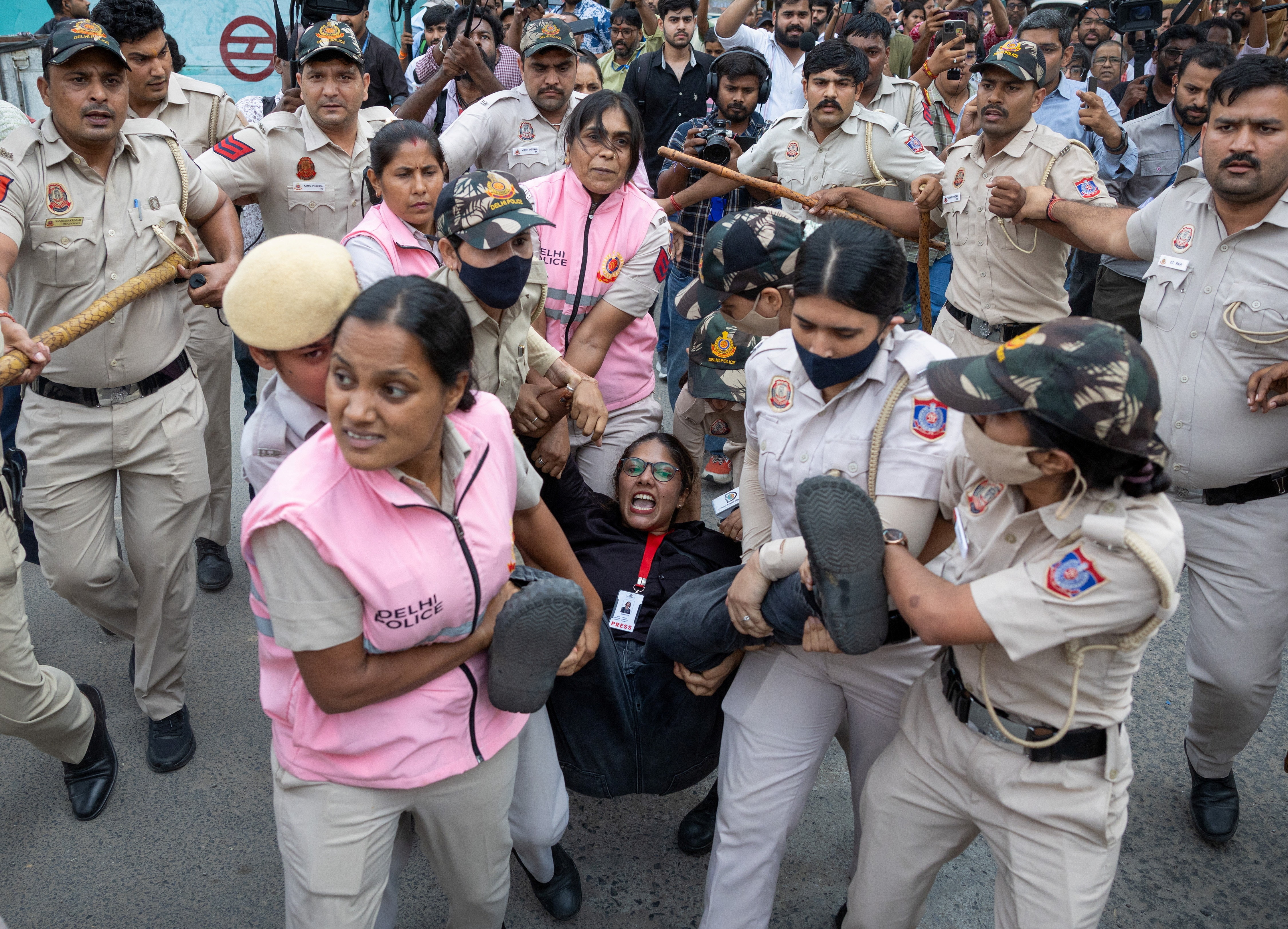
Allegations of Delhi Police manhandling protesters, including journalists, have been swirling. On October 3, along with the journalist mentioned above, two other women said they had been sexually assaulted by police.
On October 8, the National Human Rights Commission said it had issued a notice to the Delhi Police Commissioner seeking a detailed report.
The morning of October 10, an unprecedented police crackdown saw the deployment of 41,000 personnel and the mass detention of 7,000 people, including four former chief ministers, Cockroach Janta Party leaders and journalists from independent outlets as well as mainstream media.
Anushka Bhardwaj of Business Standard was initially let go after she pointed out she was a journalist, she told Supriya Sharma of Scroll. But the same police officer later returned and told her, “Bahut der se journalist journalist kar rahi hai.” She was then dragged by her bag and clothes as she resisted detention.
Citing several press freedom groups, including the Committee to Protect Journalists, the Associated Press reported 30 journalists were detained over the weekend, “including several wearing press credentials”.
On Sunday October 11, the Supreme Court convened an “extraordinary, exceptional” hearing directing the Union government and Delhi Police to stop illegal detentions and allow the free and smooth movement of people and traffic, with the caveat “subject to law and public order”.
Geeta Seshu of the Free Speech Collective said as many as 43 journalists were detained, some of them within hours of the Sunday directive. Free Speech Collective has filed two petitions in court. One for contempt for violating the court’s order and the second seeking the protection of all journalists.
Line of duty
A journalist’s job by definition, is to report on events including protests, demonstrations, conflicts and the exercise of state power. How does the state respond to public upsurges? Is there police excess? Are court directions followed? Is state action taken within rules and procedures? Is the use of force proportionate?
The right to protest is available to every citizen. But, said Seshu, “Police are targeting journalists to prevent them from documenting the illegal manner in which they are dealing with the protests and the protesters.”
The NWMI petition is specific about seeking “specific safeguards for the dignity and safety of women… to ensure that women journalists are able to occupy and report from public spaces on equal terms and without fear or physical force, intimidation or arbitrary detention.”
All journalists are vulnerable when covering volatile situations. But women are more vulnerable, said Laxmi Murthy who filed the NWMI petition on behalf of the collective. “There is proof and video evidence that Delhi police used maximum force. They were told to quell the protests using whatever means possible,” said Murthy.
Why they fear us
Reports are trickling in of police overreach not just against women journalists but also women protestors and sexual minorities.
On October 16, lawyer Raghavi who identifies as they/them tweeted that Delhi Police had detained two trans women who were being held at the Connaught Place police station. While all the other women detainees had been released, the trans women remained in custody overnight, held alongside male detainees.
“They were terrified,” Raghavi said on the phone. “How do you decide who to let off and who to keep overnight?” At the time of writing this article on Saturday evening, they had not been released.
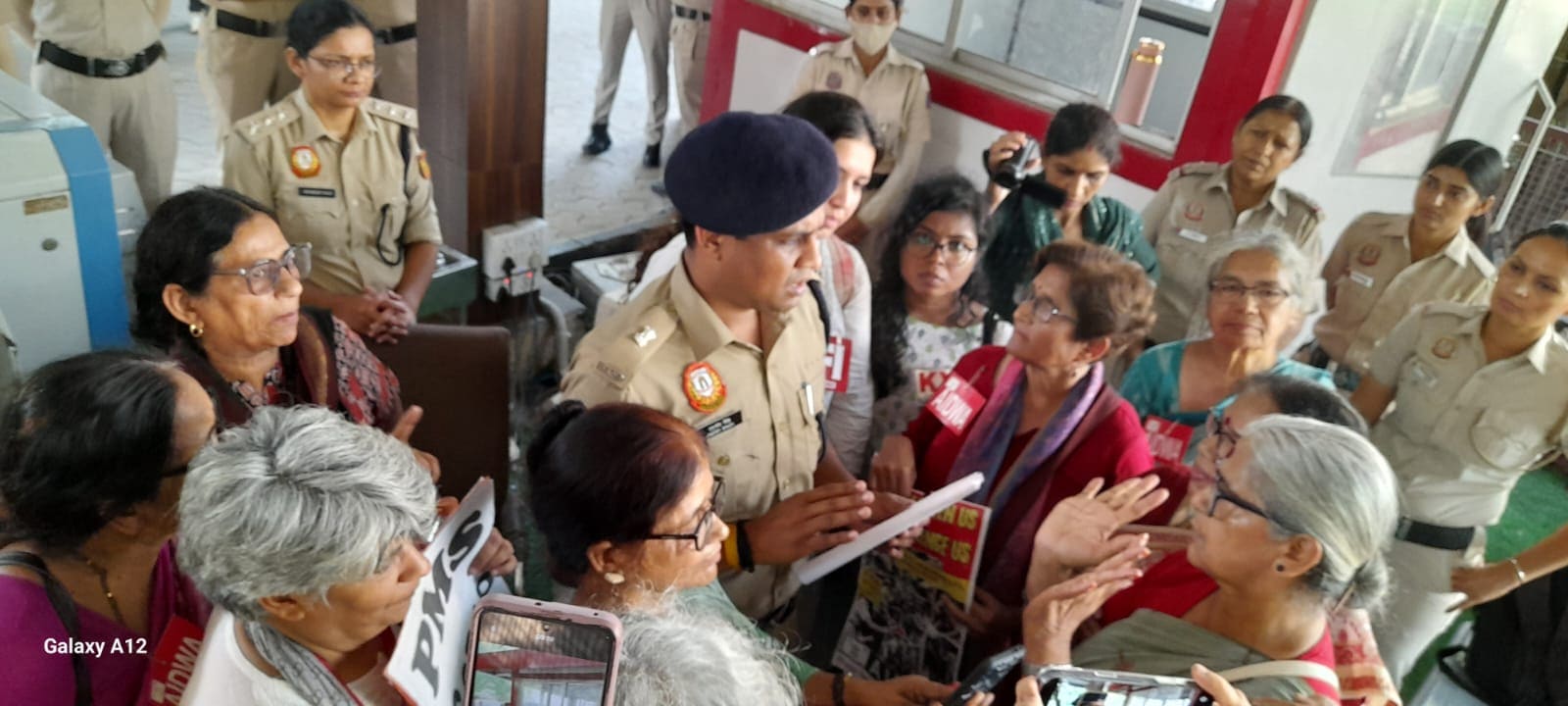
In another video, a male police officer can be seen pressed against a woman protester in a bus. “In addition to the attacks that occurred in full public view, similar and worse accounts of sexual and gendered attacks have been reported from within the detention buses and the detention centres themselves,” noted a joint statement by AIDWA (All India Democratic Women’s Association) and other women’s groups. “These deliberate actions by the authorities are nothing but misogynistic attempts to silence women’s voices and reveal a larger intent to push us out of politics and public life.”
When a woman’s clothes are torn in public or she is physically lifted and dragged by the police the assault goes beyond brute strength to an act of dehumanisation. What is lost is not modesty but dignity. What is stripped is not a garment but her professional identity as a reporter. This is the might of the state telling women who dare to question it where they belong.
What is attempted is a chilling effect, a cautionary tale to other women of what they risk simply by doing their jobs.
But women have been leading protests, from December 2012 to Shaheen Bagh. This is no different. Neha Bora, a student leader, represents a generation of young women who know they have everything to gain by challenging the status quo. These women are unafraid to voice their hopes and aspirations. They are shaking the cages that have held them in check. Perhaps this is why the state fears them.
(Full disclosure: I am a member of the NWMI collective)


