The 28th Conference of Parties (COP28) to the UN Framework Convention on Climate Change (UNFCCC) began in Dubai, United Arab Emirates on November 30 and will continue till December 12. The successive annual COPs since the Paris Climate agreement of 2015 have each fallen short of mobilising international efforts at a scale appropriate to the challenge of the climate crisis, even as the enormity of the challenge itself is becoming larger by the day. The current year could be labelled
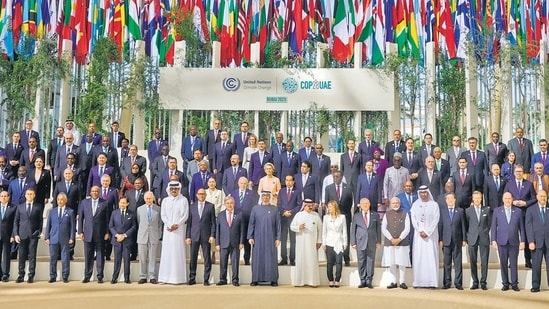
The 28th Conference of Parties (COP28) to the UN Framework Convention on Climate Change (UNFCCC) began in Dubai, United Arab Emirates on November 30 and will continue till December 12. The successive annual COPs since the Paris Climate agreement of 2015 have each fallen short of mobilising international efforts at a scale appropriate to the challenge of the climate crisis, even as the enormity of the challenge itself is becoming larger by the day. The current year could be labelled as the “Annus Horribilis” of the global climate crisis: 2023 is set to be the warmest year on record. There have been heat waves across much of the temperate and tropical zones of the planet. The frequency and intensity of extreme climate events have risen precipitously. One example is from our neighbourhood in Pakistan, which received torrential rains and suffered extensive flooding affecting over 30 million people. That the world is facing a climate emergency is now undeniable. Will COP28 be different from its predecessors?
One, a deeply fractured geopolitical situation makes the task of mobilising a serious global and collaborative effort more difficult. We are in the midst of two major wars, one in the heart of Europe in Ukraine, and the other in West Asia in Gaza. These conflicts have polarised opinion across the world in a manner not seen since the Cold War. Climate negotiations cannot be insulated from this divisive sentiment and lack of trust among countries.
Two, any credible pathway towards an ecologically sustainable future requires an accelerated transition from the current reliance on fossil fuels to a pattern of economic activity based progressively more on renewable energy and clean energy. The technologies required for this transition are available and are increasingly cost-effective.
However, their deployment requires the deployment of huge resources and significantly enhanced transfer of finance from developed to developing countries. This is unlikely to happen when the continuing wars are sucking up resources from the developed West.
Their economies are still suffering from an inflationary surge with interest rates going up. Even if enhanced commitments are made, they will not be fulfilled as we have already seen with the major shortfalls in the meagre $100 billion in annual climate finance which was on offer since the Paris Agreement.
There will be much cheer in the setting up of the Loss and Damage Fund in Dubai, but how it will be funded and what criteria will be used to channel funding to the most affected countries remains to be seen. Will India be one of the beneficiaries? I would not hold my breath!
Three, all indications are that there will be no serious effort to phase down or phase out all fossil fuels- coal, oil and gas, which is what the energy transition requires. Sixty per cent of emissions originate from the use of oil and gas and 40% from coal. However, massive investments continue to flow into the oil and gas sectors while coal has become the target since fewer advanced countries rely on coal and China, the largest generator of coal-based thermal power, has reached a saturation point. There will inevitably be a focus on a country like India whose energy mix will continue to have coal as a major energy source for the foreseeable future.
India has low per capita greenhouse gas emissions, about 2.4 tonnes per capita of carbon equivalent, which is less than half of the world average. But our overall emissions, which are 7% of the global volume, are rising the fastest among major emerging economies. Unfortunately, it is the rate of increase that is highlighted in global climate discourse. Illustrative of this is a Time magazine cover story published on January 12, 2023, with the heading, “How India Became the Most Important Country in the Climate Fight”. It suggests that India’s continued reliance on coal as its principal energy source would adversely impact the global effort on the climate crisis going forward as India’s energy demand would continue to grow. There may well be pressure on India to declare an early peaking year for its total emissions since China is likely to do this by 2030. This has to be resisted because even by 2040 or 2050, a peaking of emissions will essentially imply a cap on our development.
COP28 is important because it will conduct the first five-year global stocktake “to assess the collective progress towards achieving the purpose of (the Paris) Agreement and its long-term goals.” The assessment is to cover mitigation, adaptation and means of implementation including finance, technology transfer and capacity building. The Synthesis Report, which will form the basis for this exercise, paints an alarming picture. Based on data collected on the nationally determined commitments made by parties to the Paris Agreement, the world is currently on track to a temperature rise of 2.5 or 2.6 degrees centigrade by the end of the century, which will be catastrophic.
To stay within the 1.5-degree average global temperature rise stipulated under the Paris Agreement, there must be a peaking of global emissions before or by 2025. Further global emissions must be reduced by 43% by 2030 and 60% by 2035 as compared to 2019. It is unrealistic to expect that these radical goals will be embraced at COP28. We are in a race against time and time looks to score an easy win.
What can India do at COP28 to enhance its own interests even while mobilising an international effort towards a more ambitious but also a fair and equitable outcome? It is in our interest to raise our renewable energy target and to promote the biofuel initiative launched at the Delhi G20 Summit. A global initiative to promote green hydrogen like the International Solar Alliance would also be worthwhile.
Our expectations from COP28 should be modest. Our expectations from ourselves in accelerating our energy transition should be more ambitious. This will promote India’s energy security even while contributing to the global fight against the climate crisis.
Shyam Saran is a former foreign secretary and a former special envoy of the Prime Minister for climate change. The views expressed are personal
One Subscription.
Get 360° coverage—from daily headlines
to 100 year archives.
Archives
HT App & Website