Early Friday morning (India time), the curtain came down on the 12th ministerial meeting of the World Trade Organization (WTO) in Geneva. Trade ministers from 164 countries seemed more than exhausted due to round-the-clock small group and green room meetings in a pressure-cooker format.
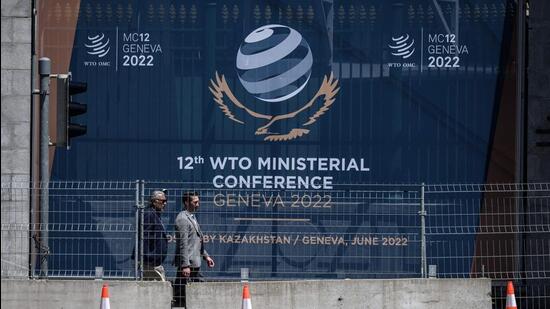
Influential members such as the European Union (EU) appeared to be the biggest winners. India also claimed success at the meeting. “PM Modi’s focus on welfare of the poor adopted on the global stage,” commerce minister
Early Friday morning (India time), the curtain came down on the 12th ministerial meeting of the World Trade Organization (WTO) in Geneva. Trade ministers from 164 countries seemed more than exhausted due to round-the-clock small group and green room meetings in a pressure-cooker format.
Influential members such as the European Union (EU) appeared to be the biggest winners. India also claimed success at the meeting. “PM Modi’s focus on welfare of the poor adopted on the global stage,” commerce minister Piyush Goyal said in a press statement. “Gone are the days, when India could be arm-twisted to accept outcomes that hurt the poor,” he added. Still, some developing countries and the poorest countries were not invited to the so-called green room meetings, the permanent opaque feature of WTO negotiations. The green room meetings are conducted by the WTO’s director-general (D-G), and involve up to 20 developed and developing countries in making decisions. The rest of the 140 members are excluded and kept in the dark till the decisions are brought to them, a way of short-circuiting multilateral principles.
But after all the noise about the meeting, how well did India do?
Let’s start with vaccines and diagnostics related to Covid-19. Despite having the support of more than 100 WTO members, India could not push through a proposal seeking a temporary waiver from WTO rules (a TRIPS waiver) to facilitate access to vaccines, diagnostics, and therapeutics in poor countries. The final outcome is almost identical to the EU’s proposal, which was meant to counter India’s proposal.
On October 2, 2020, India and South Africa had presented a comprehensive proposal to suspend provisions like the copyrights, industrial designs, patents, and undisclosed information of WTO’s TRIPS (trade-related aspects of intellectual properties) Agreement for combating Covid-19 so as to ramp up production of diagnostics, therapeutics, and vaccines across countries. Last year, the EU submitted its proposal that focused narrowly on relaxing the compulsory licensing provisions in the TRIPS agreement. India’s request for a virtual ministerial meeting in December last year to resolve this issue went unheeded. Instead, the WTO D-G constituted a group of four, the United States (US), the EU, India, and South Africa, to arrive at a solution. After months of negotiations, the draft text that emerged appears to have largely incorporated the EU’s proposal, while ignoring the original issues raised by India and South Africa. And the outcome does not achieve additional flexibilities over what is already in the WTO rulebook.
On the issue of fisheries subsidies, India gets two years to put in place a regime for managing and monitoring marine fish stocks. If it fails, it will be compelled to stop support for poor fishermen. Therefore, the claim that India fought hard to secure the ability to enhance its fishing capacity in future is not entirely accurate. It has this right under the UN Convention on the Law of the Sea.
Another issue relates to the temporary moratorium on customs duties on electronic transmissions. India’s stated position was that it would oppose any further extension of this temporary moratorium. This will now be decided only in 2024 and there is a real possibility that it could be extended again by a decision of WTO’s General Council. It is relevant to mention that India did not back Indonesia, South Africa, Sri Lanka, and Pakistan strongly on this issue.
The outcome document creates a window for an open-ended process for WTO reform – an objective pursued by the developed countries. Almost all elements of their demand figure in the outcome. The fact is that the reform process would be undertaken by the General Council of the WTO and there is no reassurance that basic features of the organisation — consensus decision-making, special and differential treatment for developing countries, and member-driven character of the WTO – will be preserved. While India managed to incorporate some of its textual provisions, many other provisions in the Ministerial Outcome document could open the floodgates for proposals that may do away with the special and differential treatment, the consensus principle for decision-making, flexible negotiating processes for pursuing what are called plurilateral (two or more countries) agreements and other such issues. Effectively, these issues being raised by the US, the EU, and other industrialised countries could torpedo India’s development agenda.
Under the garb of sustainability, the final outcome documents have provided multiple windows for negotiating onerous rules on the environment. There have been repeated public statements by the commerce minister and commerce secretary over the past few months in the Free Trade Agreement context that modern trade agreements in the 21st century cannot be finalised without provisions on trade and sustainability, and it is likely India’s position was tempered by this.
Finally, the issue of utmost importance for India, a permanent solution to public stockholding for food security, does not find a mention in the outcome, unlike in the previous ministerials. On the contrary, the importance of this issue has been considerably undermined by the Declaration on Food Insecurity, which discusses many other approaches and dimensions to food security.
This is the reality of the negotiating table. So, as the applause dies down, India would do well to reflect on its gains and losses and identify what it needs to do — not just to further its own interests but also those of other developing countries.
Ravi Kanth Devarakonda is a senior journalist based in Geneva
The views expressed are personal
One Subscription.
Get 360° coverage—from daily headlines
to 100 year archives.
Archives
HT App & Website