
 E-Paper



Grazing ground a ray of hope for pro golfers in Mhow
The prospect of changing tack made him feel worse than in early 2008, when he wanted to quit the game after failing to make cut in six appearances on the domestic tour.

 Prefer HTon Google


Without a practice facility since 2015, Om Prakash Chouhan, a five-time winner on the Professional Golf Tour of India (PGTI), contemplated leaving golf and roughing it out in overalls at the nearby Pithampur Industrial Area. The prospect of changing tack made him feel worse than in early 2008, when he wanted to quit the game after failing to make cut in six appearances on the domestic tour. This time, the 31-year-old champion from Mhow, a cantonment town in Madhya Pradesh, found himself without even a course to play on. In a desperate bid, he finally went to a neighbouring gaushala (cow shelter). They gave him permission to practice on land meant for grazing cattle.
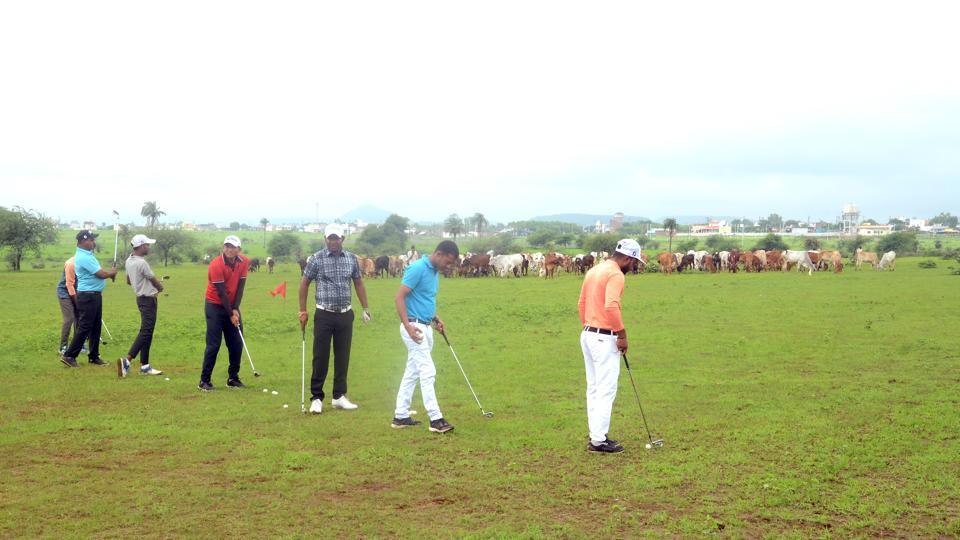
Chouhan had learnt to play at the Dussehra maidan, which also housed the Army golf course, when he started out at age 10. Access was never an issue as his father, Prem Singh, was a part of the green maintenance team at the course. In 2015, the golf course shifted to its current location at the Army War College, and civilians were barred entry. The Army maintains that its golf courses are environmental parks meant only for training officers. A few years down the line, the move is threatening to dislodge Mhow from India’s golf map as not only Chouhan but a dozen of his training partners, some winners on the Indian Golf Union’s amateur circuit and others young professionals with promise, have little to fall back on save the determination to beat the odds and carry on Mhow’s legacy of consistently producing quality golfers.
All of these golfers—a group of roughly 12—now practice their game on the grazing grounds.
It isn’t as if Chouhan hasn’t tried. He approached the golf club for membership, but the request was turned down.
For two years, he got no access. After Colonel (retd) Daljit Singh took over as secretary last year, the situation got better, but only just. Chouhan has permission to use the chip and putt area but can play the course only on Tuesdays between 8.30 am and noon when officers are not there.
Chouhan is thankful, but it is hardly a solution as the back nine of the golf course, where he has access, is poorly maintained. With caddies, children and greenkeepers jostling for space, it is hardly ideal for a professional.
Despite attempts, no official of the golf course was available for comment.
Chouhan’s concern stays unresolved but he has ploughed on, telling himself that stopping would belittle the hardships his family has borne to support his dream.
“I have made peace with the fact that I will probably never get playing rights on this golf course, but there is no giving up,” Chouhan said. “As my father keeps saying ‘if you work hard, you can rise from any situation’.”
On paper, he has a tract of wasteland, or “jungle” as he calls it, as his practice area, but turning up every day when he’s not on tour has taken a toll on the body and pocket. Soon after he started, Chouhan experienced pain at the base of the right thumb because of hitting balls on the undulating ground. “Often, the club head strikes a stone as the ground is full of them,” said Chouhan.
Medical advice wasn’t sought as the doctor would have suggested rest and Chouhan couldn’t afford to stop as he had to pay off the loan his father had taken for his golf, and staying off the tour would have led his ranking to plunge on the PGTI order of merit. That brush with injury has made him careful with ball striking, but little can be done about the quick wear and tear of the clubs.
“If one practices at a proper course, a set lasts four years. Here, the club heads get damaged in less than two years due to the constant impact with stones,” he said.
Chouhan may be pain free now but his training partners play with constant pain in the wrists and elbows.
As much as the group tries to make the most of what they have, they are often at nature’s mercy. From April till the rains come in late June, the practice ground becomes hard due to heat and the risk of injury goes up during ball striking. The boys move to an adjoining area, where the soil is softer.
After finishing practice, they pour water and cover the space with gunny bags to keep it soft for the next day. When monsoon sets in, the scene shifts to the makeshift putting green, which Chouhan has built near his house. Making do on this scratchy practice area has also led him to lower his targets rather than focus on winning as the second half of the PGTI season kicks off on September 12 with the Classic Golf & Country Club International Championship in Mewat, Haryana, which is also part of the Asian Tour.
“There’s a lot of difference between practicing in the jungle and fairways, and as a result, club selection becomes a problem during tournaments,” said Chouhan. The past two seasons, he missed cut in some of the season openers, which set him back. “It takes a couple of events to get the feel back as the mindset at the start of the year is not to miss cut.”
Shifting to nearby Ahmedabad, which has quite a few golf courses and is a six-hour drive from Mhow, has crossed his mind a few times, but the cost of setting up another base is a deterrent. It’s not been long since Chouhan repaid the loan his father took to support him.
And though he earns well now, the money is meant for the family—his father retires soon and he wants to give his brother, Deepak, a chance to resurrect his golf career.
In 2008, when Chouhan was without the means to continue as a pro, Deepak worked at the Pithampur Industrial Area to raise money for him to play at a PGTI tournament in Gurgaon. There, he made his first cut on the pro circuit and has not looked back.


