
 E-Paper



Indian boxer punch big at Asian Boxing Championship
Amit Panghal (52kg) calmly went about his business against Korean Kim Inkyu and did what was expected of him, win a gold medal.

 Prefer HTon Google


Blood trickled down Kavinder Singh Bisht’s right eyebrow to his cheeks. Kavinder had got the cut while beating the reigning world champion Kairat Yeraliyev of Kazakhstan in the quarterfinals, and now, in the final, it had opened again. His opponent, Asian Games gold medallist Mirazizbek Mirzahalilov from Uzbekistan, focused on landing his punches on the cut. Kavinder was undeterred, launching his own attack with a furious combination.
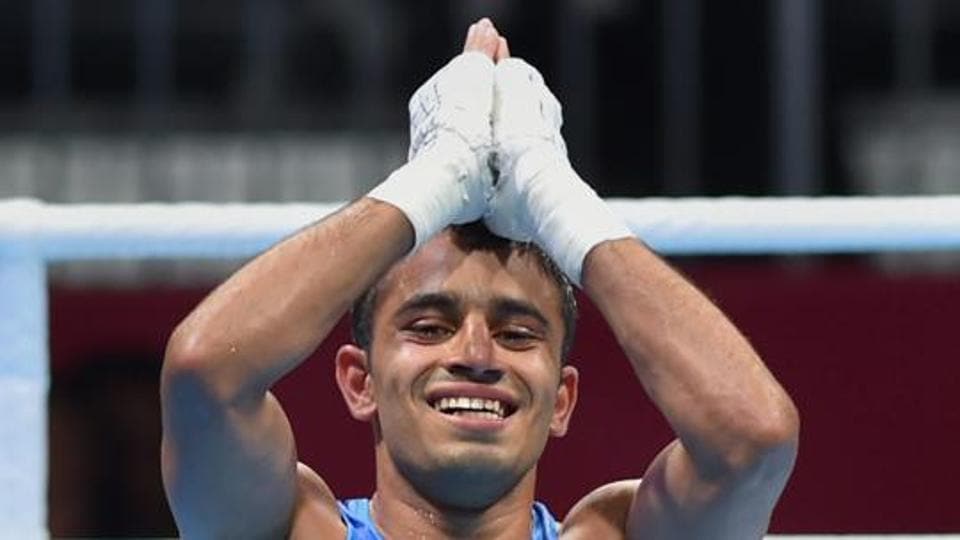
In the end, the 24-year-old Indian lost the bout, but not before announcing himself on the international stage at the Asian Boxing Championship in Bangkok. Before Kavinder’s gutsy silver, Amit Panghal (52kg) calmly went about his business against Korean Kim Inkyu and did what was expected of him, win a gold medal. The 23-year-old Army man is fast establishing a reputation as one of the best in the world in his weight class.
The bout of the day, however, belonged to Pooja Rani, who shocked the reigning world champion Wang Lina of China in the 81kg final. The seasoned Indian boxer was fearless and attacked with purpose. A six-time national champion, the Haryana girl was disappointed when she was not selected for the World Championships at home last year without any trials in her weight category. But she bounced back with a national title, earlier this year, to prove herself. It was her third medal, but first gold in the Asian meet, having won silver in 2012 and bronze in 2015. The second woman boxer in the finals, Simranjit Kaur (64kg), had to be content with silver after losing to China’s reigning world champion Dou Dan in a 1-4 decision. Two other boxers, Deepak Singh (49kg) and Ashish Chaudhary (75 kg) also won silver.
India finished the championships, which was held jointly for men and women for the first time, with 13 medals: two gold, four silver and seven bronze. It is not just the Indian team’s best performance at the Asian Championships, it is also a big leap from last year’s Asian Games, where India won just one gold and one bronze. “The Indian boxing scene is looking very good, very positive,” India’s high performance director Santiago Nieva told HT. “From where we were at the Asian Games, it is a big stride forward as we look ahead to Tokyo Olympic qualification. Now we need to prepare well for the World Championships.”
Return to the ring
India’s campaign was a story of sweat and blood, one that could go a long way in reviving the sport that went downhill when the national association (IABF) was suspended by international federation (AIBA) in December 2012.
For the next three years, the boxers were left in the lurch with hardly any international competition and exposure.
“We kept ourselves going with the hope that things will get better. We were taking part in smaller competitions during that time” says Kavinder. “This is my first medal in a major competition. Beating the World Champion in the quarterfinals was a big achievement for me. When you play such big players and beat them, it simply doubles your confidence.”
Panghal’s gold
Focused and brave, Panghal defeated Korea’s Kim Inkyu in a unanimous decision to win gold medal. Facing an opponent much taller than him, Panghal took his time to gauge the Korean’s reach before deftly stepping in. He used his nimble footwork to good effect, moving inside the Korean, and staying low to evade oncoming punches. Panghal was competing in 52kg for the first time, after moving up from the light flyweight (49kg) category where he won the Asian Games gold last year. There is no 49kg category in the Olympics.
“I have worked on my power and reach. It is a very important medal because I was able to test myself against top opponents as I will meet them at the World Championship,” Panghal said.
Controversy
In the first fight of the day, Deepak (49kg) lost to Nodirjon Mirzahmedov of Uzbekistan in a bout that the Indian coaches strongly felt should have gone in their favour.
“Deepak was clearly the better boxer in the first two rounds. Yes, sometimes, we may not see the punches clearly from the corner but we thought he was the gold medallist today,” said Nieva.
The system of protest will be re-introduced at the World Championships. It was on trial here and the Indian camp immediately sought a review of the first two rounds. “That’s all we could have done. But Deepak, the way he played, showed his class today.”
What worked for India is a new focus on aggression in the ring. “Boxers from Tajikistan, Kazakhstan, will keep throwing punches. They are very aggressive. We wanted our boxers to be more attacking and show aggression. They have executed it well,” said national coach CA Kuttappa. Handling the defensive tactics of opponents was another aspect that needed work.
“Our boxers were not very good when the rival used tactics like holding or clinching,” Nieva said. “We have worked on those areas and the results can be seen.”


