
 E-Paper



Imparting Constitutional values: A silent revolution is on in Maharashtra’s 67,000 govt schools
The programme is aligned with the National Curriculum Framework, 2005, designed by National Council of Educational Research and Training (NCERT) and Section 29 of the Right to Education Act, 2009 which calls for imparting constitutional values to children


The heart and soul of our democracy lies in the Constitution of India. But how familiar are we, our fellow citizens and our children with the essence of the Constitution?
In the simplest of terms, four words form the bedrock of our democracy: Justice, Liberty, Equality and Fraternity, enshrined in the preamble of our Constitution.
There is something fundamental that needs to bind us all in this vast, multi-religious, multi-ethnic and multi-cultural nation of ours. What binds us is not just our ‘Indianess’ — the fact that we belong to this land — but also, the lofty ideals as enshrined in the Constitution. The constitutional values enshrined in the preamble need to flow in our veins and become a part of our DNA.
Therefore, the silent revolution taking place of infusing our primary schoolchildren and teachers across the 67,000 government primary schools in Maharashtra merits attention.
It is being done through the Mulyavardhan programme designed by the Pune-based Shantilal Muttha Foundation (SMF), supported by the Tata Trusts, and implemented by the Maharashtra education department across 67,000 zilla parishad schools.
The programme is aligned with the National Curriculum Framework, 2005, designed by National Council of Educational Research and Training (NCERT) and Section 29 of the Right to Education Act, 2009 which calls for imparting constitutional values to children.
The programme is based on constructivist, activity-based pedagogy, with the use of cooperative and evidence-based learning.
On February 11, the Maharashtra state council of education, research and training, and its partners, Pune-based Shantilal Muttha Foundation and the Tata Trusts, held a day-long interaction with primary school teachers and principals of Thane district. The teachers and master trainers of the programme gathered at the Ram Ganesh Gadkari auditorium to share their experiences of the programme. They spoke of how children from Classes one to five were responding to the Mulyavardhan programme and the extraordinary changes taking place in their behaviour.
Short video clips made of a number of schools showing the implementation of the programme through group activities and other initiatives were screened at the event followed by an open discussion moderated by the eminent philanthropist and social worker Shantilal Muttha.
The feedback from teachers was that absenteeism has reduced significantly, there is greater respect for punctuality and there is a spirit of inclusiveness where children have become more accommodative of one another.
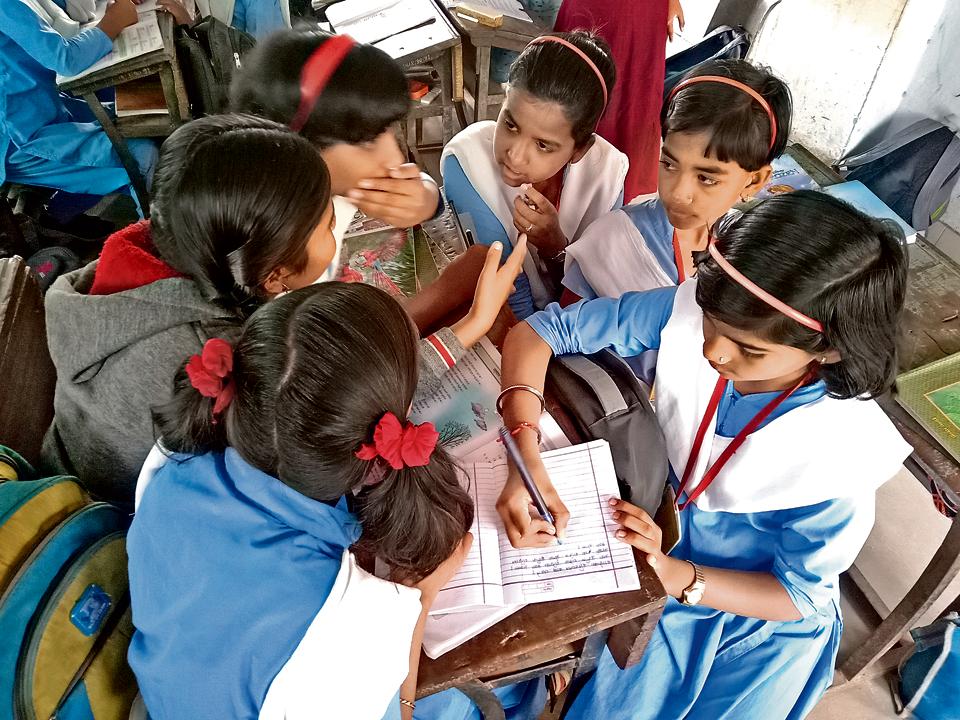
Under the programme, children are encouraged to create their own rules at school and at home, follow these rules as a part of their discipline and participate in various group activities.
“In our school, the children extended the rule of punctuality to our teachers and if the class teacher is late, they give a punishment,” one teacher said much to the shock and astonishment of the gathering. “And what is this punishment? The teacher has to sing a song or sketch something on the blackboard and entertain the students,” this teacher said, much to the relief and amusement of all.
In February 2016, in a report on the implementation of the Mulyavardhan programme, Govind Nandede, director, Maharashtra state council of education research and training (MSCERT) said that government teachers and cluster coordinators had received the programme wholeheartedly. “We feel confident that implementation of Mulyavardhan in schools will bring positive changes in students’ thinking and behaviour and also strengthen democratic values among them.”


