
 E-Paper



Story of Sector 17: Chandigarh’s heart has grown older than the city
BY THE WAY || The movie was Jahan Ara, the year 1964. There was only one set of ‘spools’, or movie reels, available for the city. But there were two theatres interested in playing it, both in Sector 17. Solution: Jagat Cinema started the movie half an hour after Neelam Theatre did, and the reels were shared.

 Prefer HTon Google


The movie was Jahan Ara, the year 1964. There was only one set of ‘spools’, or movie reels, available for the city. But there were two theatres interested in playing it, both in Sector 17. Solution: Jagat Cinema started the movie half an hour after Neelam Theatre did, and the reels were shared.
Yet, the sign outside both theatres read ‘House Full’ almost every day. “There were hardly 10 shops in the market at that time. You could see opposite Sector 9 from the Neelam lane,” recalls Jai Gulati, 67, whose father had just opened a grocery store called Empire Stores in the Neelam/Coffee House lane.
Cut to now. Neelam looks like a relic and is reduced to a landmark. It houses a food court that is often on the wrong side of the law; and it plays movies with the audience mostly comprising those who just can’t afford to go to a multiplex. Once in a while, there are rumours of its sale and redevelopment, and big names and multi-crore figures are thrown around.
As for Jagat, it has been converted into a mall that opened recently after a six-year battle with building bylaws. It is finding it hard to attract tenants in a sluggish market.
Weekdays can be tough for markets anywhere, but the decline here is visible on the weekends, when roads outside the city’s marquee mall are choked, and Sector 17 is at best a stroller’s delight.
“It’s not a mall. It’s a bazaar,” underlines Subhash Gulati, 72, Jai’s elder brother. Indeed. Malls have air-conditioning in an enclosed space that houses everything under one roof in a sanitised environment, while bazaars have only their liveliness, something grossly missing in the regimented, bylaw-bound environment of what was once considered the heart of Chandigarh. Its size was the big plus, but the minute a mall big enough came up, the deal was sealed.
Also read | The long and short of Chandigarh #shortskirtban
Over the past half a decade, the main bus stand has shifted from here to Sector 43, leaving only a few routes from Sector 17, and so have the district courts. Not long after that, the bubble created by realtors also burst. There was a time five years ago when a showroom of around 2,000 sq feet in Sector 17 reportedly went for Rs 22 lakh a month as rent. That’s the cost of a 2BHK flat in the periphery! But that’s not the comparison we need to make.
Here’s the perspective: That rental from 2011 is at least five times of what the same space costs in a prime mall now, and 10 times of what it costs in other markets of the city. The point was that you had to be in Sector 17 if you wanted to show you are a big brand. That’s no longer true. Sector 17 took itself too seriously, say old-timers, some of whom shifted their businesses on the first floor and rented out the ground floors for astronomical sums. Many such ground floors are now up on the rental market every six months or so. Rent has come down by 40% since the boom all but ended in 2012, having started around 2005.
But that’s the business side of it.
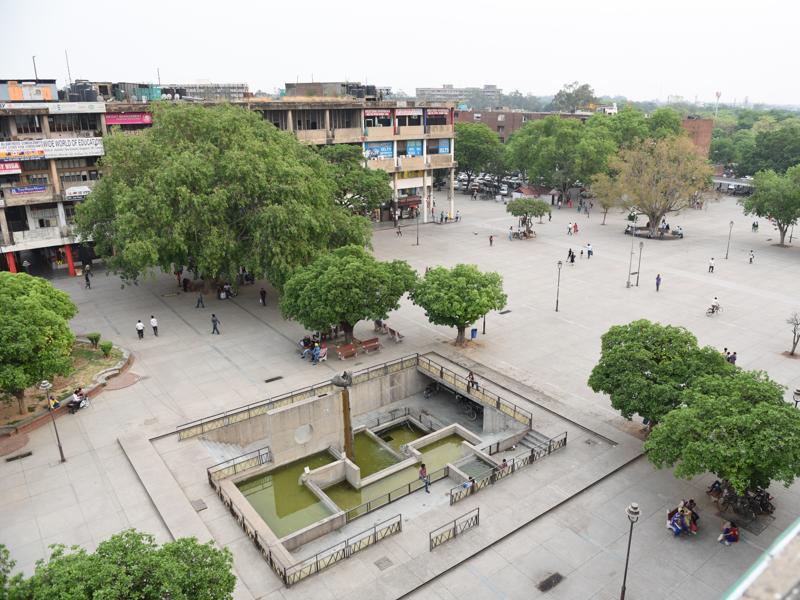
On the ground, words like rejuvenation and revival and upgrade are thrown around routinely, by bureaucrats who run the city, by politicians who claim to run the city, and journalists who think they know how to run the city. One thing everyone agrees on. Let’s use the vast space – the Plaza – for something that sets the market apart. Open-air cafes, fancy flea markets, seasonal fairs, licensed vendors, gazebos for people to sit and chat, and probably some more trees to counter Corbusier’s beloved concrete! Ideas float around like a mild breeze that never leaves Chandigarh.
But the obsession with a so-called heritage has meant Chandigarh’s heart has grown older than the city is. The minute the government plans to shift the parking space to a new underground lot, there are protests. The minute there are talks of allowing vendors, the elite of the city is worried about this ‘Paris-like’ city losing its sheen. The minute someone talks of the new in a city that claims to be a symbol of modernity, the ghost of Corbusier pops out of one of the many imposing, borderline-ugly behemoths that he built.
By the way, have those who talk of the city as some kind of European oasis in the middle of India’s grime and dirt ever been to that continent? I am sure they have, and clicked selfies with coffee cups and books aesthetically placed on a cafe table on the roadside in a car-free zone. I am sure they know what Sector 17 needs. (For the others, I suggest, watch some of the recent Woody Allen movies.)
Open spaces help a city breathe. And, no, that does not necessarily mean a designated, manicured park in every locality.
(This article is the first in a series in the ‘By the Way’ column about the past, present and future of Sector 17, contact writer at aarish.chhabra@hindustantimes.com)
Also read: Forget Gurgaon, Assam: If not rain, give Chandigarh the headlines


