
 E-Paper



Delhi Master Plan 2047: 40 lakh homes planned, affordable housing, 100+ floor towers and metro expansion in focus
To accommodate an expected population increase of 80 lakh, Master Plan 2047 targets 30-40 lakh housing units and vertical growth over the next 20 years


Outlining a long-term roadmap for Delhi’s urban development in line with the vision of ‘Viksit Bharat’, Union Housing and Urban Affairs Minister Manohar Lal said on August 20 that 30-40 lakh homes will be built in the national capital under Master Plan Delhi 2047 to accommodate its growing population, which is projected to reach 3.2 crore in the next two decades, with a focus on affordable housing.
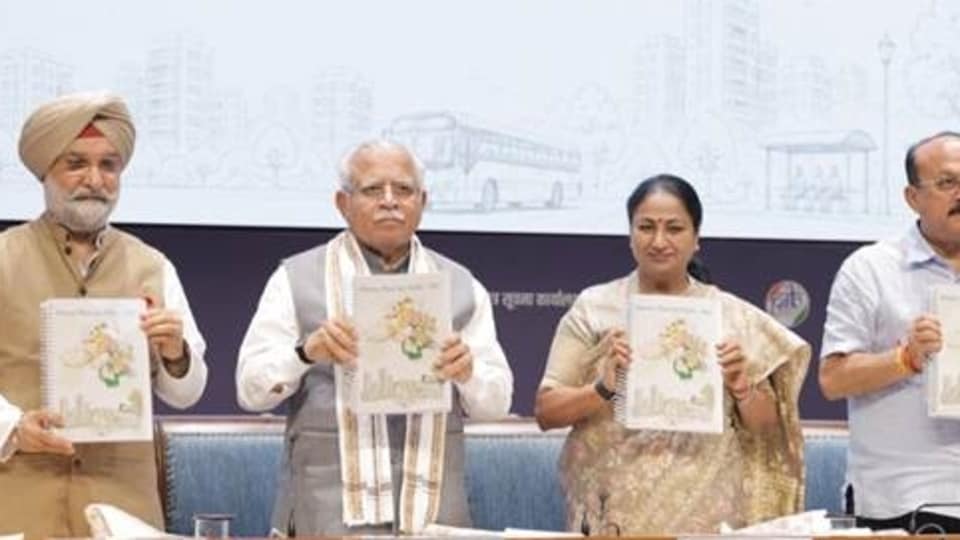
"Today, in 2026, the Delhi Development Plan 2047 has been officially launched, aligned with the contemporary vision of Viksit Bharat (Developed India) to establish a structured roadmap for the capital's growth through 2047," he said.
"To accommodate an expected population increase of 80 lakh and the growing prevalence of nuclear families, the new plan targets the addition of 30 to 40 lakh new housing units, with a primary focus on affordable housing," he said unveiling the Delhi Master Plan 2047.
"Because the city's total land area remains fixed at 1,483 square kilometres, this surging population creates immense spatial and infrastructural pressure, reinforcing the need for planned urban development," Khattar said while releasing the 535-page master plan, along with Delhi Lieutenant Governor T S Sandhu and Chief Minister Rekha Gupta.
Khattar said the plan was designed to ensure that Delhi's future expansion takes place in a planned manner while addressing the changing needs of its population.
Addressing a press conference in the capital, Khattar said Delhi’s population had risen from 94 lakh in 1991 to 1.38 crore in 2001 and 2.12 crore in 2021. It is currently estimated at around 2.4 crore and is projected to reach 3.2 crore by 2047.
Master Plan 2047 aims to meet this housing demand through redevelopment and densification of existing neighbourhoods, transit-oriented development (TOD), land pooling and planned expansion into new areas. Future housing development will be closely aligned with the availability of roads, public transport, water, sewerage and other essential infrastructure. In greenfield areas, future expansion will be driven largely through land pooling and other policy-led development models. The plan also promotes a mix of residential, commercial, industrial, recreational and public uses to create more integrated, self-contained neighbourhoods.
Metro to be expanded to 695 km by 2047
Under Master Plan 2047, Metro, RRTS networks are expected to support denser development.
Khattar said that the metro rail network will be expanded to 695 km by 2047 to support the growing population. Public transport, including metro rail, buses and six new Regional Rapid Transit System corridors, will also be developed in the city, he said.
Master Plan 2047 envisages high-density mixed-use development under the transit-oriented development norms within 500 m on either side of existing and planned Metro corridors and within 500-metre radius of nodes around RRTs, railway and high-speed rail stations.
On building norms in the city
Khattar said that the building height norms have been removed in the city, barring Lutyens' Bungalow Zone, Civil Lines Bungalow Area, Connaught Place and its extension, Zone 'O' (the Yamuna floodplain and the Ridge), Land Pooling Areas, Low Density Areas, and areas restricted under the Archaeological Survey of India (ASI) or the National Monuments Authority (NMA).
For plotted residential housing outside these special zones, the master plan prescribes a maximum height of 15 metres for plots without stilt parking and 17.5 metres for plots with stilt parking. Commercial activities will be allowed on ground floors along roads 30 metres wide in residential areas. Data centres, co-working areas and cloud kitchens have been kept under the new economies category, the minister said.
The Master Plan 2047, notified by the MoHUA on August 20, also paves the way for vertical and high-rise development, potentially allowing 100-plus-floor buildings to come up in Delhi. It categorises such structures as ‘tall buildings’ and classifies them as ‘landmark developments.’
Khattar also said there is a proposal for round-the-clock activity zones: “There is a proposal to develop '24-hour city' zones, where operations continue around the clock.”
Multimodal transit hubs at Anand Vihar, Sarai Kale Khan and Kashmiri Gate, a unified parking management system, and relaxed floor area ratio (FAR) for various categories are also a part of the master plan notified by the Ministry.
TOD to facilitate affordable housing
Transit Oriented Development Policy will facilitate affordable housing, Khattar said, adding no farm houses will be allowed in low density areas.
"Furthermore, to support seamless mobility, the framework prioritises public transport corridors--spanning Metro rail, bus networks, and RRTS--backed by a dedicated Transit-Oriented Development (TOD) policy to guide high-density growth along major transit routes," the Union Minister said.
TOD, or transit-oriented development, is an urban planning strategy that promotes homes, offices, shops and recreational spaces around public transport hubs. The aim is to reduce dependence on private vehicles, shorten commute times and lower transportation costs. Under TOD, higher Floor Area Ratio (FAR) may be allowed for land parcels near public transport corridors, enabling greater development and more people to live and work close to mass transit.
Also Read: Delhi Master Plan 2047 explained: What it means for housing, redevelopment and NCR’s real estate market
CM Gupta said the long-awaited MPD 2047 will revitalise the city by focusing on affordable housing and strengthening transportation facilities. The master plan, aligned with the vision of Viksit Bharat@2047, aims to transform Delhi into a world-class, inclusive and economically vibrant city for nearly 3.2 crore people.
"For Delhi, this is not just a Master Plan but a vision document for development, a comprehensive roadmap for development. Keeping the capital's current challenges in mind, it will set the direction for development in line with its future needs. Better coordination between the Central and Delhi governments was giving fresh momentum to the city's development," she said.
She said urban development planning under the new Master Plan has also taken into account the issue of rising transport-related pollution in the national capital. "Urban development planning has also taken into account the rising transport-related pollution in Delhi," the Chief Minister said.
Gupta said the plan seeks to provide housing for people across all sections of society. "A major highlight of this Master Plan is the provision of housing for all sections of society," she said.
She also said commercial operations would now be permitted on the ground floors of buildings located along roads that are 30 metres wide.
"A significant decision has also been made regarding commercial activities: commercial operations will now be permitted on the ground floors of buildings along all 30-meter-wide roads in Delhi," CM Gupta said.
She said Delhi's development should not be limited to roads and buildings, and it must have better housing, quality education, healthcare, employment, transport, green spaces and public facilities.
The chief minister said residents of several old residential colonies in Delhi have for years been waiting for a path towards redevelopment of their areas. "For the slum settlements in Delhi, work will be undertaken towards developing housing through the PPP model, with coordination between the DDA and the Delhi government. Providing eligible families with better and dignified housing is a priority for the government," she said.
LG Sandhu said that the MPD 2047 is a reformative framework with a long-term vision of a 'Viksit Delhi' which is part of the journey towards a Viksit Bharat' by 2047. It proposes a strategic and enabling framework to guide future growth of Delhi. “It is a transformative document,” he added.
24-hour city zones
Khattar also spoke about the proposal for round-the-clock activity zones.
“There is a proposal to develop '24-hour city' zones, where operations continue around the clock.,” he said, adding “Provisions are being made to ensure 24-hour transportation services, particularly Metro connectivity, for these locations.”
On low-density development areas, Khattar said, "Plans have been formulated for low-density areas; these include provisions for internal roads with an 18-meter width and master trunk roads with a 45-meter Right of Way (ROW)."
"To manage congestion effectively, the layout requires leaving open space along the plots on both sides of the 15-to-18-meter internal roads," he said.
MPD-2047 to boost real estate investment, spur new projects, say real estate experts
“After nearly a decade in the making, a notified Master Plan for Delhi 2047 gives the industry the certainty it has long been waiting for," said Amit Goyal, Managing Director of India Sotheby's International Realty.
It’s worth noting that the draft MPD-2047 that was cleared at the DDA meeting on 12 August 2026, also included the Green Development Area (GDA) policy, under which roughly 69 villages were slated for development combining residential and commercial hubs with green areas. That also finds no mention in the final gazette notified, he said.
"The real headline value creator is Transit-Oriented Development. As it takes off in earnest, higher densities along the metro and RRTS corridors could transform how and where Delhi lives and works. And the plan's ambition of roughly 40 lakh additional dwelling units over the next two decades is the scale of supply the capital requires," he added.
Parveen Jain, president, NAREDCO, said that “approval of the Delhi-2047 Master Plan is a very positive development for the capital and its real estate sector. The plan takes a more development-oriented approach to urban planning, with a clear focus on better infrastructure, efficient land use, investment and improved quality of life. This provides a strong foundation for Delhi’s next phase of planned growth.”
Harsh Vardhan Bansal, president, NAREDCO Delhi, said that “The approval of the Delhi-2047 Master Plan is an encouraging step for Delhi’s real estate market. What stands out is the plan’s focus on planned development supported by infrastructure, better land utilisation and a more flexible approach to mixed-use development. This can create a more conducive environment for developers to plan and invest in the city."
“This is a positive opportunity for the sector. With better integration of housing, commercial activity, mobility and infrastructure, MPD-2047 can encourage new projects, support investment and contribute to the creation of better and more liveable neighbourhoods across Delhi,” he said.


