
 E-Paper



Gen Z's housing wishlist for real estate developers: Co-working spaces, EV charging points, pet-friendly zones and more
For Gen Z, a home is no longer just about size. This digitally native generation prefers compact homes with app-based services and pet-friendly amenities

 Prefer HTon Google


When members of the Cockroach Janta Party (CJP) gathered at Delhi's Jantar Mantar to protest examination paper leaks, they weren't just demanding accountability. Their protest was designed for the social media age, with meme-worthy slogans, visual storytelling and a strong sense of community participation.
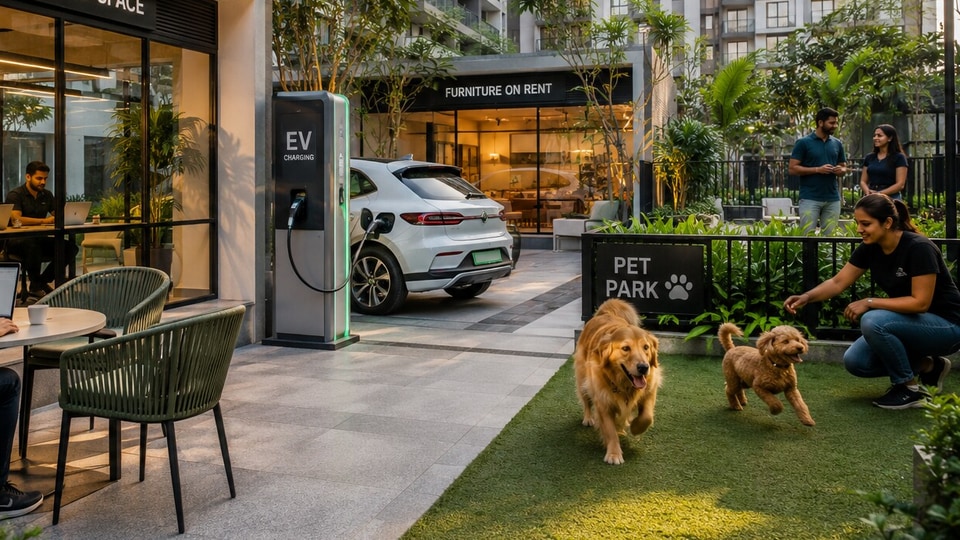
This generation that expects every service to be available on a smartphone, now wants homes to reflect those habits. Artificial Intelligence may be helping real estate developers interpret these changing preferences, but the bigger transformation is cultural: homes are no longer designed simply as places to live; they are designed around how Gen Z chooses to live.
While much of Gen Z is still renting or living with family, its older cohort, particularly those aged 25 to 29, is emerging as a key segment of first-time homebuyers. Many are salaried professionals in technology, finance, consulting, healthcare, and entrepreneurship, prompting developers to tailor projects to compact homes, smart technology, flexible layouts, and community-centric amenities.
Rent first, buy later
Unlike previous generations, Gen Z is not rushing into homeownership. For many young professionals, renting offers the flexibility to switch jobs and cities during the early stages of their careers. But buying remains the long-term goal.
As incomes grow and rents continue to climb in cities such as Bengaluru, Mumbai and Gurugram, many are choosing to buy homes earlier than they otherwise would have, seeing property as both a lifestyle upgrade and a long-term wealth creator, say real estate experts.
A recent report by NoBroker showed that even tenant behaviour is changing as fast as tenant demographics. Gen Z tenants switch homes roughly 1.5 times more often than older cohorts, compressing the rental cycle in a way that landlords are still adjusting to. Among tenants aged 18–24, as many as 30% move every six to 12 months, against around 10% of those aged 35 and above. As tenants get older, stability returns: the majority of those over 55 stay put for more than three years at a stretch, it noted.
Smaller homes, smarter design
Gen Z buyers are less concerned about owning the biggest apartment and more focused on making every square foot count. Instead of oversized homes, they prefer well-planned 1BHK and 2BHK apartments with minimal wasted space, flexible layouts that accommodate hybrid work, larger balconies, better natural light, open kitchens and intelligent storage solutions.
"Today, we go beyond identifying preferred amenities and focus on understanding how these people actually live, how their day unfolds and what matters to them at different moments," said Shivam Agarwal, Vice President, Strategic Growth, Sattva Group.
Rather than relying only on conventional market surveys, developers are increasingly deploying AI tools to analyse customer feedback and identify emerging lifestyle patterns, he told HT Real Estate.
Those insights are translating into tangible design changes. Young buyers wanted homes that ‘breathe’, prompting developers to improve cross-ventilation, increase ceiling heights and transform balconies into usable outdoor spaces. Storage, once an afterthought, is now being built into apartments through more flexible, space-efficient designs.
"Community design has also evolved. Buyers weren't looking only for amenities but for opportunities to connect. This led to the creation of interest-based clubs, open social spaces designed for everyday interaction, and curated resident experiences. Pet-friendly zones were consistently highlighted in feedback and are now thoughtfully incorporated into common-area planning," he said.
Technology no longer a luxury, dedicated parcel rooms a must-have
For Gen Z, technology is expected, not marketed as a premium feature.
App-based building management systems that allow residents to manage visitors, amenities and home services have become increasingly common.
The rapid growth of e-commerce has also changed residential design. Dedicated parcel and delivery rooms are emerging as a practical necessity, while EV charging stations are increasingly viewed as essential infrastructure rather than premium add-ons.
Community spaces are evolving, too. Instead of clubhouses used occasionally, developers are creating co-working lounges, wellness spaces, pet-friendly parks and informal gathering areas that encourage interaction among residents, say realtors.
Move-in-ready homes are gaining popularity
Young professionals relocating for work increasingly prefer fully furnished or semi-furnished homes, particularly in rental markets, to avoid the cost and inconvenience of furnishing an apartment from scratch.
Many also rent furniture through subscription services, allowing them to relocate easily and upgrade furnishings without high upfront costs. Once they purchase a permanent home, however, most gradually transition to owning furniture and prefer furnished apartments.
Developers say Gen Z is forcing the industry to rethink not just products but planning itself.
"Gen Z homebuyers are redefining what makes an apartment desirable," said Manan Joshi, founder of Sarvam Properties. "Beyond affordability, they are looking for smart layouts, modern amenities, seamless connectivity, co-working spaces, fitness facilities and technology-enabled conveniences."
Bhavesh Kothari, founder and CEO of Property First Realty, said younger buyers are taking a more analytical approach to homeownership, balancing affordability with connectivity, construction quality, lifestyle amenities and long-term appreciation potential.
Gen Z prefers using investment gains to purchase a home
According to JLL, millennials and Gen Z are expected to account for nearly 60% of new homebuyers by 2030. Their preferences are shifting demand towards sustainability, technology integration, neighbourhood experiences and flexibility rather than simply larger apartments.
The Anarock Homebuyer Sentiment Survey (H1 2025) had also highlighted a growing generational divide. While 63% of respondents across age groups identified real estate as their preferred investment, the motivations vary.
For millennials, homeownership remains closely linked to family formation, stability and long-term security. Around 70% of them plan to use investment gains to purchase a home. Gen Z is also embracing homeownership, but much earlier than previous generations. Rather than viewing property primarily as a legacy asset, they evaluate homes based on rental potential, appreciation prospects, financing costs and lifestyle value, while placing greater emphasis on flexibility and quality of life, it had noted.


