
 E-Paper



Aditya-L1 launch time: When and where to watch solar probe lift-off
Aditya-L1 launch mission time: The propulsion module of ISRO's solar probe will take around 125 days to cover nearly 1.5 million km from Earth to reach the L1.

 Prefer HTon Google


Aditya-L1 launch mission time: In less than 24 hours, the Indian Space Research Organisation (ISRO) is set to launch its ambitious Aditya L1 solar mission – days after the Chandrayaan-3 made a landmark touch down on the lunar surface, a feat only four countries have achieved so far.
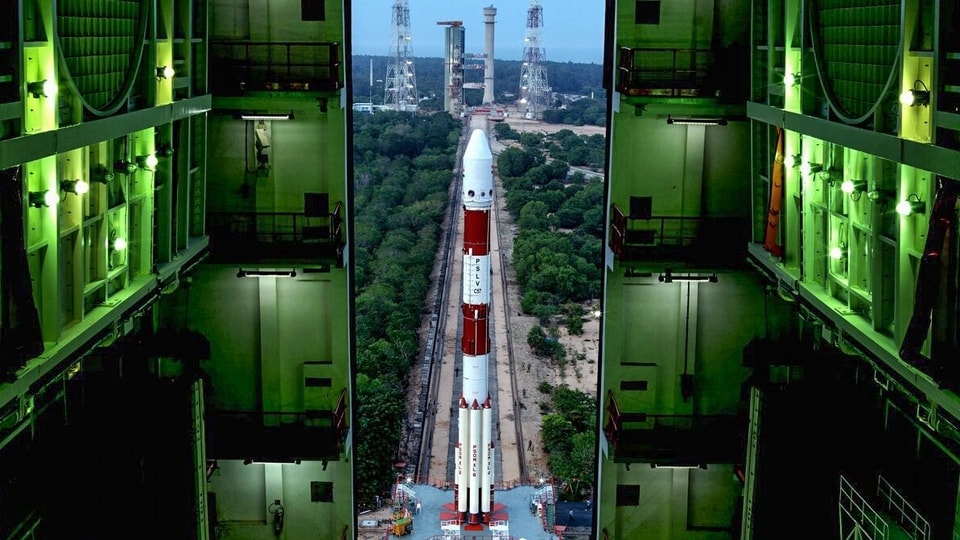
To set up the first space-based observatory to study the Sun, ISRO will launch the mission using the Polar Satellite Launch Vehicle (PSLV)-C57 from Andhra Pradesh's Sriharikota launchpad tomorrow at 11:50 am.
Follow Aditya L1 launch LIVE updates here
Where can you watch the Aditya L1 mission launch?
The Aditya L1 propulsion module will cover around 1.5 million km of distance in nearly 125 days to reach the Lagrangian Point 1 situated between Earth and Sun.
The PSLV-C57 carrying a total of seven payloads will lift off on September 2 at 11:50 am. The live telecast of the launch can be witnessed on ISRO's website, YouTube channel along with its social media handles. Viewers can also watch the live telecast on Doordarshan.
Similarly, you can also visit the Hindustan Times website to catch all the live action of the Aditya L1 solar mission.
What is the Aditya L1 mission?
The primary objective of the mission is to study atmospheric dynamics of the outer-most layer of Sun's atmosphere called corona and chromosphere. It will also carry out studies to find out the sequence of processes that occur at multiple layers of the Sun which eventually lead to several solar events including the ejection of solar mass in the form of solar flares.
"The suits of Aditya L1 payloads are expected to provide most crucial information to understand the problem of coronal heating, coronal mass ejection, pre-flare and flare activities and their characteristics, dynamics of space weather, propagation of particle and fields etc.," ISRO said in a statement.
Four out of seven payloads will study the Sun, whereas, three of them will carry out experiment at the Lagrangian Point to observe the local environment.
Why has ISRO opted the Lagrangian Point 1?
The name Lagrangian Point was given after the French mathematician Joseph Louis Lagrange for its discovery. These points are where the gravitational forces between two terrestrial objects balance each other enabling a spacecraft to hover in the area without the use of external force. There are a total of five such points and L1 is the most significant of them.
"A satellite placed in the halo orbit around the L1 point has the major advantage of continuously viewing the Sun without any occultation/eclipses. This will provide a greater advantage of observing solar activities and their effect on space weather in real-time," ISRO said.


