
 E-Paper



History lesson in mathematics: Ancient tablet reveals genius who lived 3,700 years ago
Scientists say they have cracked the secrets of a 3,700-year-old broken Babylonian clay tablet that likely contains secrets of trigonometry.


Remember racking your brains, trying to solving trigonometry problems back in school? Turns out a Babylonian man mastered the science 3,700 years back, a millennium before Greek mathematician Pythagoras came up with his formula on the right-angled triangle.
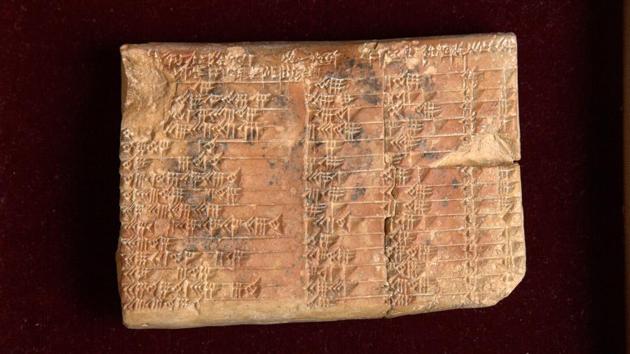
Scientists say they have cracked the secrets of a 3,700-year-old broken clay tablet in the collections of Columbia University. “...an unknown Babylonian genius took a clay tablet and a reed pen and marked out not just the same (Pythagoras) theorem, but a series of trigonometry tables which scientists claim are more accurate than any available today,” a report in The Guardian said.
Other experts, however, say the work on tablet -- Plimpton 322 (P322) -- is speculative.
“Consisting of four columns and 15 rows of numbers inscribed in cuneiform, the famous P322 tablet was discovered in the early 1900s in what is now southern Iraq by archaeologist, antiquities dealer, and diplomat Edgar Banks, the inspiration for the fictional character Indiana Jones,” another report said.
The scientists believe the tablet could have been used in calculations for construction of temples and buildings.
The UNSW Sydney, whose scientists discovered the purpose of the tablet, said the left-hand edge of the tablet is broken and the researchers build on previous research to present new mathematical evidence that there were originally six columns and that the tablet was meant to be completed with 38 rows.
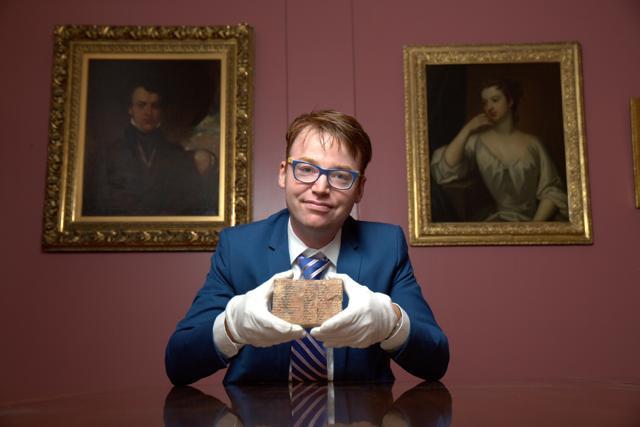
“Our research reveals that Plimpton 322 describes the shapes of right-angle triangles using a novel kind of trigonometry based on ratios, not angles and circles. It is a fascinating mathematical work that demonstrates undoubted genius.
“The tablet not only contains the world’s oldest trigonometric table; it is also the only completely accurate trigonometric table, because of the very different Babylonian approach to arithmetic and geometry,” says Dr Daniel Mansfield of the School of Mathematics and Statistics in the UNSW Faculty of Science.
Sciencemag.org quotes Mathematical historian Christine Proust as saying “(The idea is) mathematically robust, but for the time being, it is highly speculative.” “(It) is really an open question at the moment,” she says.


