
 E-Paper



Erling Haaland rewriting UCL history one game at a time; Lionel Messi, Cristiano Ronaldo's records in danger
Erling Haaland continues to set trend when it comes to goal scoring in UCL. Messi, Ronaldo's elite records are in danger.

 Prefer HTon Google


Erling Haaland is not stopping with his goal scoring and is thus bending the curve in the Champions League. The Manchester City striker hit the 50 goals mark in 49 appearances, the fastest anyone has ever reached the milestone. As of now, he has 52 goals in 50 matches, which means that this is just not another hot streak of a player; it is supreme consistency in front of the wooden bars.
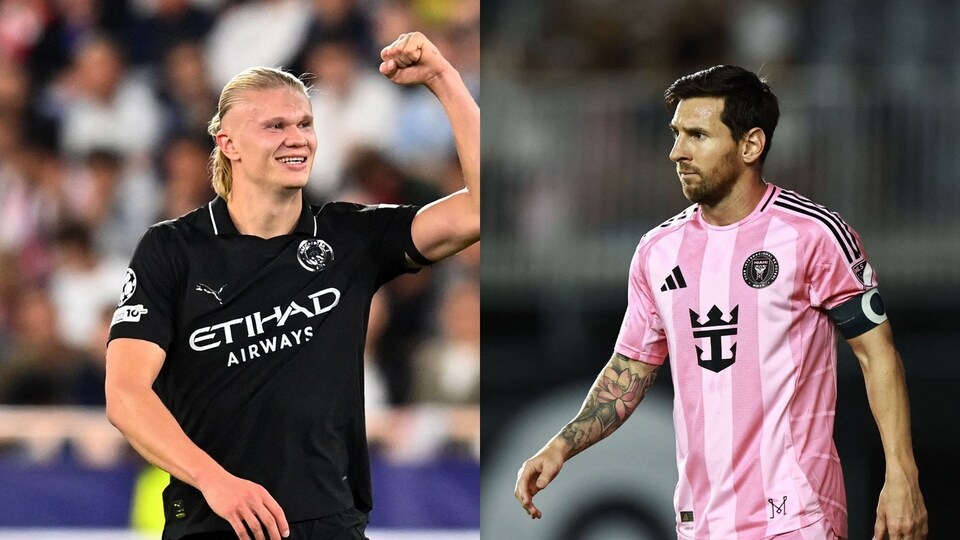
The Norwegian goal machine is now moving towards an elite record. The one in front of him is arguably the best the game has ever seen, Lionel Messi. Haaland closes in on Messi’s record of 60 UCL goals in 80 appearances. If Man City’s front man continues at the current rate, he would reach the landmark way ahead of the Argentinian maestro and might have the record under his belt by the end of this season itself.
Fewest games to reach 50 UCL goals
- Erling Haaland - 49 Appearances
- Ruud van Nistelrooy - 62 Appearances
- Lionel Messi - 66 Appearances
The headline is the gap in the number of appearances taken. Haaland didn’t shave a match or two; he wiped 13 games off van Nistelrooy’s record, a chasm in the elite list.
The Messi record ahead of Haaland
Lionel Messi’s 60 in 80 is a quintessential record of goal-scoring rate. His numbers are a reflection of peak Barca gravity, ruthless final-third execution that was repeatable over seasons. The reference pack around him gives an indication of why this was an elite feat to achieve. Robert Lewandowski took 85, Kylian Mbappe 89, and Cristiano Ronaldo 98 appearances to score 60 UCL career goals. Erling Haaland is on the path to clear that ladder, establishing the fact that he is quickly moving from fastest bursts to an era of sustained goal-scoring domination.
The sprint vs the summit: How far is Cristiano Ronaldo?
Cristiano Ronaldo’s affair with the Champions League is well established. He remains the competition’s summit when it comes to longevity and volume. However, his early mile splits show how unusual Haaland’s current sprint is. The Portuguese legend needed 91 matches to reach 50 UCL goals, and 98 to reach 60. The figures highlight the contrast between an all-time accumulator and an era-defining pace-setter. Haaland is detonating early checkpoints at a pace that even the all-time leader took far longer to clear.
Why Haaland’s pace travels
Pep Guardiola’s City manufactures high-value touches in the width of the posts. Haaland’s system of cut-backs, first-time finishes, aerials from the six-yard channel - maximises expected goals per shot and minimises the variance. That is precisely the template that keeps him ahead in the pace-setting trends.
Haaland’s runway was built before his time at Manchester City. Haaland front-loaded UCL goals while being a part of Salzburg and Dortmund, then moved into an atmosphere at Manchester City that turned out to be a chance factory for him. The curve is linear and steep across three different environments - the hallmark of a portable skill rather than a single-team spike.


