
 E-Paper



Here’s looking at the nominees for the best male and female athletes in 2021
In a year when record tumbled, all five men and women look fit to win on Wednesday


Not since Usain Bolt burnt the track in 2008 and 2009, setting inconceivable world records and winning Olympic gold medals at will in 100m and 200m sprints, has the world seen an athletics season quite like the one this year.
Track world records tumbled like rocks in a landslide—12 new world marks were set, some of them erasing timings that have stood for decades. And this before the Olympics in Tokyo had started. It was a season of scorching sprints, sizzling rivalries and extraordinary comebacks and tumbling records.
At the Olympic Stadium in Tokyo, the record-smashing continued, the athletes giving their all even inside an empty coliseum. Three more world records and 12 Olympic records were set in Tokyo.
So, when World Athletics decides their best Male and Female Athletes of the Year on Wednesday, they will have their task cut out for them.
Each of the 10 nominees—five men and five women—deserve the title.
Eliud Kipchoge, Joshua Cheptegei, Karsten Warholm, Ryan Crouser and Mondo Duplantis are the male nominees. Sifan Hassan, Sydney McLaughlin, Elaine Thompson-Herah, Faith Kipyegon and Yulimar Rojas are the women.
Many of these performances, like those of Bolt, set new standards that may stand for a long time.
Karsten Warholm
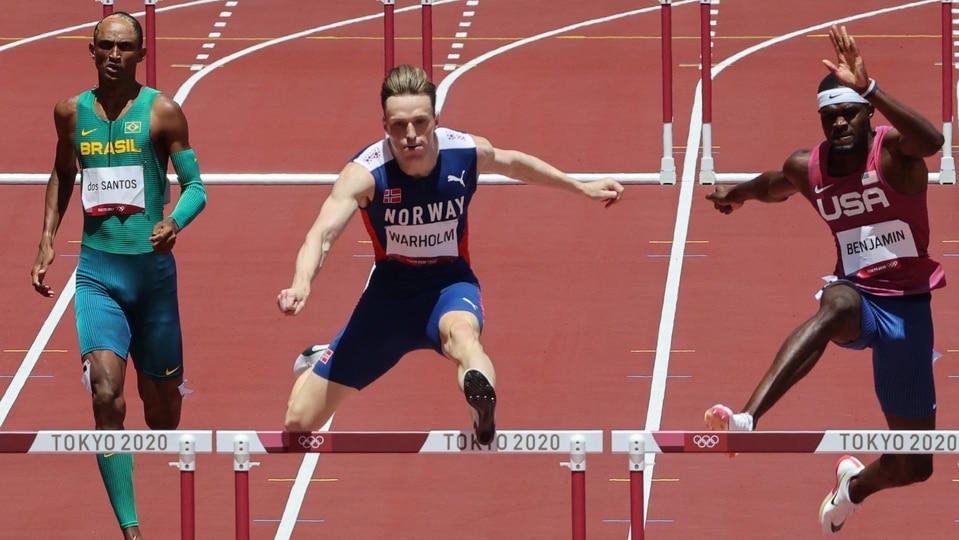
Warholm’s 400m hurdles gold in Tokyo is one of the greatest races ever run—each of the three medalists recorded a time that would have broken the previous world record.
Norway’s Warholm and Benjamin Rai of USA were hot on each other’s heels in the lead-up to the Games, chasing Kevin Young’s nearly three-decade old world record (46.78s). At the US Olympic trials in June last year, Rai became the second fastest hurdler of all time with a scorching 46.83s and coming within 0.05 of the long-standing world record. Warholm responded spectacularly, shattering Young's mark–set in Barcelona 1992 Olympics—clocking 46.70 in front of his home fans at the Wanda Diamond League in Oslo.
That came just a month before the Tokyo Olympics. Their much-anticipated showdown lived up to the hype in Tokyo. Warholm came up with a staggering run, decimating his previous world record—set a month ago–with an incredible 45.96s run, becoming the first man to dip below 46s. Even Rai smashed the world record by running a 46.17 but it was not enough. Such was the quality of the field that bronze medal winner Alison dos Santos from Brazil also came close to the world record (46.72s). With that freakish show in Tokyo, 25-year-old Warholm entered the club of all-time greats.
Sydney McLaughlin
The women’s 400m hurdles produced another spectacle amid the backdrop of a similar epic rivalry between compatriots Sydney McLaughlin and Dalilah Muhammad.
McLaughlin,21, had shown what to expect at the US Olympic trials where she clocked a world record timing of 51.90, producing the first sub-52sec time in history, beating world and Olympic champion Muhammad. Like Warholm, McLaughlin had another shot at the world record at the big Olympic stage. It was again a rare piece of history unfolding at the Olympic stadium in Tokyo, eerily similar to the 400m men’s hurdles race. McLaughlin beat Muhammad to the tape with her final strides, going past her previous world record — set a month before — clocking 51.46s. Muhammad, 31, also went past the world record 51.58s — but finished with silver. In a desperately close race, Femke Bol of the Netherlands, who took bronze, was just .13 seconds behind. McLaughlin and Muhammad were then part of the US team that won the 4X400m relay.
Elaine Thompson-Herah
Surprise was in store in women’s 100m and 200m sprints, where Elaine Thompson-Herah was one fire, becoming the first woman in history to win back-to-back Olympic sprint doubles.
In the run up to the Olympics, it was legendary Shelly-Ann Fraser-Pryce, who was making heads turn. Fraser-Pryce, the 100m Olympic champion of Beijing and London Olympics and winner of three world titles, clocked 10.63 in Kingston on June 5. That made her the second-fastest woman in history behind Florence Griffith Joyner (10.49s). She then won the 100m (10.71sec) and 200m with a personal-best timing of 21.79 seconds in the Jamaican Olympic trials ahead of Thompson-Herah in both races. At 34, Fraser-Pryce went to Tokyo with the potential to become the oldest individual Olympic sprint champion in history.
Thompson, however, shocked Fraser-Pryce with an explosive burst and with a new Olympic record of 10.61 sec, dismantling legendary Florence Griffith Joyner’s 33-year-old Olympic mark of 10.62s in the women’s 100m set at the 1988 Seoul Olympics. She simply blew away the field relegating Fraser-Pryce to a distant second (10.74s) and had enough time to celebrate, ala Usain Bolt, on the finishing line. She joined the elite club of Bolt after another sensational triumph in 200m (21.53s) to complete a rare sprint double.
Thompson-Herah capped her Olympic campaign three days later with a third gold medal teaming up with her Jamaican teammates for 4x100m title, setting another national record with 41.02.
Duplantis, Ryan Crouser and Yulimar Rojas
Mondo Duplantis was soaring over the bar in the last couple of years and won his first Olympic title comfortably. The world record pole vaulter, who won the Male World Athlete of the Year in 2020, notched up 15 victories and 14 six-metre clearances between January and September, setting world-leading marks of 6.10m indoors and outdoors.
Though he could not break his world record in Tokyo, Duplantis was simply class apart, competing all by himself when the rest of the field was done. Mondo was raising the bar one after another to attempt a new record. He almost cleared 6.19m — one centimetre beyond his world record — only for his chest to graze the bar and bring it down.
He suffered a rare defeat in his first competition after Tokyo, finishing fourth in Lausanne, but returned to victory at the Wanda Diamond League meetings in Paris (6.01m), Brussels (6.05m) and at the final in Zurich (6.06m).
Like Duplantis, Crouser dominating the shot put. He set the world records – 23.37m outdoors and 22.82m indoors, erasing marks 30 years old. But his incredible tally of 22-metre – and now 23-metre – throws cannot be ignored. He has 58 throws beyond 22 metres this year which is more than any other shot putter has achieved across his career span. He has three farthest throws in history. And at the Tokyo Olympics, he smashed the Games record with 23.30m to win gold.
Venezuelan triple jumper Yulimar Rojas, the two time world champion, earned the World Female Athlete of the Year award in 2020. She has pitched herself in reckoning with another big season that saw her achieve five of the top six jumps in history in any conditions, all of which she produced this year. In Tokyo, she was in a different league. She started with an Olympic record of 15.41m and smashed the world record by 17 centimetres (15.67m) with her final leap.
Kipchoge and Hassan
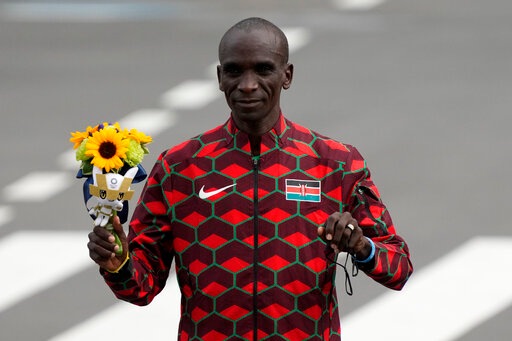
Middle-and-long distance running threw up incredible results. Eliud Kipchoge is already a legend. In 2019, he chased down his dream of becoming the first person to run a marathon (26.2 miles) under 2 hours. At the Tokyo Olympics, Kipchoge entered history books becoming only the third runner ever to win back-to-back Olympic marathons after Abebe Bikila of Ethiopia (Rome 1960 and Tokyo 1964), and Waldemar Cierpinski (Montreal 1976 and Moscow 1980).
Nothing could stop Kipchoge from his goal, not even soaring temperatures and sweltering humidity of Sapporo. Despite the tough conditions, Kipchoge won in 2:08:38, six seconds quicker than Rio and the fifth-fastest run in Olympic history. His winning margin of 1:20 was the biggest in an Olympic men’s marathon since Frank Shorter's win in 1972.
It was his second stunning performance of the year, having shown his class and tenacity with a world-leading time of 2:04:30 at the NN Mission Marathon event in Enschede, the Netherlands, three months before Tokyo.
Sifan Hassan was expected to blaze the field in Tokyo and she did it in style, claiming three Olympic medals, including two gold. She was attempting a golden treble but returned bronze in the 1500m. The gold medals came in 5000m and 10,000m.
“This Olympics is one of the best feelings I've ever had in my life. It's something special. I'll never forget it,” she said.
In May at the FBK Games in Hengelo, the 28-year-old Hassan clocked 29:06.82 to shave over 10 seconds off the world 10,000m record that had been set by Ethiopia's Almaz Ayana at the 2016 Olympic Games. It was quite crazy that the 10,000m mark stood just two days, as on the same Hengelo track, Letesenbet Gidey cut down five seconds to 29:01.03 to win the Ethiopian trials.
In Tokyo, however, Hassan showed up to first claim 5000m gold. She had fallen off in the 1500m heats earlier in the day but returned to the track 12 hours later to win in 14:36.79. After four days, she then won bronze in the 1500m behind Faith Kipyegon and Britain’s Laura Muir.
Less than 24 hours later she was back for the 10,000m and became only the second woman after Ethiopia’s Tirunesh Dibaba in 2008 to complete the Olympic 5000m and 10,000m double. She clocked 29:55.32.
Not to forget Joshua Cheptegei, the world 5000m record-holder, who became the Olympic champion. Cheptegei ran the second-fastest ever Olympic time of 12:58.15 one week after securing silver in the 10,000m (27:43.63) in Tokyo.
Kenyan middle-distance runner Faith Kipyegon also stole the show this year. She retained the Olympic 1500m crown with a Games record, set a world-leading time over 1500m, and won nine of her 10 races throughout the year on way to producing some of the fastest times in history.


