E-Paper



The moves that are catapulting Praggnanandhaa into the big league
The aggressive play of the 16-year-old from Chennai is winning him new admirers and the attention of top players too.


Eyes firmly focused on the computer screen, left hand placed on the side of his forehead – a horizontal stripe of temple ash adorning it – and nervousness etched on his face. When Grandmaster (GM) R Praggnanandhaa is plotting moves on the chess board, his demeanour doesn’t exude the confidence of a 16-year-old prodigy. There is none of the smugness that a teenager might display on the back of beating reigning five-time world champion Magnus Carlsen twice in three months and world No 10 Anish Giri, which is what he managed to do at the recently-concluded Chessable Masters while finishing runner-up to world No 2 Ding Liren.
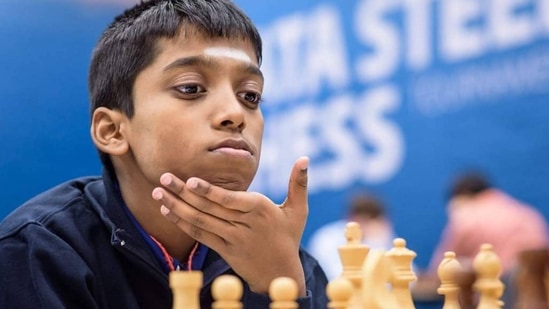
While that is reflective of his shy and reserved nature, it shouldn’t take away from the flamboyance that the boy from Chennai exhibits on the board. According to his coach RB Ramesh, Praggnanandhaa’s instinct has always been to take the initiative and gain the upper hand. That was a factor in his wins over Carlsen in February and May, exerting incessant pressure on the Norwegian and eventually drawing blunders out of him.
“In chess, we have two styles. One is an aggressive style and the other is a slow approach. He is good in aggressive positions, where he is attacking and taking risks. That is his strong point. We are also trying to make him better at playing quiet, simple positions without taking risks,” said Ramesh, who has been coaching Praggnanandhaa for close to a decade.
The youngster’s propensity for risk-taking has caught GM Dibyendu Barua’s eye too. Barua – who became India’s second GM, after Viswanathan Anand, in 1991 – first saw Praggnanandhaa in action at the Commonwealth Chess Championships in Scotland in 2014.
“He is gradually becoming a total player. That is why he is defeating top-ranked players. His instincts are very good. It is good to take risks at this age. If you just play games cautiously now, it will be difficult to cope with situations as you grow older. You become afraid of taking risks. Whenever there is a possibility, you should go for a win. I am not saying positional players are bad. Playing according to the position is required, but players should have the courage to take risks,” Barua said.
Praggnanandhaa’s recent run of results isn’t a case of a sudden spurt of course. He has been breaking records and making sure that his 14-letter name enters public conscience right from 2016, when he became the youngest International Master (IM) ever. In 2018, he became the then second-youngest GM while, in December 2019, he also became the second-youngest to achieve the rating of 2600.
However, GM Srinath Narayanan feels that there has been a significant improvement in Praggnanandhaa’s game since the onset of the Covid pandemic. If not for the many rapid and blitz tournaments that he has played online in the last couple of years, his classing rating is likely to have been a lot higher than 2642.
Srinath trains another talented teenager in 17-year-old Nihal Sarin, with 16-year-old D Gukesh rounding off a triumvirate widely believed to be the future of Indian chess. Where Praggnanandhaa stands out, according to Srinath, is in the wider repertoire of moves at his disposal. It makes him that much more difficult to counter because opponents cannot second-guess his moves.
“His game has stabilised a lot. I felt Praggnanandhaa was not quite strong strategically before 2020 and his openings needed a lot of work. The amount of improvement post pandemic without even playing classical tournaments has been astounding. Now he has a very impressive opening preparation. He is constantly finding new ideas everywhere. He is becoming a trendsetter of sorts in these aspects. His overall understanding of chess has also improved significantly,” Srinath said.
The need to work on Praggnanandhaa’s openings had been identified by Ramesh around one-and-a-half years ago. “He has made significant progress in that area (openings) in the last few months. At the higher level, you need to be good at everything. So, we are trying to move towards that. Currently, his endgame skills are pretty well developed. One area we are still trying to focus on is to make him a better player position-wise,” Ramesh said.
While mastering different positions on the board is one aspect, there is also the mental challenge of facing the top players in the world, knowing that there could be no coming back from the smallest of errors.
“It’s a massive challenge to not get overawed. Praggnanandhaa deserves big credit. But it’s also easier for this generation. They have had access to playing the top players in their early teens. They get exposure at an early age and have many more opportunities. It helps you understand that the top players are also human.”