
 E-Paper



India to detect Einstein’s gravitational waves! LIGO observatory by 2030
To observe gravitational waves predicted in Einstein's Theory of General Relativity, a LIGO lab will be established in Hingoli, Maharashtra.

 Prefer HTon Google


Back in the early twentieth century, physicist Albert Einstein proposed that when bodies such as stars or planets orbit each other, gravitational waves are produced, similar to ripples produced when a stone is thrown in pond. However, direct observation of the theory took nearly 100 years. The waves were detected in September 2015 by scientists using two Laser Interferometer Gravitational-wave Observatory in Louisiana and Washington, in United States. (Also read: A look at gravitational waves and LIGO)
But even so, more such observatories are needed to thoroughly analyse gravitational waves and cover the entire sky. With this motivation, the Narendra Modi-led Union Cabinet approved a project on Thursday to build and set up a Laser Interferometer Gravitational Wave Observatory-India (LIGO-India) in Hingoli, Maharashtra, at a cost of ₹2,600 crore, with oexpected completion by 2030.
Simplifying Gravitational waves
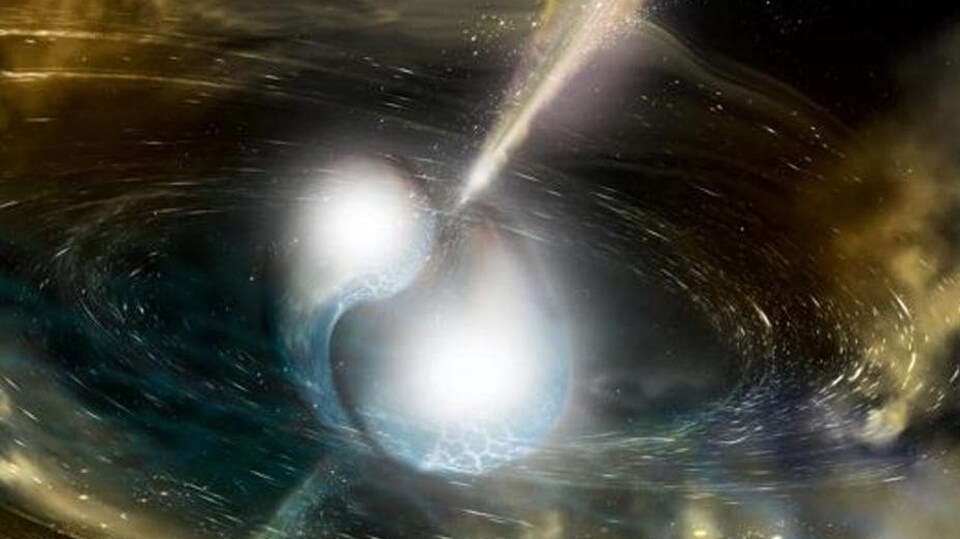
Einstein's Theory of General Relativity predicts gravitational waves as "ripples in space-time." Mass bends or curves space-time in the same way that a sheet is stretched when a ball is placed on it. When two masses orbit each other, they cause ripples in space-time similar to the ripples caused by two balls on a sheet.
The study of gravitational waves is assisting scientists in understanding some of the most fundamental physical laws, such as the formation and growth of galaxies, black holes, and the ability to observe the universe just a fraction of a second after the Big Bang.
Indian centre a game-changer!
Constructing a third LIGO interferometer is primarily motivated by the need to build a larger global network of gravitational wave detectors.
A network of widely-separated facilities is needed to extract the best information from gravitational waves, to locate sources, test theories of gravity, space, and time, and provide important clues to puzzles in astrophysics and cosmology.
Two detectors in a network, such as those in Livingston and Washington, can confirm that a signal is a gravitational wave, but they cannot effectively locate the source or reveal the wave's actual polarisation.
A network of three detectors can improve polarisation information and source location, but four comparable detectors must be operating simultaneously around the world to localise a source anywhere in the sky, a report from LIGO observatory noted.
LIGO India will be the fifth detector after Virgo of Italy and KAGRA of Japan. It will significantly improve the likelihood that four detectors are operating at any given moment, playing a critical role in the global gravitational wave detector network.


