
 E-Paper



Google puts spotlight on idli with a special doodle: All about the popular South Indian dish’s origin
Google celebrated idli with an amazing Doodle that has wowed people.

 Prefer HTon Google


Google’s homepage has a surprise for people today, especially Indians, as it features the popular South Indian dish idli. The soft and fluffy steamed dish, eaten with different types of chutneys, became the focus of today’s Google Doodle.
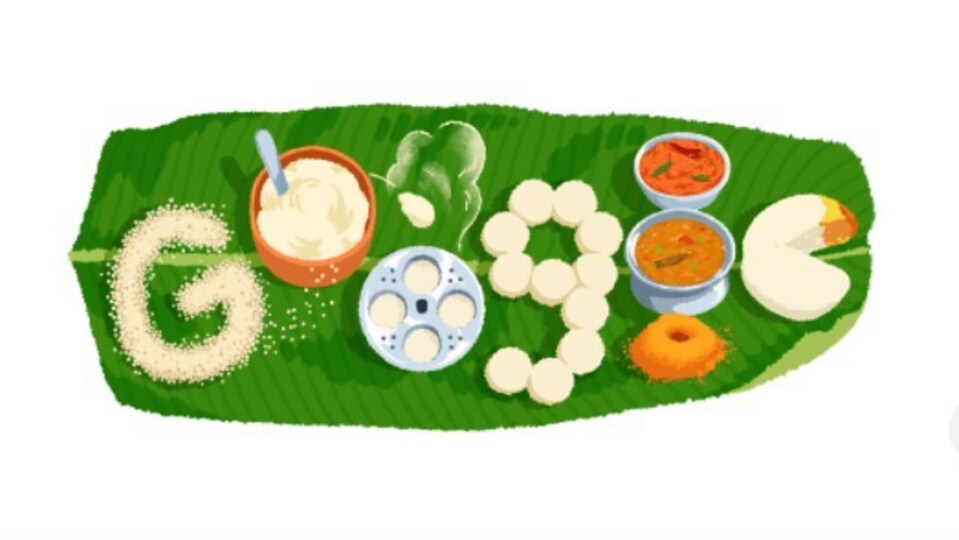
When you open the Google browser and click on the Doodle, the browser provides a small note on the dish. It reads, “Celebrating Idli: Today's Doodle celebrates idli, a savoury, steamed South Indian cake made from a fermented batter of rice and urad dal.”
Also Read: Google turns 27: Birthday doodle brings back its 'first' 1998 logo
What does the doodle show?
Each letter of the word “Google” has different elements of the dish. The first letter “G” shows a white granular element, probably rice grains, the key ingredient of idlis. The first “O” shows something white kept in a bowl. The next “O” shows idli batter in a traditional idli maker. The following letter, “G”, is designed with several idlis. The chutneys form the letter “L” and the last letter “E” consists of a side dish. The entire arrangement is kept on a banana leaf.
Explaining more about the Doodle, Google wrote that the idli visual is a part of its “Food and Drink” Doodle theme. It was launched on October 11, 2025, specifically for India.
Where did the idli originate?
Despite popular belief that it originated in India, food historians argue that the dish may have had a foreign origin. In a 2018 report, Vir Sanghvi wrote that eminent food historian KT Achaya suggested that the dish came from a medieval Indonesian dish.
Also Read: From space to chess, Google Doodle features India’s milestones through tile art this Independence Day
The theory suggests that the cooks on the Indian ships that sailed to Indonesia during that era for trade learned how to cook it. Eventually, they brought it back to India.
There is also a second theory, which says that idlis came from Arabia. According to this theory, the Arab traders who settled in South India made rice cakes that later became idlis.


