E-Paper



Woman shares why she quit 7-figure job at 21 with no backup: ‘I wanted exploration, not stability’
A Rajasthan woman explained why she left her job at 21, saying she wanted to experiment early.

 Prefer HTon Google


For many young graduates, landing a well paying job at a reputed multinational company soon after college is seen as the ideal start to a career. On paper, Vidhi Moondra’s life seemed to be moving in the perfect direction. However, she decided to step away from that certainty when she quit her seven figure job at Barclays without having another job in hand.
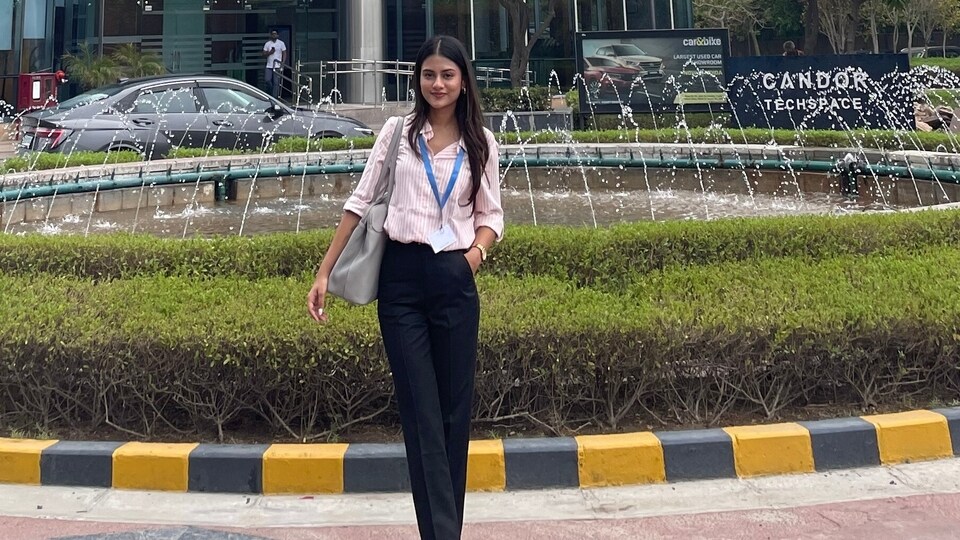
(Also read: Barclays techie treats parents and sister to first flight, five-star stay: ‘Last in race of success, yet I won’)
Speaking to HT.com, Moondra said the decision was not triggered by a bad workplace experience. Instead, it came from a growing realisation that she wanted to build, experiment and work closer to creation rather than remain in a predictable corporate structure.
From LSR to Barclays
Moondra was born and brought up in Jodhpur. She pursued B.Com Honours from Lady Shri Ram College and graduated in 2024. Soon after college, she was placed at Barclays through campus placements, where she joined as a Graduate Analyst. Her office was located in Noida.

“My experience at Barclays was genuinely amazing in the beginning. It was my first real exposure to the corporate world, and honestly, everything felt a little unreal at first,” she said. She added that she often found herself interacting with senior leadership and managing directors across global teams, which felt “incredible” at 21.
Within the first few months, Moondra said she also received recognition from directors based out of London for her work and process improvement initiatives. Since she was aligned to UK hours, her workday usually ran from 12:30 pm to 9:30 pm.
“I’d typically begin by catching up on emails and pending communications from the previous day. A major part of the day involved handling BAU operations, problem solving, and firefighting across different situations that came up in real time,” she said.
(Also read: Patna youth leaves Barclays job, secures 11th rank in UPSC civil services exam)
Moondra described her annual compensation as a seven figure package. However, she chose not to disclose the exact amount publicly due to confidentiality clauses.
When success began to feel incomplete
Despite the strong start, Moondra said something began to feel off around six to seven months into the role.
“I remember coming back home after work and feeling restless and anxious despite having done everything ‘right’. It’s hard to explain, but it’s that feeling of going to sleep knowing that what you’re doing with your life doesn’t fully make sense to you anymore,” she said.
She emphasised that the work environment was great and that she was grateful for the opportunity. However, she began to feel that she was not meant to simply work in a system but build one.
“The feeling became stronger once the work started becoming repetitive in a way that no longer challenged or stretched me. I don’t hate monotony. I hate monotony that doesn’t help me grow,” she said.
Moondra said she slowly realised that the parts of work she enjoyed most were those involving building, improving systems, solving undefined problems and creating something from scratch. The idea of settling into stability so early in life began to scare her more than taking a risk.
“I was also the youngest person at Barclays - most people around me were in their late 20s and at a very different stage of life. And while there’s absolutely nothing wrong with stability, I realised that at 21, I personally wasn’t looking for stability yet. I wanted exploration, experimentation, uncertainty, and experiences that would push me beyond what I already knew about myself. The idea of settling into a predictable version of life so early on honestly scared me more than taking a risk did. On paper, my life looked successful at 21, but internally I knew I was craving a very different kind of challenge and ownership. I didn’t fully know what I was meant for yet but I knew this wasn’t it. So, I left,” she said.
Quitting without a backup plan
Leaving Barclays without another offer was one of the hardest decisions she had made, Moondra said.
“People often only see the brand names, LSR, Barclays and assume my life is sorted. It definitely is in some way but what people don’t see is the pressure that comes attached to those names,” she said.
She said people around her questioned her decision and asked why she would want to “ruin an already established career”. Moondra understood their concerns, but felt she could no longer ignore what she was feeling.
“For me, leaving Barclays was a leap of faith in myself. I didn’t have all the answers. I just knew I couldn’t ignore what I was feeling anymore,” she said.
Her biggest fear was simple. “What if I was wrong?” she recalled. “What if this decision was just an emotional phase? What if I couldn’t prove myself outside the structure and credibility of established institutions? What if I had walked away from something stable for an idea of myself that didn’t actually exist in reality?”
Over time, she said, she learnt to look at decisions differently. “No decision is right or wrong. You take a decision, and then you work hard enough to make it right,” she said.
Five months in Jodhpur
After resigning, Moondra moved back to Jodhpur for five months. She described that phase as one of the most uncomfortable periods of her life.
“Leaving Barclays sounded empowering in my mind, but then came the reality of packing up my life and moving back to Jodhpur with no clear plan ahead,” she said. “For five months, I had to sit with the uncertainty of the decision I had made every single day.”
She had not lived at home for nearly four to four and a half years, which made the transition emotionally difficult. From a fast paced corporate life in a metro city, she suddenly found herself spending long hours with her own thoughts.
“There were days where I would just lie in bed staring at the ceiling for hours, questioning everything, my decisions, my future, my identity, my capabilities,” she said.
The hardest part, she said, was watching her peers continue on conventional paths while she was still trying to understand what came next.
“The biggest fear I struggled with was the fear of becoming average and never reaching my own potential. That scared me more than failure itself,” she said.
Choosing an internship after a corporate job
After nearly four months of overthinking, Moondra decided to explore the kind of work that genuinely interested her. She was curious about the direct to consumer space, especially beauty and personal care, and began reaching out to startups and founders.
She received a few full time Founder’s Office opportunities but was not fully convinced. Eventually, she came across an internship at a D2C skincare startup that excited her.
“I was going from a full time role at a reputed MNC with a strong salary package to just moving back to Delhi for an internship with a stipend and not even knowing for sure whether I would ultimately like the startup ecosystem long term,” she said.
She knew the move would appear irrational to many, but she decided not to base her decisions only on titles or how they would look on her CV.
“I realised that if I truly wanted to reach somewhere different in life, I had to be willing to go through somewhere uncomfortable first,” she said.
That internship, she added, changed the direction of her life. It gave her clarity that she enjoyed the chaos, speed, problem solving and creativity of startup life.
Life at Fix My Curls
Moondra is now based in Gurgaon and works in the Founder’s Office at Fix My Curls, a D2C haircare startup. Her role cuts across brand, content, strategy, execution and problem solving.
“I genuinely think these decisions changed the direction of my life,” she said. “For the first time in months, I stopped questioning whether I had made the wrong decision leaving Barclays.”
Today, Moondra said her life is almost the opposite of what it was at Barclays. It is more unpredictable, intense and pressure filled, but also more aligned with who she wants to become.
“There’s constant firefighting, uncertainty, pressure, and problem solving in the startup world but strangely, my mind feels more peaceful now than it did then,” she said. “I think the difference is that stress feels very different when it comes from something you consciously chose for yourself.”
She has also been creating content on LinkedIn and Instagram, building a community of more than 32,500 people on LinkedIn and over 8,000 on Instagram.
A lesson in risk and self belief
Looking back, Moondra believes quitting at 21 gave her the freedom to experiment early. She said young people should not let one job role or one company become their entire identity.
“You are always far more than the designation written on your LinkedIn profile,” she said.
For her, success is deeply personal. “External success without internal fulfilment eventually starts feeling empty. You can have the right college, the right company, the right salary, a high growth startup or business and still feel disconnected from yourself,” she said.
(Also read: Breaking the IIT myth: 5 Indian-origin leaders at top global firms)
When asked about her line, “At 21, I’d rather experiment early than regret it for the rest of my life,” Moondra said it means even more to her now. However, she clarified that she does not believe in romanticising reckless decisions.
“Before leaving Barclays, I made sure I had enough emergency savings to sustain myself for 6 to 8 months because if you choose to take a risk, you also have to take responsibility for that risk,” she said.
“And honestly, if I had to do it all over again, I still would,” she added.