
 E-Paper



America calls Jair Bolsonaro’s conviction a “witch hunt”
Mr Bolsonaro is the first Brazilian president in the country’s history to be convicted for coup plotting


 Prefer HTon Google


On September 11th Brazil’s Federal Supreme Court (STF) convicted hard-right former president Jair Bolsonaro of attempting a coup d’état. The sentence, handed down by Justice Alexandre de Moraes after a majority of a panel of judges had chosen conviction, was more than 27 years in prison. The 70-year-old Mr Bolsonaro was also barred from holding public office until 2060. The judgment will cause shock waves that alter the course of politics inside Brazil and its relationship with the United States. After the news Marco Rubio, the secretary of state, said the STF had ruled “unjustly” and that America would “respond accordingly to this witch hunt”.
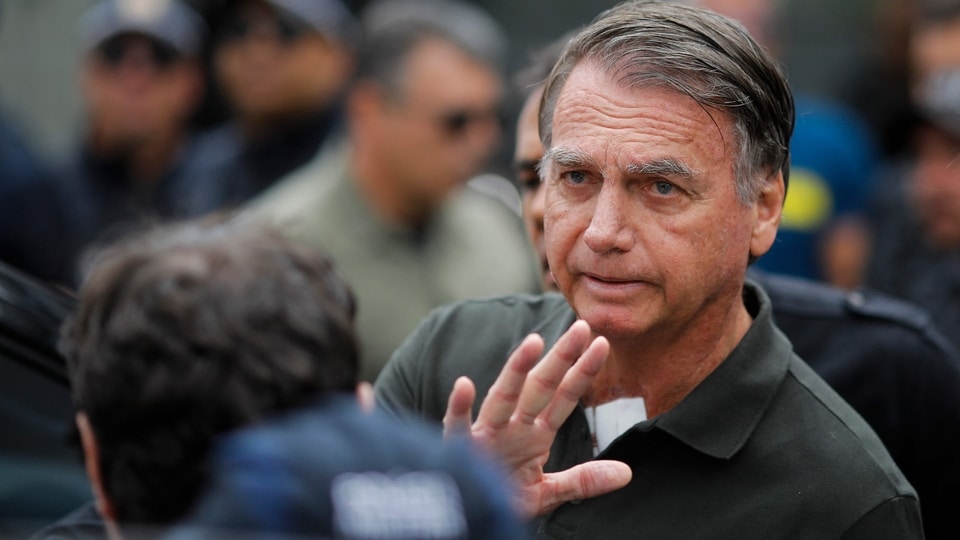
Mr Bolsonaro is the first Brazilian president in the country’s history to be convicted for coup plotting; previous conspirators were never investigated. But those who hope that his conviction will allow Brazilians to move past a polarising period of their history and get on with the business of improving their country must wait at least a little longer.
He will appeal. There is little chance of changing the verdict, but a reduced sentence or one served under house arrest is possible. Most of his co-defendants, including former ministers and army generals, received sentences of over 15 years. Mr Bolsonaro’s political allies have promised to put an amnesty bill before Congress as soon as September 16th. And evangelical leaders have held vigils and encouraged their flocks to pray for him.
Retaliation from the United States is another threat. After the sentencing was handed down, Mr Bolsonaro’s son, Eduardo, who moved to Texas to lobby for his father’s cause, hinted that further American sanctions against STF judges were on the way. Days earlier, when asked about the government’s reaction to the looming conviction, White House press secretary Karoline Leavitt said the United States was not afraid to use its “military might”.
Therefore the pummeling of Brazil by the United States which began in July will probably escalate. Then, the American government placed sanctions on Brazilian judges and officials, and tariffs of 50% were placed on imports of many Brazilian goods. It may be a source of frustration for the Trump administration that this not only failed to influence the outcome of Mr Bolsonaro’s trial, but that it is, so far, doing little economic damage to Brazil while boosting the polling of Luiz Inácio Lula da Silva, Brazil’s president. It is hard to see how escalation could change this. If the United States was to bring any more pressure it would probably unite more Brazilians behind the STF’s verdict, and around Lula, as the president is known.
An amnesty bill is unlikely to change the outcome of the trial. The STF has already said it will overturn any law that wipes away the convictions of Mr Bolsonaro and his senior co-conspirators, as it would be unconstitutional. The court is more open to a law that reduces the sentences of the 1,600 people charged with invading Brazil’s institutions on January 8th 2023. This could mean releasing people like Débora Rodrigues, a young woman who was given 14 years in prison for writing on a statue with lipstick. If Mr Bolsonaro’s supporters push for an amnesty bill, prompting a stand-off with the STF, it may prolong the wrangling over Mr Bolsonaro’s fate.
And it might help to whip up Brazil’s evangelicals. This crucial group, some 27% of the population, has largely stuck with Mr Bolsonaro during his trial. They comprise the majority of the 37% of people in Brazil who said, in a poll taken in early September, that they believed Mr Bolsonaro should not be convicted. Evangelicals also dominate the 20% who said they would vote for him if the presidential election were held “today”, far higher than every other right-wing candidate combined. “This is the geology of public opinion right now,” says Christopher da Cunha Bueno Garman of Eurasia Group, a consultancy.
Mr Bolsonaro still holds considerable influence over Brazilian politics. If he were to endorse a candidate for the presidential elections next year, that person would be all but guaranteed to make it to the run-off vote against Lula in October 2026. In exchange, Mr Bolsonaro is likely to seek a presidential pardon should that person win. As with the amnesty bill, the STF has said it will overturn an unconstitutional pardon. But three of its eleven justices are retiring by 2030, meaning the next president will get to reshape the court’s composition significantly. If that president is Bolsonaro-annointed, it raises the chances of a re-trial or reprieve, says Luisa Ferreira, professor of criminal law at São Paulo University.
And so in recent months many centrist presidential hopefuls have veered right, lambasting the STF in order to clinch the blessing of Mr Bolsonaro and his supporters. The current frontrunner appears to be Tarcísio de Freitas, the governor of São Paulo and former infrastructure minister in the Bolsonaro administration. A mild-mannered engineer, Mr Freitas unofficially kicked off his campaign in recent weeks by denouncing the “dictatorship” of the STF and the “tyranny” of Mr Moraes. He affirmed he would pardon Mr Bolsonaro in the “first hour” of his presidency. Soon after the sentencing, he posted online that “justice will still prevail”.
With Mr Freitas and others chasing his blessing, Mr Bolsonaro’s influence seems likely to last until next year’s election at least, if not beyond. Presidential hopefuls only need to declare their candidacy a handful of weeks before an election, meaning aspirants like Mr Freitas must keep dancing to Mr Bolsonaro’s tune until the second half of 2026.
That will probably lead to more awkward positions like the one in which Mr Freitas found himself in July, when Mr Trump imposed his 50% tariffs. The move disproportionately hurt beef, coffee, and sugar exporters from São Paulo, Mr Freitas’s own state. The governor’s allegiance to Mr Bolsonaro meant he initially tried to brush off the impact, attempting to blame Lula for “placing his ideology above the economy”. After an immediate backlash, he hastily called to “leave politics aside” and to negotiate with Mr Trump.
Some commentators believe Mr Bolsonaro still wants a family member to assume his mantle, either one of his sons, or his wife, Michelle. But none are ideal candidates. The obvious choice was Eduardo, a congressman, but his role in bringing American tariffs and sanctions down on Brazil has left him deeply unpopular. Flávio, a senator, is well-liked by his father’s allies but lacks political clout. Carlos is a mere councilman. The former first lady is best-liked by the evangelical base and could capture undecided female voters, but has never held elected office. Brazil has taken a historic step in imprisoning a coup monger for the first time. In so doing, it has probably destroyed Mr Bolsonaro’s chances of making a political comeback. But in his role as a powerbroker, Mr Bolsonaro will hang over Brazilian politics for some time yet.


