E-Paper



‘Any solution in Afghanistan without Taliban runs risk of failure’: Russian foreign minister Sergey Lavrov
The latest developments in Afghanistan figured prominently in the meeting between Lavrov and Jaishankar.

 Prefer HTon Google


Any process to find a solution to the conflict in Afghanistan that excludes the Taliban runs the risk of failure, Russian foreign minister Sergey Lavrov said on Tuesday after talks with his Indian counterpart S Jaishankar.
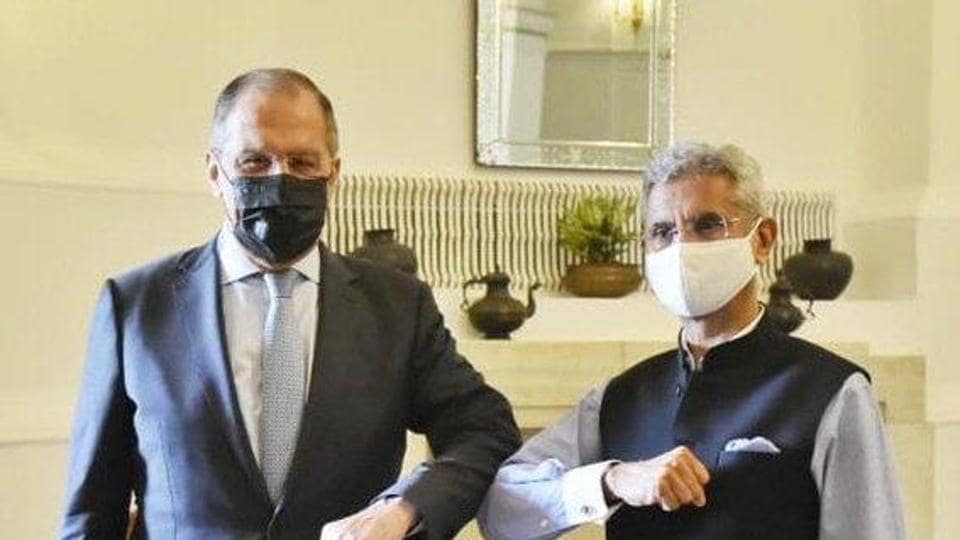
“The Taliban movement is part of Afghan society, and decisions on the settlement in Afghanistan should foresee the participation of all political, ethnic and religious groups of Afghanistan. Otherwise, it’s not going to be stable,” Lavrov told a joint press conference in response to a question on a possible power-sharing agreement with the Taliban.
The latest developments in Afghanistan figured prominently in the meeting between the two ministers, who shared their assessments on the situation in the war-torn country. Lavrov’s delegation included Zamir Kabulov, the Russian presidential envoy to Afghanistan and a key player in Moscow’s reconciliation efforts.
Lavrov said he and his Indian counterpart agreed the Russian and Indian representatives on Afghanistan will be in close contact regularly, while Jaishankar pointed out that “what happens in Afghanistan impacts [India’s] security directly”.
“This decision has to be based on the balance of political and ethnic and religious interests... Any other way that foresees the exclusion of any group from this process will not lead to agreements that could be implementable and sustainable. All of this would be fraught with the risk of the resumption of the hostilities, which is not anybody’s desire,” he added.
Jaishankar said India’s approach hinges on durable peace in Afghanistan, which would “require harmonising interests of all, both within and around that country”. He added, “The peace process must be based on foundational principles to which we all subscribe, and a political solution should mean an independent, sovereign, united and democratic Afghanistan.”
Lavrov said he hoped the Biden administration would implement the agreement the Trump administration signed with the Taliban last year as it had “created a window of opportunity to reach an agreement between all the hostile parties”. Russia is ready to arrange further consultations under the “Moscow Format”, which includes India, China and Pakistan, to give impetus to the peace process, he said.
People familiar with developments, said on condition of anonymity, that there was a frank exchange of assessments by both sides regarding the situation in Afghanistan, especially after the US administration’s fresh push for peace between the Afghan government and the Taliban. The Indian side highlighted its concerns about any hasty power-sharing agreement undoing the gains of the past two decades, the people said.
India has been facing calls in recent years from leaders in the US, Russia and Iran to engage with the Taliban, though the government in New Delhi is yet to take a call on the issue.
Questions were raised when Russia didn’t include India in a meeting of the “extended troika” in Moscow last month, especially after Pakistan was invited to the meet that included Taliban representatives. Lavrov headed to Pakistan from India, and his itinerary raised eyebrows in New Delhi as it is virtually unheard of for a Russian leader to travel to Islamabad from New Delhi.
Lavrov also didn’t have an interaction with the Indian prime minister, usually a standard feature for a visit to New Delhi by a senior Russian leader. The people cited above sought to play down the matter, saying no such meeting was scheduled as the prime minister was away in West Bengal to address public meetings at Cooch Behar and Howrah as part of the BJP’s campaign for the state elections.
There were no indications of differences at the joint press conference with both Lavrov and Jasishankar giving a positive readout on their discussions.
While growing political and defence cooperation between Russia and China have sparked speculation about a potential military alliance between the two countries, Lavrov ruled out such a possibility.
He said Russia-China summits had concluded that bilateral relations “are at the highest [point] in the history but these relations do not pursue a goal of establishing a military alliance”.
Lavrov added, “By the way, we’ve heard speculations about pro-military alliances not only regarding Russia-China relations but also about such alliances allegedly being promoted such as ‘Middle East NATO’ and... ‘Asian NATO’. Today, we exchanged views on this and Indian friends have the same position as us. We believe that this is counter-productive and we are interested in inclusive cooperation that is for something, and not against somebody.”